How Brexit reduced the City of London’s financial clout – new research
- Written by: Amr Saber Algarhi, Senior Lecturer in Economics, Sheffield Hallam University
The whole point of Brexit was to change the UK’s relationship with Europe. And one of the less visible shifts has occurred in the financial markets, affecting pension funds and the cost of borrowing.
Before the referendum, when London’s stock market sneezed, Europe caught a cold. Now though, our research[1] suggests that the financial relationship between the UK and the EU has flipped.
The change came after decades of London being the focus[2] of European finance – and what’s known as a “net transmitter” of financial shocks. This meant that changes in London’s stock exchange had an immediate impact on investors in Paris, Frankfurt and Milan. London’s institutional ties to the European single market served as the foundation for this financial leadership.
To see if this level of influence remained after Brexit, we observed daily movements of the stock markets in nine European countries, comparing two five-year periods: before the Brexit vote (2011–2016) and after the UK left the EU (2020–2025).
Our comparison featured a specialist financial metric called a “net volatility spillover score” which measures the difference between the amount of risk (volatility) a specific market transmits and receives from other markets.
The results were stark. Before Brexit, the UK had a net volatility spillover score of +11.8, meaning it sent far more financial turbulence into Europe than it received. After Brexit, that score fell to –5.5. The UK now absorbs more shocks from Europe than it sends, making it a net recipient of volatility.
This is largely down to the fact that European investors stopped reacting to UK market signals as strongly as they once did. The UK’s financial shocks still happen – they just matter less to the rest of the continent.
Meanwhile, over the same period, Germany’s transmitting influence grew by nearly 50%, and Italy transformed from a shock absorber into the second most influential market in the system.
When London was a financial leader[3] in Europe, its market signals shaped how continental investors valued risk across borders. This gave the City extra influence over capital flows, borrowing costs and investment decisions.
Now that influence has weakened, the consequences go far beyond the offices of City traders.
UK firms seeking to raise capital from European investors may face higher costs, because European markets are now less attuned to British price signals. A UK pension fund invested in European equities, for instance, now finds its returns shaped more by what happens in Frankfurt or Milan than by signals from the London market it sits alongside.
And the UK has less sway over the financial conditions that govern cross-border trade and investment – conditions that ultimately feed into jobs, mortgages and the cost of living.
The physical infrastructure tells a similar story. After Brexit, more than 440 financial firms moved[4] at least some of their operations from the UK to the EU, taking with them more than £900 billion in bank assets – such as business loans, investment portfolios and cash reserves – worth around 10% of the UK’s banking system.
As part of this transition, London was not replaced by a single city, but by a range of European centres (including Frankfurt, Paris and Dublin) which all absorbed enough activity to reshape the network. And although London is still a major international financial hub, its cross-border ties with Europe have been weakened[5].
So can London win back its influence? It’s unlikely. This was not a temporary dip caused by market panic. Overall connectivity across European markets barely changed. The European financial network did not shrink – it just reorganised. Countries such as Germany and Italy simply stepped into the space that the UK had vacated.
The new system, driven by legal changes[6], relocations and regulatory divergence in financial services[7] now shows no sign of changing.
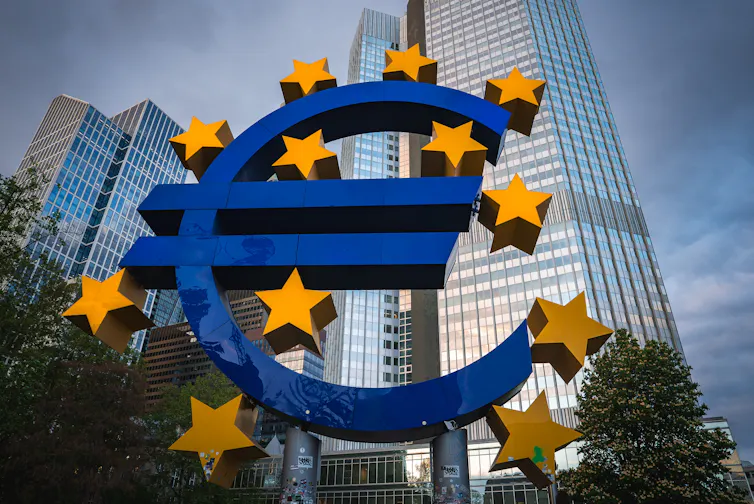
And although the recent UK-EU summit[9] suggests both sides want closer ties, so far that effort has centred on trade in goods and security[10] rather than financial services. Until the reset reaches the City, London’s diminished role in European markets looks set to stay.
None of this means London is finished as a financial centre. But within the European network, the UK’s role has fundamentally changed.
It has gone from setting the tempo to following the beat from elsewhere. And for a country which built much of its post-industrial economic power around financial services, that’s quite a shift.
References
- ^ our research (doi.org)
- ^ London being the focus (www.bankofengland.co.uk)
- ^ financial leader (www.cityoflondon.gov.uk)
- ^ more than 440 financial firms moved (www.newfinancial.org)
- ^ have been weakened (www.bis.org)
- ^ legal changes (ukandeu.ac.uk)
- ^ divergence in financial services (www.slaughterandmay.com)
- ^ NorthSky Films/Shutterstock (www.shutterstock.com)
- ^ recent UK-EU summit (theconversation.com)
- ^ on trade in goods and security (news.sky.com)