

Everything can be a bet now – the rise and risks of prediction markets
- Written by: Sarah Mills, Professor of Human Geography, Loughborough University
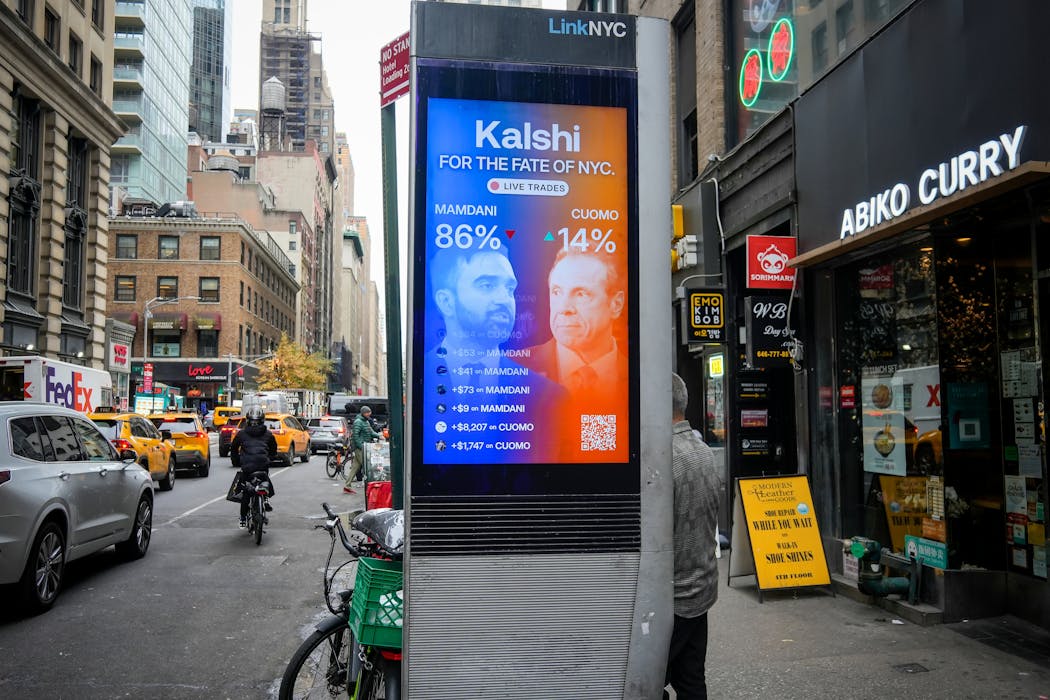
Yes or no? It’s a simple question that now drives more than US$13 billion (£9.7 billion) a month on prediction markets – companies like Polymarket, PredictIt and Kalshi.
These firms run digital platforms that use blockchain technology[1] to let anonymous users gamble on uncertainty and place “predictions” rather than bets. Users can buy a yes or no “event contract” on anything from strikes on Iran[2] to the most popular show on Netflix and the return of Jesus.
Politics and popular culture have merged, with reports that Kalshi and others are becoming a new “stock market for trends”[3] in the so-called “attention economy”[4]. Everything is now monetised.
However, several incidents have brought the politics of prediction markets into sharp relief. These include large volumes of predictions (or bets) placed in the hours before election results in Portugal[5], the presidential coup in Venezuela[6], and in Israel[7], where two people have been charged on suspicion of using classified information to place bets about military actions.
In the US, where Polymarket has its headquarters, the platform has been controversial since its launch a few years ago. The website has been blocked there for most of its short life, including during the country’s 2024 presidential election. But it recently relaunched in its home country – with President Donald Trump’s support[8]. The president’s son, Donald Trump Jr, serves in advisory roles[9] at both Polymarket and Kalshi.
One advertising slogan for Kalshi states: “The world’s gone mad, trade it”. However, not all the world can trade.
As a geographer, I’m fascinated by how online gambling is now a global game, in many cases bypassing national legislation on gambling laws via VPNs. My latest project[10] charts how traditional political gambling[11] – through licensed bookmakers or online gambling companies – is now simultaneously bordered and borderless. National laws on gambling remain important, but there is increasing fluidity with the rise of VPNs and digital platforms. This trend is creeping into prediction markets too.
Polymarket is banned or geo-blocked in several countries including the UK, France and Belgium due to regulatory and licensing challenges (and now Portugal[12] after the election incident). And its blockchain technology[13] and use of cryptocurrency are complex and hard to regulate. The space between gambling and gaming[14] is proving to be a grey area for many countries to legislate in.
Even if countries don’t allow their citizens to access prediction markets, the world is still betting on those nations and their next election or leadership contest. This could be the future of election betting – and possibly the future of geopolitics – if world events can be influenced by prediction market activity.
One of the key questions in the debate is whether this is gambling. Or is it simply users drawing on their expertise, perhaps more akin to playing the stock market? There have been suggestions that prediction markets offer a loophole[15] for gambling restrictions. The controversies all come down to whether there is insider information, a very serious legal minefield and especially in the context of military or classified information.
Increasingly, viewers see prediction market “odds” appearing on the rolling coverage or infographics of major US news channels such as CNN and CNBC. These are not pollsters’ or even bookmakers’ odds, but rather the current yes or no trends. So is this really data, or just vibes?
The increasing professionalisation of prediction markets embedded into news infrastructures is significant. Indeed, people have argued that the websites of prediction markets themselves are now consumed like live news channels[16]. As a result, these platforms are driving huge amounts of revenue, with Polymarket alone valued at US$9 billion (£6.7 billion) in October 2025. There are forecasts that together these platforms will reach a trillion dollars[17] in trading volume by 2030.
Polymarket is trying to increase awareness of its brand.The rise in prediction markets raises critical questions for the future of democracy. In order to ensure that trust and democracy can be upheld in the era of prediction markets, regulations and safeguards must be strengthened for an industry that is now both bordered and borderless.
One of Polymarket’s advertising slogans invites users to “answer some of the world’s biggest questions”. Perhaps the single biggest question concerns the political and ethical implications of predicting the future for money in this way.
References
- ^ blockchain technology (theconversation.com)
- ^ strikes on Iran (www.theguardian.com)
- ^ “stock market for trends” (www.inc.com)
- ^ “attention economy” (www.un.org)
- ^ in Portugal (www.theblock.co)
- ^ in Venezuela (theconversation.com)
- ^ in Israel (www.npr.org)
- ^ President Donald Trump’s support (www.independent.co.uk)
- ^ advisory roles (www.theguardian.com)
- ^ latest project (www.lboro.ac.uk)
- ^ political gambling (www.sciencedirect.com)
- ^ now Portugal (finance.yahoo.com)
- ^ blockchain technology (www.sciencedirect.com)
- ^ gambling and gaming (www.tandfonline.com)
- ^ offer a loophole (www.theguardian.com)
- ^ like live news channels (www.theguardian.com)
- ^ a trillion dollars (www.cnbc.com)






