Why has Trump launched so many tariffs and will it cause a recession? Expert Q&A
- Written by: Linda Yueh, Fellow in Economics/Adjunct Professor of Economics, University of Oxford
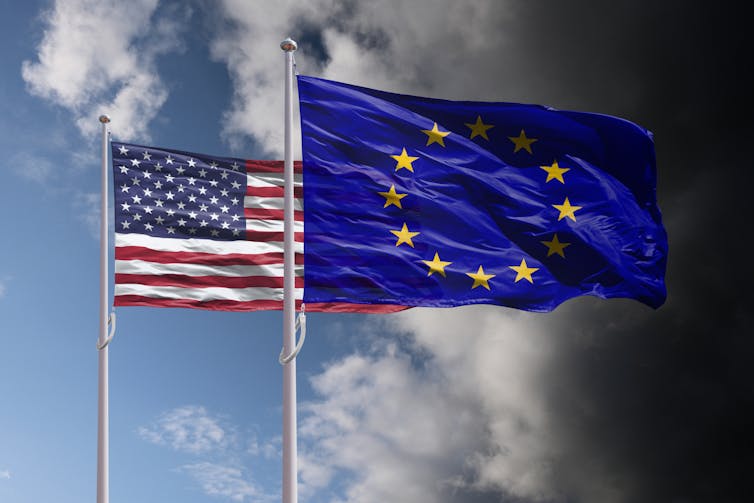
Donald Trump has always talked about how much he likes tariffs. And on April 2 2025, he showed that he meant it. For the president it was “liberation day”, but for his fellow world leaders it was a tense wait to see what percentage figure would be attached to their country’s vital exports.
Those tariff rates ranged from 10% for the UK to 49% for Cambodia, charges which Trump says will raise trillions of dollars for the US economy and “make America wealthy again”.
“Our country has been looted, pillaged, raped and plundered,” he said, before unveiling the tariffs which will cause headaches for business leaders and politicians across the world. We asked Linda Yueh, an economist at the University of Oxford, to answer some of the most pressing questions the tariffs pose.
What is Trump thinking?
Economically speaking, the president of the US says he wants to make international trade fairer – by equalising tariffs. He said that if countries want these “reciprocal tariffs” removed (on top of the 10% baseline tariff[1] on all US imports), then they also need to remove non-tariff barriers, such as opening more of their markets to US companies.
As with his first administration, he also wants companies to bring production and manufacturing jobs back to the US. Basically, he views current international trade as unfair and is using tariffs in a way that’s unprecedented in modern times to try to level the playing field.
Why such a broad range of tariffs?
The formula[2] used by the White House to calculate the various tariff rates is apparently based on the trade balance – what each country sells and buys from the US. The Trump administration views a trade surplus (where the US buys more than it sells) as a proxy for unfair trade, so is imposing “reciprocal tariffs”[3] to retaliate.
And some countries do indeed levy higher tariffs than the US. For instance, some developing countries do so in accordance with their level of development. But tariffs are generally governed by the World Trade Organisation, so that’s where countries would normally go to resolve trade disputes.
But because no tariff is set below 10%[4], there will be tariffs levied even on countries with whom the US runs a trade surplus (those which do more buying from the US than selling). These include the Netherlands, Australia and Brazil[5].
Over 100 countries will have tariffs imposed, including small countries like Fiji (32%) and poor economies like Haiti (10%). Those are also likely to be the ones which will find it most challenging to get into the queue to negotiate a lower tariff any time soon.
What options do countries have in terms of their response?
The EU (20%) has said it will retaliate, while the UK (10%) says it will keep talking though all the options on the table. Trump has said he is open to negotiations before the baseline tariffs are imposed on April 5, and the extra reciprocal tariffs land on April 9.
Engaging in a tit-for-tat trade war is economically damaging – as the independent Office for Budget Responsibility (OBR) set out[7] in its latest assessment of the UK economy. Each government will take its own view on the appropriate approach, but with the knowledge that it’s highly unlikely that everyone will be able to negotiate a better deal conclusively within a week.
Will there be a recession?
The International Monetary Fund (IMF) estimates that Trump’s tariffs could reduce global economic growth by 0.5%[8] through next year, which is significant. But, it also believes that a global recession[9] is not on the horizon.
That said, the economic impact of these tariffs is highly uncertain and unpredictable. The effects will vary[10] from country to country, and a lot will depends upon how long the tariffs are levied for, how other countries respond and how companies manage the tariffs and the uncertainty of trade policy.
Read more: How the UK and Europe could respond to Trump's 'liberation day' tariffs[11]
And it remains a big gamble for Trump too. For a president who considers himself to be the master of deals, there are risks of rising inflation, falling stock markets and potentially denting the US economy.
References
- ^ 10% baseline tariff (eu.usatoday.com)
- ^ formula (www.ft.com)
- ^ “reciprocal tariffs” (news.sky.com)
- ^ below 10% (www.marketwatch.com)
- ^ the Netherlands, Australia and Brazil (www.bea.gov)
- ^ Tomas Ragina/Shutterstock (www.shutterstock.com)
- ^ set out (obr.uk)
- ^ 0.5% (www.jpmorgan.com)
- ^ global recession (www.reuters.com)
- ^ effects will vary (theconversation.com)
- ^ How the UK and Europe could respond to Trump's 'liberation day' tariffs (theconversation.com)