

How green innovation could be the key to growth for the UK’s rural businesses
- Written by: Panagiotis Kyriakopoulos, Research Fellow (Entrepreneurship & Innovation Group), Warwick Business School, University of Warwick
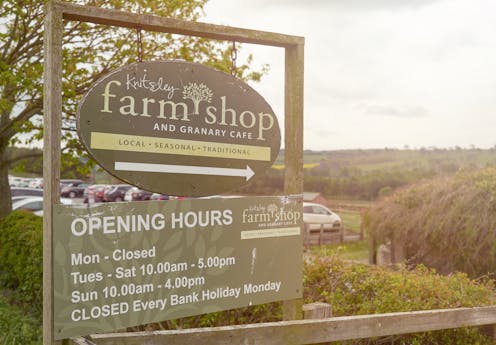
As climate change speeds up[1] and resources become more scarce, businesses are realising that innovation and sustainable practices are becoming necessities rather than merely nice things to do. Companies that invest in sustainable operations (for example, waste management and net zero practices) are setting themselves up for resilience and success, as climate issues threaten their businesses, and customers and governments demand better practices.
Rural businesses need particular help in this quickly evolving environment. These companies – firms like small-scale manufacturers, farms, and rural service providers like independent shops – face particular pressures related to their economic and geographical landscapes.
These businesses make up nearly a quarter of all firms[2] registered in England – more than 549,000 enterprises employing 3.8 million people.
The recent protests by UK farmers[3] highlighted the need for fair inheritance tax legislation that considers the unique financial challenges of farming, such as being asset rich but cash poor. For rural firms more broadly, because of their limited access to markets, infrastructure and resources, these businesses are more vulnerable to changes to things like taxes or severe weather events than their urban counterparts.
My recent review paper[4] on business innovation in rural areas highlights the innovation gaps that rural firms deal with compared to competitors in more urban settings. This disparity is frequently the result of rural firms being overlooked both in terms of policy and research.
For instance, my research showed rural businesses are less likely[5] to invest in sustainable solutions like solar energy or waste management systems, or to adopt the latest technologies. This is because rural businesses frequently have less money and fewer options available to them because of their location. Adopting smart systems and artificial intelligence (AI) technology can improve their efficiency and their connection to suppliers and customers.
But their growth is often restricted by the increasing costs of buying new tech or the firms’ own resistance to change and adapting to the digital era. This makes them more vulnerable to environmental stressors and economic shocks. Addressing these issues, and investing in innovation, is essential if they want to grow.
Things like advanced energy storage systems and investment in renewable energy technologies can help rural enterprises to reduce their dependency on fossil fuels and provide more energy stability. Similarly, environmentally friendly farming methods like circular waste management[6] (where waste materials are reused, repurposed or recycled) and precision agriculture[7] using satellites and automation can increase output while reducing environmental harm.
These developments not only improve rural businesses’ long-term competitiveness, they also help the environment. For instance, energy-efficient procedures reduce operating expenses, and implementing sustainable branding might draw in eco-aware clients. According to my study[8], innovation in digital technology, waste management and energy can completely transform rural businesses and give them the tools they need to prosper in a changing global environment.
Cutting greenhouse gas emissions has become a primary environmental challenge for businesses. Transitioning to renewable energy sources like solar and wind is becoming increasingly important. Businesses that adopt these practices can reduce their carbon footprint and eventually lower their energy costs.
But what is clear from my research is that rural firms need support to become more innovative. Critical barriers to innovation include a lack of skilled labour, inadequate infrastructure and restricted access to funds like grants. Rural firms frequently operate in remote locations, which may limit their opportunities to collaborate and share knowledge.
The government can help rural businesses overcome these barriers by creating innovation hubs in rural areas, and investing more in rural infrastructure. Partnerships between colleges, universities and rural companies are also important for sharing ideas and best practice. Grants to businesses in those sectors and investment in better transport operations are also critical to their expansion.
Overall, it is clear from my research that when rural businesses invest in environmental sustainability, growth becomes far more likely. In addition to making the companies themselves more resilient, the firms also support wider regional growth with new products, services and processes.
Supporting rural businesses in implementing sustainable practices is a vital pillar of the UK government’s ambitions to build a greener economy[10] and its emphasis on economic growth[11]. Investing in innovation in rural businesses is not a choice, it is a necessary path to growth.
By overcoming their particular difficulties and encouraging them to adopt sustainability, rural businesses can realise their full potential as engines of environmental and economic advancement.
References
- ^ climate change speeds up (www.ipcc.ch)
- ^ quarter of all firms (www.gov.uk)
- ^ UK farmers (theconversation.com)
- ^ review paper (www.sciencedirect.com)
- ^ less likely (www.rsnonline.org.uk)
- ^ circular waste management (www.wastemanaged.co.uk)
- ^ precision agriculture (www.nesta.org.uk)
- ^ my study (www.sciencedirect.com)
- ^ Neil Bussey/Shutterstock (www.shutterstock.com)
- ^ greener economy (labour.org.uk)
- ^ economic growth (theconversation.com)






