Bears have upper hand in the short term, but long-term uptrend remains intact, says Kalkine Media
- Written by: PR Newswire

|
SYDNEY, Sept. 24, 2021 /PRNewswire/ -- The year 2021 has been a great one, with global markets continuing their one-sided rally towards all-time highs. The S&P/ASX 200 also marked its lifetime high of 7,632.8 on 13 August 2021, delivering a year-to-date (YTD) return of 10.78%.
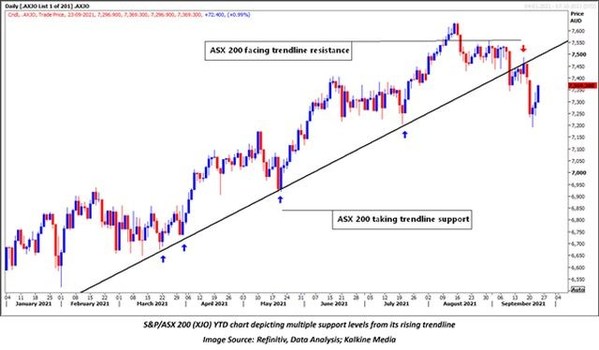 Bears have upper hand in the short term, but long-term uptrend remains intact, says Kalkine Media
The major constituents of the index have had a major role in contributing to this bull run. Australia's largest miner, BHP Group had rallied 25.56% to AU$54.55 this year, on the back of escalating iron-ore prices. However, the recent softening of iron ore prices has eaten away its entire YTD return. Rio Tinto has also seen a sharp dip lately, eroding its peak YTD return of 20.64% to -11.14%.
The big four banks – CBA, WBC, NAB and ANZ – are still holding onto their strong YTD returns of 21.35%, 28.6%, 19.07% and 19.34%, respectively.
*Note: The referenced data in this report has been sourced from REFINITIV. Price information as on 23 September 2021.
Is the market overbought now?
144 stocks in the ASX200 index are holding their ground with a positive YTD return, while only 56 stocks have fallen this year.
Trend analysis of the broader market suggests a tough fight between bulls and bears, with respect to their relative momentum compared to their simple moving average. A total of 99 constituents of the S&P/ASX 200 are trading above their 60-day average, out of which 71 are above their short-term 30-day average. While, 129 stocks are trading below 30-day average, out of which and 101 are below their 60-day average.
Kalkine believes that the long-term trend analysis is still weighted towards bulls. Of the 200 constituents of the S&P/ASX200, 129, i.e., 64.5% of the pack are comfortably trading above their 200-day moving average, which is considered to the be the "line of control" for bulls and bears. The remaining 71 stocks are trading in the bear's territory. Based on the way the short term and long-term momentum are set up, bulls might seem to be in control from a long-term perspective, but the short-term momentum is turning in bear's favour.
Kalkine Media's research aims to analyze and understand the stock markets and its underlying risks and rewards. (www.kalkinemedia.com[1]).
Contact Details: honey.bhargava@kalkinepr.com[2]
References
- ^ www.kalkinemedia.com (www.kalkine.com)
- ^ honey.bhargava@kalkinepr.com (www.prnasia.com)

Read more https://www.prnasia.com/story/archive/3517147_AE17147_0