

Out of home advertising in Australia
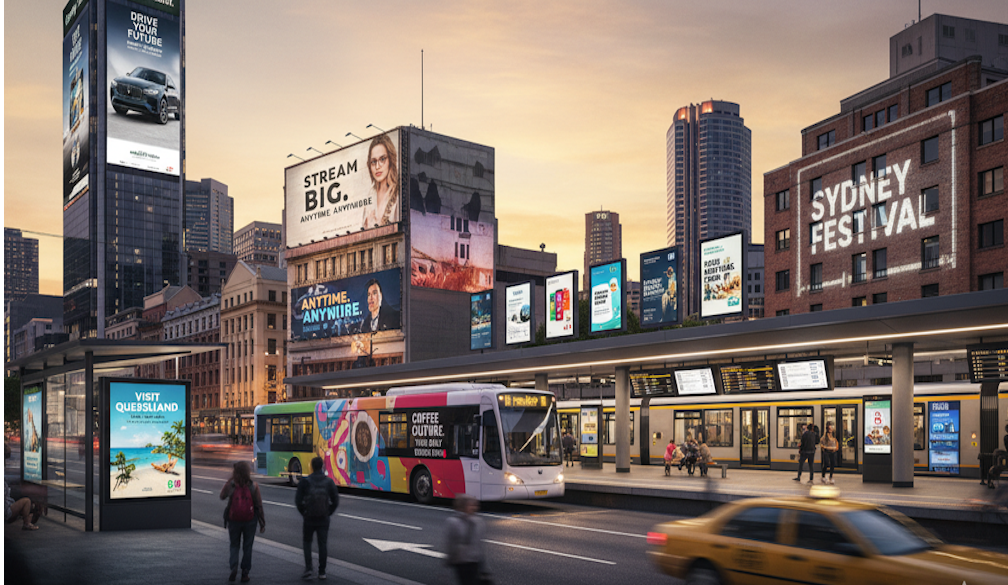
Australian brands are competing for attention in one of the most digitally saturated markets in the world. Search costs are rising, and consumers have become fluent at ignoring online advertising. Outdoor advertising in Australia sidesteps that fight completely, putting your brand in front of people before they open their phones.
We focus on why Australia is one of the strongest OOH markets in the world, including how the country's lead in digital outdoor changes what advertisers can actually do with the format, why recall remains the channel's biggest performance argument, and how the environments themselves work in your brand's favour.
Australia leads globally on digital OOH
Most countries are still working through the transition from static outdoor to digital. Australia has already made it. The majority of Australia's outdoor advertising revenue now comes from digital formats, putting the country ahead of most comparable markets globally.
For brands used to the precision of digital media buying, OOH offers the same data-driven controls, with the added benefit of physical presence in the world your audience actually inhabits.
Recall that online advertising can't match
The effectiveness argument for OOH has a compounding effect on the action that occurs after exposure. Outdoor consistently produces stronger consumer recall than radio, podcasts, online advertising, and streaming TV. A consumer who notices your billboard on the way to work is significantly more likely to remember your brand than one who sees a pre-roll ad they skip after 5 seconds.
A multiplier for your other channels
That recall advantage compounds when OOH is used alongside other channels. Brands that run outdoor in parallel with paid search and social consistently see uplift in both. The mechanism is straightforward: a consumer who has seen your brand in the physical world recognises it faster, trusts it more readily, and is more likely to engage with it when it appears while they’re browsing the internet, or receive one of your online ads.
The strongest campaigns use OOH to build ambient brand presence, making every paid search click and retargeted display ad more effective.
The environments work in your favour
Australia's outdoor advertising environments are unusually varied and unusually well-trafficked. The capital cities concentrate enormous volumes of daily commuter and pedestrian traffic into corridors that have been built up with high-quality OOH inventory over decades. Sydney's CBD and Pitt Street Mall, Melbourne's CBD tram network, and the arterials feeding Brisbane and Perth all provide high-frequency exposure to mass urban audiences.
Transit environments
Transit environments add the dwell time dimension that roadside formats can't match. Airport inventory deserves specific mention. International and domestic terminals serve frequent business decision-makers and tourists with discretionary spending power. For brands targeting that demographic, airport OOH in Sydney, Melbourne, or Brisbane is a strong strategy play.
Retail and shopping centre inventory
Australia has a strong shopping centre culture, and OOH inventory inside those environments is one of the most underrated formats in the country's media landscape. Major mall complexes across the capital cities concentrate large volumes of consumers in a single location, and those consumers are already in a buying mindset.
That's the point-of-purchase advantage. A digital screen near a fashion retailer, a food court, or a major anchor tenant reaches consumers seconds or minutes before a purchase decision, in an environment specifically designed to facilitate spending. For brands with retail distribution, that proximity converts. For lifestyle and consumer brands more broadly, it pairs intent with attention in a way that few other formats can match.
Conclusion
Australia's outdoor advertising market is one of the few in the world where the infrastructure has caught up with the ambition. Digital formats dominate, programmatic buying is well-established, and the audiences in the country's capital cities are reachable at a scale that digital channels alone can't replicate. For brands looking to build recognition that lasts longer than a scroll, the format is doing exactly what it's supposed to do.






