

With over 17,000 shops in the UK expected to close this year, city centres must move on from retail
- Written by: Lyndon Simkin, Professor of Strategic Marketing, Manchester Metropolitan University
British businesses are under such strain that around 50,000 are on the brink of collapse according to a recent report[1]. Retail is an especially vulnerable sector, with predictions[2] that over 17,300 shops will close this year, costing 200,000 jobs.
Last year, the equivalent of 38 shops closed every day[3]. A few re-opened, but most did not, fuelling a sense of economic decay[4] on high streets across the UK where 15% of shops are now empty[5]. In some particularly badly hit places, more shops are closed than open.
These include some still empty former premises of brands like BHS and Woolworths, which have been out of action for almost a decade. Every week, more closures are announced, with many driven by rising tax rates[6] and operating costs.
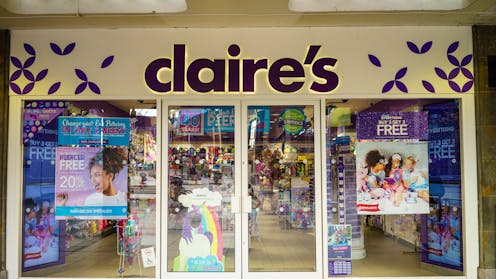
Fashion retailer River Island recently announced 33 store closures[7], with more under threat. Now the fashion accessories chain Claire’s has gone into administration[8], putting 278 shops at risk of closure.
This is a far cry from the halcyon days of the 1980s[9], when an empty retail unit was rare, soon to be snaffled up by Dixons or Burton Group or a host of other expansion-hungry chains. But those days will not return. Online shopping has seen to that[10].
So if shopping habits have changed, so surely, must high streets. They need to be used differently – given a different purpose[11].
There is research which suggests that one good option is for city centres to develop an “experience economy”[12], where entertainment and leisure are the focus. Another viable path is to embrace more mixed use[13], where tourism, recreation, housing and education have a more prominent role, instead of everything being aimed at attracting shoppers.
Some towns and cities are already doing this. Former department stores are being redeveloped into a mixture of flats and offices, and retail space is being demolished to be replaced with hotels and housing.
In Cardiff for example, a new square is being planned[14] with a former department store being demolished to be replaced with green space.
Over in Coventry, where retail footfall is down 55%[15] from pre-pandemic levels, a large area of the city centre is being demolished and re-imagined[16] with new street layouts and more open space. Buildings are being designed to offer leisure facilities, along with housing, offices, healthcare – and just a little retail – to breath much needed life into a struggling city centre.
Such mixed use re-developments and re-purposing are challenging. They require agreement from landlords, tenants, planners, local authorities and residents. And they demand considerable investment in new infrastructure and transport links.
They also require a fundamental economic and philosophical shift – to relinquish retail’s grip on the high street and city centre and let new ideas emerge and flourish. The UK needs more housing, and it needs more green open space. These were once banished from the heart of many towns, but there’s no reason for them not to return.
Unfortunately though, too few cities are acting like Cardiff or Coventry. The demoralising demise continues in many towns. One unwelcome consequence is that criminals have moved[18] into cheap shop units to sell counterfeit goods and launder money[19].
The main challenge will be to achieve agreement around a vision for change. As various solutions emerge for repurposing retail space and buildings, there will be work to do that will be different in every town and city. After all, it is unlikely that only one model of land re-use will be the preferred solution everywhere.
But what is certain is that city centres must change their shape and purpose. The people who use them have already changed their behaviour. It’s time for high streets – and those who own and administer them – to catch up.
References
- ^ recent report (www.standard.co.uk)
- ^ predictions (www.retailresearch.org)
- ^ 38 shops closed every day (www.bbc.co.uk)
- ^ economic decay (publications.parliament.uk)
- ^ 15% of shops are now empty (www.theguardian.com)
- ^ by rising tax rates (www.dailymail.co.uk)
- ^ announced 33 store closures (www.bbc.co.uk)
- ^ gone into administration (www.bbc.co.uk)
- ^ halcyon days of the 1980s (www.ipsos.com)
- ^ seen to that (store.mintel.com)
- ^ given a different purpose (www.placemanagement.org)
- ^ develop an “experience economy” (journals.sagepub.com)
- ^ embrace more mixed use (www.researchgate.net)
- ^ square is being planned (www.walesonline.co.uk)
- ^ down 55% (www.coventrytelegraph.net)
- ^ demolished and re-imagined (www.bbc.co.uk)
- ^ muratart/Shutterstock (www.shutterstock.com)
- ^ criminals have moved (www.bbc.co.uk)
- ^ counterfeit goods and launder money (www.bbc.co.uk)






