UK borrowing costs have hit their highest level since the banking crisis. An economist explains what’s happening
- Written by: Linda Yueh, Fellow in Economics/Adjunct Professor of Economics, University of Oxford
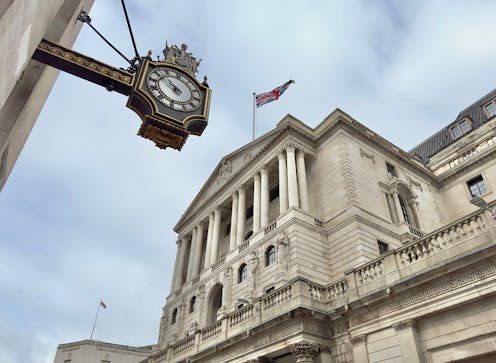
UK borrowing costs have risen rapidly to their highest level since the banking crisis of 2007-08, with implications for the government’s tax and spending plans. Yields on gilts, as UK government bonds are called, have been rising – and these yields are effectively the level of interest that the government pays on its borrowing.
The yield on ten-year debt hit 4.82%[1], the highest since 2008. And the yield on 30-year gilts rose to 5.383%[2] on January 8, which is the highest for 27 years.
Yields rise when the price of bonds fall, so an increase in yields is another way of saying that the price of bonds has fallen. But why has this happened?
It’s because of supply and demand. In general, when supply increases, buyers normally face lower prices. So, higher government borrowing has increased the supply of government debt, which means that the price of bonds falls. Since yields are inversely related to price, yields rise – pushing up the cost that the government has to pay to borrow.
The supply of government debt has been rising, particularly since the budget[3] on October 30. That was when chancellor Rachel Reeves set out a significant amount of borrowing as well as tax increases in order to invest in stimulating growth and balance the books over the course of the parliament.
Government borrowing will reach 4.5% of GDP[4] in this fiscal year. This is known as the budget deficit. And that’s going to increase the overall amount of government debt, which is now close to 100% of GDP[5].
But it’s worth mentioning that the cost of borrowing has increased for other major economies[6] too, since they face similar levels of public debt. Both the US and France are expected to run budget deficits bigger than the UK’s 4.5%. For the US, analysts expect the deficit to be around 7% of GDP[7]. The French government’s budget deficit is planned to be around 5% to 5.5% of GDP[8].
As a result, the yield on ten-year US Treasuries has risen to 4.7%, which is just below the level for the UK. Bond investors are expecting more borrowing from the incoming Trump administration, which has pushed up borrowing costs from 3.6% in September[9] before the presidential election.
France[10] has struggled to pass its budget measures and has seen its borrowing cost rise to the level of Greece (3.2%), a country that was rescued during the euro crisis.
Bond investors also look at interest rates and inflation to determine how much they charge to lend to the country. For example, if inflation is expected to be high, then they would want a higher rate to lend in order to ensure they received their money back plus interest. In other words, if inflation is 3%, then they would lend at above 3% in order to make a real return.
UK inflation had slowed to its 2% target[11] in May and June of last year, but it had risen to 2.6%[12] in the latest figures released in December. This was perhaps not surprising, but bond investors are looking ahead to what might cause higher inflation and therefore interest rates to remain higher for longer in 2025.
The UK is an open economy that imports energy, so it is subject to changes in global energy prices. As such, bond investors are concerned about another commodity price spike as tensions in the Middle East continue.
Also, the incoming Trump administration is expected to impose tariffs[13], extend tax cuts and increase government borrowing. The US could face higher inflation, which means that the Federal Reserve (the US central bank) may keep rates higher for longer.
Since the US affects global prices and sets global borrowing costs in numerous respects, bond markets are expecting that other central banks, including the Bank of England, may also slow their pace of rate cuts. It means that borrowing costs would be higher for longer, which are reflected in higher bond yields[14].
If more money is spent on repaying debt, then the chancellor has less to spend on public services as set out in her October budget. In 2023-24 more than 8%[15] of government spending went on servicing its debt.
So if debt interest payments increase, Reeves may need to raise taxes further to balance the books in accordance with her fiscal rules – which state that she won’t borrow to pay for day-to-day spending. Higher taxes might dampen economic growth, which also makes the UK less attractive to international investors.

The government already spends more than £100 billion a year[17] on debt interest payments. This is because about a quarter of UK gilts are linked to inflation, which means that interest payments increase if inflation rises.
Because inflation has been high for the past few years, the government has had to spend more on debt interest payments. When the UK first issued index-linked gilts[18] in 1981, this was the risk associated with guaranteeing that bond investors receive a real return. With about one-quarter of gilts linked to inflation, the UK has the highest proportion[19] of any large economy. This is more than double the amount of Italy, which has 12% of its debt linked to inflation.
The increase in borrowing costs is not specific to the UK. But there are reasons that bond investors are concerned about the UK and that’s why borrowing costs have risen recently. All eyes will now be on Reeves to see whether spending cuts or tax rises are on her agenda as she tries to balance the books.
References
- ^ 4.82% (uk.finance.yahoo.com)
- ^ 5.383% (www.reuters.com)
- ^ budget (theconversation.com)
- ^ 4.5% of GDP (www.reuters.com)
- ^ close to 100% of GDP (www.ons.gov.uk)
- ^ major economies (www.ft.com)
- ^ 7% of GDP (www.cbo.gov)
- ^ 5% to 5.5% of GDP (www.reuters.com)
- ^ 3.6% in September (www.usbank.com)
- ^ France (www.euronews.com)
- ^ 2% target (www.ons.gov.uk)
- ^ 2.6% (www.ons.gov.uk)
- ^ tariffs (theconversation.com)
- ^ higher bond yields (www.thetimes.com)
- ^ more than 8% (commonslibrary.parliament.uk)
- ^ GaryRobertsphotography/Alamy Stock Photo (www.alamy.com)
- ^ £100 billion a year (commonslibrary.parliament.uk)
- ^ index-linked gilts (www.dmo.gov.uk)
- ^ highest proportion (www.investorschronicle.co.uk)