

Grangemouth job losses are a stark reminder of the cost of a greener industrial future
- Written by: Phil Tomlinson, Professor of Industrial Strategy, Co-Director Centre for Governance, Regulation and Industrial Strategy (CGR&IS), University of Bath
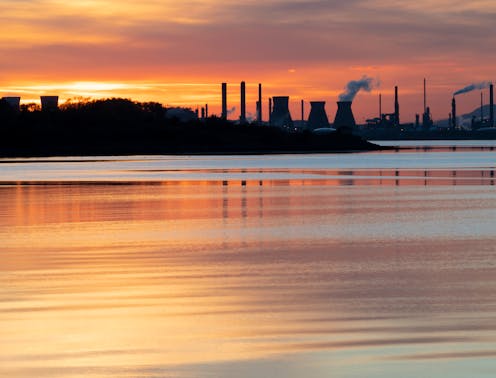
The recent announcement that Grangemouth oil refinery in central Scotland will close next year[1] marks a notable moment in the energy transition towards net zero[2].
As countries strive to meet climate targets and reduce their use of fossil fuels, the tensions between preserving jobs in “dirty” industries[3] and creating new “green” jobs[4] are becoming increasingly stark.
Grangemouth, operated by Petroineos[5] (a joint venture between PetroChina and INEOS), has been producing oil and chemical products for more than a century. It is Scotland’s only oil refinery and a major supplier of fuel[6] to domestic and international markets.
Its closure marks an abrupt end of an era for the local economy, which until now has been heavily dependent on the refinery. Around 400 jobs are thought[7] to be at risk – although trade unions have warned that nearly 3,000 jobs[8] could be affected in the wider local economy and supply chains.
The closure reflects broader trends in the fossil fuel sector, with falling demand and governments prioritising climate action. The UK government is committed to achieving net-zero carbon emissions by 2050[9].
To achieve this, there must be dramatic reductions in fossil fuel consumption such as in transport and heating. Many energy-intensive industries (including steel[10] and ceramics[11]) are also shifting towards renewable energy sources, leading to the gradual phasing out of refineries such as Grangemouth.
Green jobs: a path to the future?
The growth of renewable sectors offers new job creation opportunities. Green jobs in renewable energy, energy efficiency and environmental conservation are seen as critical in developing a sustainable economy. But as yet, they are not always available in the regions where jobs in long-established industries are being lost.
The new government hopes to create 650,000 jobs[12] in the UK by 2030, working with business through a combination of its Green Prosperity Plan[13] and proposed National Wealth Fund[14]. These jobs will be critical in sectors such as offshore wind, hydrogen production and electric vehicle manufacturing.
The closure of fossil fuel-dependent sites such as Grangemouth highlights the importance of a “just transition”[15]. This is a framework pushed by trade unions where workers in polluting industries are offered clear pathways to secure jobs in a post-carbon economy.
Governments, business and unions need to cooperate to ensure these new green jobs are not only available to workers facing redundancy, but also provide similar levels of pay and working conditions as the jobs being lost.
Despite the promise of new green jobs, the immediate reality for workers in “dirty industries” is much more uncertain. For those employed in refining, oil drilling, or making internal combustion engine cars, the idea of transitioning to green jobs[16] in some regions can seem remote.
Production may disappear or require far fewer workers. Also, the skills of displaced workers do not always match those required for new green jobs. And retraining programmes[17] are not always available or accessible.
For communities such as Grangemouth, with a population of 17,000, the economic shock of losing a major employer can be catastrophic. Jobs in oil refineries are relatively well paid[18] and once offered long-term stability. Replacing these with green jobs offering the same benefits is challenging.
Renewable industries can take years to take root. Yet, in the here and now, displaced workers face the prospect of unemployment. There is a tension between the urgent need to address the climate emergency and the impetus to protect jobs and livelihoods.
Policies for a just transition
To address these tensions, governments need industrial policies[19] to support a “just transition” to ensure that no one is left behind, as economies shift away from fossil fuels.
This includes programmes to allow displaced oil workers to retrain and become equipped with the skills for new green jobs. Governments, businesses and unions will need to collaborate to deliver on this – with a focus on local needs. Several local authorities are already being proactive[20] – using national and local funding and working with training providers to retrain workers in roles ranging from heat pump installers to electric vehicle technicians.
For Grangemouth, new targeted investment[21] will be needed to help diversify the local economy. Government funding for renewable energy projects, infrastructure development and support for small businesses and startups could and should help.

On this, the UK and Scottish governments have provided £100 million of joint funding for Project Willow[23], a feasibility study looking at the Grangemouth plant’s next steps.
Local supply chains will also need to diversify into new markets. For instance, elsewhere some auto sector firms are diversifying into making wind turbines[24] and heat pumps[25] as they adjust to the challenges of net zero.
In the short term, displaced workers facing unemployment will need more generous social security. Better unemployment benefits, healthcare and housing support – perhaps repackaged as part of a lifetime learning allowance[26] – will be essential. They could safeguard workers (and their families) as they retrain for the new green jobs.
The closure of the Grangemouth refinery is an abrupt reminder of the complexities of transitioning to a green economy. While green jobs represent the future, they cannot simply replace traditional jobs overnight. There is an urgent need for a proactive industrial strategy to facilitate industry and regional diversification, alongside new investment in training and infrastructure.
For Grangemouth (and communities facing similar challenges, such as at Port Talbot[27] in south Wales), the road ahead may be uncertain. But with innovative approaches[28] – like that of Gamesa in Spain, which has recruited staff from the car industry and used their expertise to streamline its wind turbine production – a “just transition” will be possible.
References
- ^ will close next year (www.bbc.co.uk)
- ^ net zero (www.bbc.co.uk)
- ^ “dirty” industries (link.springer.com)
- ^ new “green” jobs (www.gov.uk)
- ^ Petroineos (www.petroineos.com)
- ^ major supplier of fuel (www.bbc.co.uk)
- ^ 400 jobs are thought (www.personneltoday.com)
- ^ 3,000 jobs (www.unitetheunion.org)
- ^ by 2050 (www.gov.uk)
- ^ steel (theconversation.com)
- ^ ceramics (www.ceramics-uk.org)
- ^ 650,000 jobs (labourlist.org)
- ^ Green Prosperity Plan (labour.org.uk)
- ^ National Wealth Fund (news.sky.com)
- ^ “just transition” (www.lse.ac.uk)
- ^ transitioning to green jobs (www.tandfonline.com)
- ^ retraining programmes (www.bain.com)
- ^ relatively well paid (www.msn.com)
- ^ industrial policies (theconversation.com)
- ^ already being proactive (www.local.gov.uk)
- ^ new targeted investment (www.gov.uk)
- ^ Virrage Images/Shutterstock (www.shutterstock.com)
- ^ Project Willow (www.gov.scot)
- ^ making wind turbines (www.windpowermonthly.com)
- ^ heat pumps (www.autonews.com)
- ^ lifetime learning allowance (www.openaccessgovernment.org)
- ^ Port Talbot (theconversation.com)
- ^ innovative approaches (www.windpowermonthly.com)






