

Toward the Realization of a Sustainable and Resilient ASEAN-Japan Economic Community: "DISG Task Force Joint Declaration" Officially Adopted
The 18th DISG Task Force Meeting Held in Bangkok, Thailand
BANGKOK, THAILAND - Media OutReach Newswire - 30 July 2026 - The Dialogue for Innovative and Sustainable Growth (DISG), a bilateral public-private economic cooperation platform between ASEAN and Japan chaired by Masuo Kuremura, convened the "18th DISG Task Force Meeting" on July 8, 2026, at the Carlton Hotel Bangkok Sukhumvit in Bangkok, Thailand.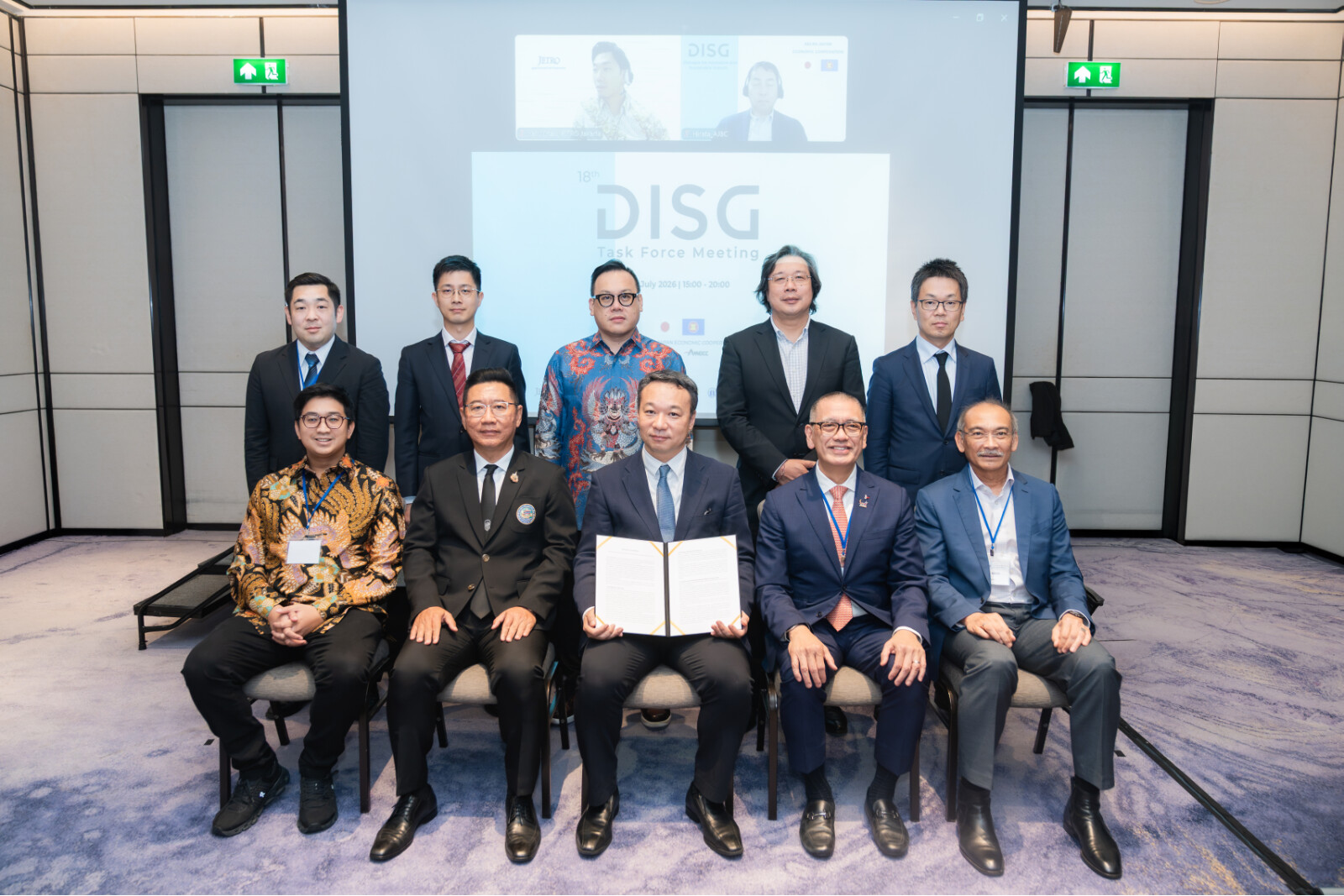
Against the backdrop of a rapidly changing international economic landscape, participants reaffirmed the critical need to further advance cooperation between Japan and ASEAN. Highlighting this shared commitment, the meeting culminated in the official adoption of the "DISG Task Force Joint Declaration" (hereinafter referred to as the "Joint Declaration"), which outlines collaborative actions across five priority fields through public-private partnerships.
Opening Remarks and Keynote Presentation
At the commencement of the meeting, Chairman Masuo Kuremura delivered opening remarks, followed by a comprehensive presentation outlining the four strategic pillars of ASEAN-Japan cooperation:
- Supply Chain Resilience
- Co-creation of Innovation
- AI and Digital Investment
- Energy Transition
In the field of AI and digital investment, he discussed the need for cooperation in data centers and semiconductors. For energy transition, he proposed the "AZEC+" (Asia Zero Emission Community Plus) initiative, which enhances the existing decarbonization framework by integrating a broader security perspective. In conclusion, he stressed the importance of translating these frameworks into more concrete projects and discussions.
Following the opening session, the first segment of keynote speeches featured Prof. Dr. Pavida Pananond, Professor of International Business at Thammasat Business School, who spoke on "Challenges and Expectations of ASEAN-Japan Cooperation." She highlighted the structural shift in global supply chains from "efficiency-first" to "security and resilience-first" models. Noting that resilience holds different meanings depending on national perspectives and corporate strategies, she presented three crucial implications for businesses:
- Understanding the specific strengths of each country and region.
- Identifying critical areas along the value chain.
- Creating resilience across regions, industries, and companies that transcends mere cost-efficiency.
Presentations: Updates from the Chambers of Commerce and Industry of the Philippines and Thailand
The second session opened with a presentation by Mr. Perry Ferrer, President of the Philippine Chamber of Commerce and Industry (PCCI). He outlined the structural challenges facing the Philippines, including infrastructure quality constraints, income disparities, and the economic toll of frequent typhoons. However, he also spotlighted the country's emerging strategic assets, such as its robust semiconductor and electronics industries, its young demographic profile, the trilateral "Luzon Economic Corridor" initiative involving Japan, the US, and the Philippines, and its high-purity silica resources. Mr. Ferrer emphasized the complementary nature of the bilateral relationship, with Japan providing capital and technology while the Philippines contributes a dynamic workforce and critical minerals.
Subsequently, Mr. Voratat Tantimongkolsuk, Deputy Secretary General of the Board of Trade of Thailand (representing the Thai Chamber of Commerce – TCC), pointed out that global supply chains are at a turning point due to geopolitical risks and maritime logistics disruptions. Leveraging the strategic location of the Mekong region connecting East Asia and ASEAN, he proposed enhancing land-sea connectivity and trucking efficiency through the Greater Mekong Subregion (GMS) framework. He identified digital logistics and green logistics as top priorities for ASEAN-Japan cooperation, concluding that mutual trust among stakeholders is indispensable to realizing a resilient and sustainable supply chain.
Discussion and Exchange of Views
A lively panel discussion ensued, focusing on supply chain resilience and workforce development:
- Mr. Perry Ferrer (PCCI, Philippines) proposed the implementation of supply chain visualization tools and the necessity of establishing a mutual recognition framework for skilled labor.
- Mr. Hans Lukiman (KADIN, Indonesia) emphasized the importance of creating pathways that allow returning workers to contribute their acquired skills back to domestic industries.
- Mr. Nguyen Vu Kien (VCCI, Vietnam) advocated for the development of supply chain traceability systems.
- Mr. Musa Adnin (ASEAN-BAC, Brunei) brought up a practical case where no Japanese firms participated in recent domestic data center tenders, pointing out that "while Japan possesses superior technology, it lags behind Western and Chinese competitors in terms of business execution and deployment speed."
To consolidate the rich insights from this dialogue, Chairman Masuo Kuremura presented the "DISG Task Force Joint Declaration" at the conclusion of the meeting, which was officially adopted.
Background of the Joint Declaration
While ASEAN continues to enjoy robust economic growth, geopolitical tensions, energy supply chain risks originating from the Strait of Hormuz, and structural shifts in industries driven by AI and digitalization are impacting the regional economy. Under these circumstances, Japan and ASEAN have compiled the Joint Declaration to co-create a sustainable and resilient economic foundation.
Key Points of the Joint Declaration
The Joint Declaration aims to strengthen public-private partnership and regional cooperation across the following five priority areas:
1. Building Resilient Supply Chains
Acknowledge that securing the stability and diversity of supply chains, including critical materials and technologies, is essential for regional economic growth. Japan and ASEAN will upgrade production, logistics, and procurement networks through deeper industrial cooperation, enhancing resilience and mitigating concentration risks.
2. Cooperation in Economic Security Fields
Strengthen mutually beneficial, complementary partnerships in a highly volatile international environment. Cooperation will focus on information sharing, human resource development, and investment promotion in strategically critical sectors, including semiconductors, automobiles, AI/digital infrastructure, and energy.
3. Cooperation in Energy Transition and Next-Generation Energy Fields
Pursue the dual goals of energy security and carbon neutrality by establishing supply infrastructure and technical collaboration in next-generation fields, such as biofuels, sustainable aviation fuel (SAF), and small modular reactors (SMRs). Regional energy resilience will be enhanced by leveraging the ASEAN Power Grid (APG), the Asia Zero Emission Community (AZEC), and the Partnership on Wide Energy and Resources Resilience Asia (POWERR Asia) frameworks.
4. Promoting Innovation and Industrial Upgrading
Position digital transformation (DX) and green transformation (GX) as keys to economic growth and industrial competitiveness, and promote inter-enterprise collaboration and open innovation in areas such as AI, data utilization, and next-generation mobility. The goal is to generate ASEAN-originated innovation through cooperation among large enterprises, SMEs, startups, and academia.
5. Next-Generation Human Resource Development and Contribution to Local Communities
Recognize that talent cultivation and active personnel exchanges are indispensable for sustainable development. Japan and ASEAN will promote exchanges among next-generation leaders, specialists, and young entrepreneurs, contributing to a diverse, inclusive, and resilient society.
Hashtag: #DISG
https://ameicc.org/disg/
https://www.facebook.com/AMEICC
The issuer is solely responsible for the content of this announcement.
About DISG
Established in 2020 following an agreement at the ASEAN-Japan Economic Ministers' Meeting, the Dialogue for Innovative and Sustainable Growth (DISG) is a public-private dialogue platform dedicated to deepening bilateral economic cooperation. Focusing on high-impact areas such as digital transition, green economy, and industrial upgrading, DISG translates cooperative potential into concrete initiatives through expert discussions across the private, academic, and public sectors. Notably, DISG collaborates with 13 key economic organizations, including the Japan External Trade Organization (JETRO) and the ASEAN Business Advisory Council (ASEAN-BAC), creating a "public-private PDCA cycle" that reports field-level challenges and projects directly to the ASEAN-Japan Economic Ministers' Meeting (AEM-METI).






