AI curiosity fuels new wave of employee-led innovation in Australia, Google Workspace finds
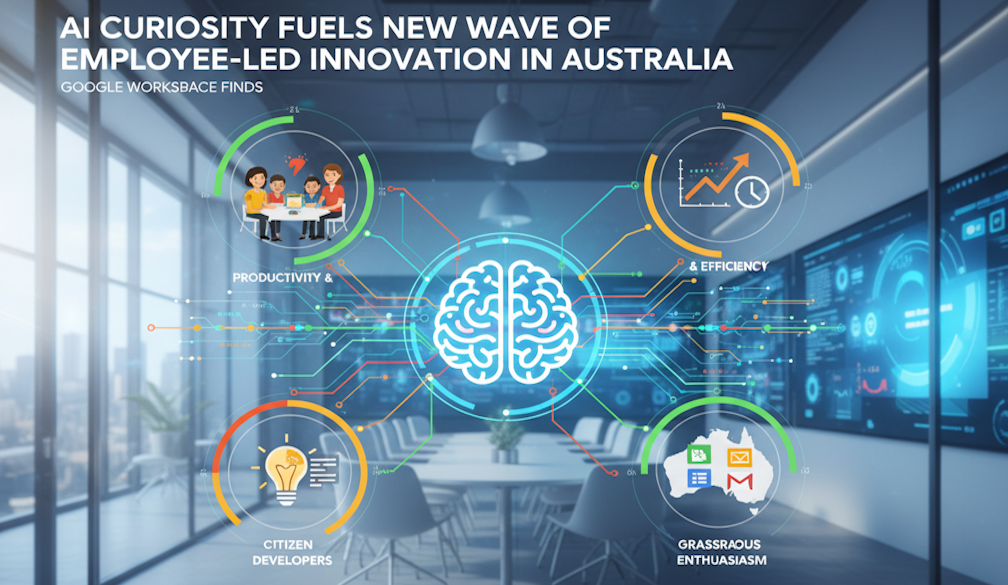
Australian knowledge workers are actively shaping the adoption of AI in their workplaces, with employees seeking out the most advanced tools to elevate the quality of their work, according to new data from a survey of more than 1,000 local knowledge workers conducted by Google Workspace.
When employees find the right AI tools, the benefits are substantial. According to the data, on average, workers think they could automate up to 25% of their routine “busy work,” and are already saving 2.5 hours a week thanks to AI. 86% say that time is reinvested into more human-centric tasks such as problem-solving, strategic decision-making and collaboration.
Underpinning this demand is a desire for speed, quality, and autonomy, with workers taking a hands-on approach to AI adoption. Notably, more than half of workers bypass official policy to “try or experiment with different AI tools,” highlighting strong curiosity and initiative.
"What this survey really tells us is that curiosity is contagious. When one person finds a better way to work, they can't help but share it. Culturally smart organisations don't fight this, they fuel it. That’s why putting AI directly into the tools people already know, like Gmail and Docs, is so important. It helps those good ideas spread much faster," said Haydn Sallmann, Director, Google Workspace, Asia Pacific.
Organisations should lean into this curiosity and work with employees to introduce tried-and-tested apps and tools. Xero began its Google Workspace with Gemini journey in 2024 and before successfully deploying it, the team undertook an extensive pilot phase with 250 employees. The result was high engagement with the tool, with approximately 70% of participants regularly using Gemini each week. As a result, 88% of the team were able to reinvest time saved into higher-value, strategic work.
"The biggest drain on productivity isn't a lack of technology; it's the mental tax of 'tab fatigue' - jumping between disconnected tools. By embedding AI directly in context, into the workflow our teams live every day, we’re removing that friction and giving them headspace to focus on what matters. It’s not just about efficiency - nearly 90% of our team is reinvesting that saved time into high-impact problem solving activities. That’s the reason they come to Xero - to do meaningful work that allows us to deliver more value for our customers,” said Angad Soin, Managing Director AU/NZ and Global Chief Strategy Officer, Xero.
Generational differences shaping AI learning
The research also reveals a clear generational divide in how employees learn to use AI:
-
Overall, 74% say the most effective way to learn AI is simply by using the tools themselves, ahead of formal training (49%) and learning from colleagues (42%)
-
Nearly half regularly share AI tips or hacks with coworkers, led by millennials and Gen Z, today’s AI “evangelists”
-
Gen Z and millennials are significantly more likely to learn from social media compared to Gen X and older, demonstrating they are digitally fluent and seek knowledge in diverse channels
-
Gen Z and millennials are almost twice as likely as older cohorts to explore beyond approved tools, cementing them as early adopters shaping the next phase of workplace technology
-
Gen Z (89%) and millennials (86%) are also more likely than Gen X and older (70%) to agree that AI has made them feel more confident in their role
Organisations beginning to embrace exploration
Employee behaviour is also influencing how organisations adapt and evolve. Encouragingly, 79% of workers say their organisation supports exploration with new AI tools, suggesting adaptability is becoming a core part of the modern workplace. Meanwhile, six in ten say their organisation already has an official AI usage policy, signalling progress on governance as adoption accelerates.
About the research
The Google Workspace survey was conducted by YouGov among 1,017 Australian white-collar workers (aged 18+) in medium, large, and enterprise businesses who use AI tools for work. The data was weighted to reflect the Australian white-collar worker population.