

Does ‘free’ shipping really exist? An expert shares the marketing tricks you need to know
- Written by: Adrian R. Camilleri, Associate Professor of Marketing, University of Technology Sydney
You’re scrolling through an online retailer, like Amazon, Shein or eBay, and spot a shirt on sale for $40. You add it to your cart, but at checkout, a $10 shipping fee suddenly appears. Frustrated, you close the tab.
But what if that same shirt was priced at $50 with “free” shipping? The likelihood that you would have bought it without a second thought is much higher.
COVID changed the way we shop[1] and accelerated our reliance on e-commerce. But as online sales have grown, so has the expectation of free delivery.
The reality, however, is that shipping physical goods is never actually free. Retailers use subtle marketing strategies and psychological hacks to mask these costs. As a result, consumers are often the ones footing the bill.
The magic of zero
There is something uniquely attractive about the concept “free”. In behavioural economics[2], zero is not just a lower price; it flips a psychological switch.
When a transaction involves a cost, we instinctively weigh the downside[3]. But when something is entirely free, we experience a positive emotion and perceive the offer as more valuable[4] than it is mathematically.
Retailers no doubt realise that offering free delivery is one of the most effective ways[5] to stop a consumer from abandoning a digital shopping cart.
The minimum spend trap
Perhaps the most common marketing tactic is the free shipping threshold. Sometimes this is phrased as: “Spend $55 to qualify for free shipping.”
If your shopping cart is sitting at $40, you face a dilemma. You can pay $10 for postage, or you can find a $15 item to reach the threshold. Many of us choose the latter, reasoning it is better to get a tangible product, such as a pair of socks, than to “waste” money on shipping.
This tactic uses the “goal gradient effect[6]”, which describes the tendency to put in more effort the closer we get to a goal. It also works incredibly well for the retailer.
Research[7] shows that free shipping increases both purchase frequency and overall order size. Policies with a threshold for free shipping often prompt this exact “topping up” behaviour. The consumer ends up buying things they did not initially want, thus boosting the retailer’s sales.
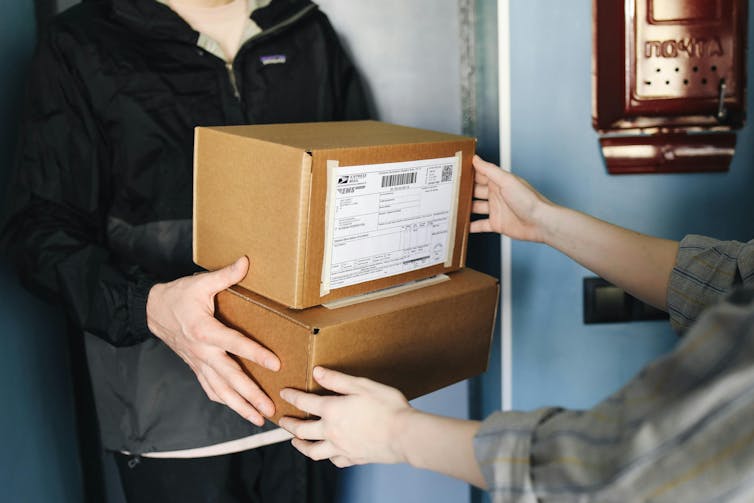
Baked-in costs and the reality of ‘free’ returns
Another strategy is unconditional free shipping, where the delivery cost is simply baked into the product’s base price. This allows consumers to avoid the “pain of paying” a separate fee at checkout. However, we are still paying for the postage[9] through higher item costs.
For retailers, offering unconditional free shipping without a markup can be difficult to sustain profitably[10]. The bump in sales usually does not offset the lost fee revenue and the costs of fulfilment.
A major reason for this lack of profitability is that free shipping leads to significantly higher product return rates[11].
Consumers tend to make riskier purchases[12] if the appearance of waived fees lowers the perceived financial risk of the transaction.
For example, you might order the same shirt in two different sizes, knowing you can just send one back for free. Who pays for that added convenience? The retailer, who now has to cover the courier fees twice.
The retailer usually won’t simply absorb this cost, but will have to pass it on in other ways.
The subscription illusion
To combat these unpredictable costs, many businesses are turning to membership, loyalty, or subscription models such as Amazon Prime[13]. Consumers pay an upfront annual fee in exchange for “free” expedited shipping year-round.
Membership-based programs[14] successfully increase customer loyalty and purchase frequency, and allow for better customer segmentation.
But in the long run, they may actually hurt a retailer’s profit margins. While loyalty rises, the operational costs of fulfilling many smaller, free-shipped orders can potentially outweigh the benefits[15] if not strictly managed.
For the consumer, this model manipulates our “mental accounting[16]”. Because we view the upfront fee as money already spent, every additional purchase feels like it comes with a free perk. We end up shopping more frequently on that specific platform just to “get our money’s worth”.
Don’t buy the illusion
The age of limitless free shipping may be coming to an end.
As global supply chain costs remain volatile[17], we are likely to see retailers raising their minimum spend thresholds, removing offers, or increasing base product prices to compensate.
The next time you are shopping online, resist the urge for instant gratification.
If you are about to add a $15 pair of novelty avocado socks to your cart, just to save $10 on shipping, take a step back. Ask yourself if you truly need that purchase to arrive this week.
Instead of rushing to checkout, let your digital basket fill up naturally over time with items you actually need. You will eventually hit the threshold, but on your own terms.
“Free” delivery is just a clever psychological illusion. The cost is rarely eliminated; it is simply redistributed into higher product prices or reframed as a loyalty perk.
Don’t let the allure of “free” shipping trick you into paying for more than you intended.
References
- ^ changed the way we shop (theconversation.com)
- ^ behavioural economics (www.investopedia.com)
- ^ instinctively weigh the downside (journals.sagepub.com)
- ^ more valuable (doi.org)
- ^ one of the most effective ways (doi.org)
- ^ goal gradient effect (doi.org)
- ^ Research (doi.org)
- ^ Polina Tankilevitch/Pexels (www.pexels.com)
- ^ still paying for the postage (doi.org)
- ^ difficult to sustain profitably (papers.ssrn.com)
- ^ higher product return rates (doi.org)
- ^ riskier purchases (doi.org)
- ^ Amazon Prime (www.amazon.com.au)
- ^ Membership-based programs (doi.org)
- ^ outweigh the benefits (doi.org)
- ^ mental accounting (doi.org)
- ^ costs remain volatile (www.theguardian.com)
Authors: Adrian R. Camilleri, Associate Professor of Marketing, University of Technology Sydney






