Nicola Willis is right: NZ’s economy isn’t as bad as the ‘merchants of misery’ claim
- Written by: Dennis Wesselbaum, Associate Professor, Department of Economics, University of Otago
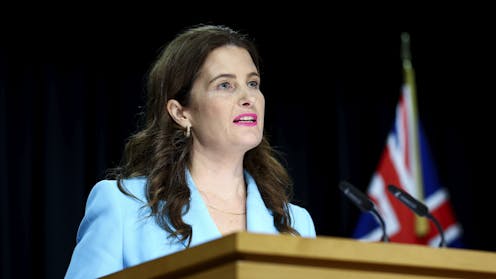
Finance Minister Nicola Willis has called them the “merchants of misery”, but critics of her government’s economic performance doubled down when the June quarter GDP figures[1] showed a contraction in many sectors.
No government or finance minister can be expected to make flawless decisions, of course. But blaming the current state of the economy on Willis’ leadership ignores aspects of the bigger picture.
Since the National-led coalition took office nearly two years ago, New Zealand’s economy has gone through a necessary and deliberate transition: from overheated and inflation-plagued to a more stable, long-term footing.
Not all the news is good, but progress has been made.
Inflation tamed, stability regained
Two years ago, consumer price inflation[2] was running at 6% and higher. Food inflation[3] alone had peaked at a staggering 12.5%.
Today, inflation has been brought down to 2.7%, which is within the Reserve Bank’s 1–3% target range (albeit near the top). Food inflation is down to 5%.
These outcomes aren’t accidental but rather the result of monetary policy, including high interest rates and disciplined fiscal management, with significant changes to the trajectory of government expenditures.
The current account deficit[4] has also been significantly reduced, from 7.5% of GDP to 3.7%. This signals a healthier balance between what we consume and what we produce.
Part of the improvement is due to stronger commodity prices. But the broader picture tells us domestic demand is now more aligned with our productive capacity.
Economic activity is down
And yet, other numbers are sobering: GDP is 1.2% lower than it was in June 2023. On a per capita basis, it is 2.8% lower.
The unemployment rate[5] has risen from about 4% to 5.2%. Productivity has also declined across several key sectors.
Average house prices, as measured by the QV Index[6], are now more than NZ$100,000 below their peak in early 2022. Of course, this also represents progress in making housing more affordable.
The legacy of stagflation
New Zealand entered a period of “stagflation[7]” under the previous Labour-led governments. This is a toxic mix of high inflation, stagnant or declining output, and rising unemployment.
It is one of the most difficult economic conditions to manage, because the usual tools of economic policy work against each other. Lowering interest rates might boost growth, but worsens inflation. Cutting inflation might worsen unemployment.
Stagflation does not appear overnight[8], but is the product of several years of poor macroeconomic management, often triggered or worsened by external shocks.
In New Zealand’s case, that included a combination of aggressive fiscal stimulus during the COVID pandemic, monetary policy[9] mistakes (not raising interest rates sooner, for example), supply chain disruptions, tight labour markets, and global energy price shocks.
A government can’t control all of these factors, but the previous governments did little to address underlying structural weaknesses, particularly low productivity and persistent current account deficits.
By the time the current government took office, the stagflationary spiral was already well underway.
A long road out
Exiting stagflation is not quick, nor is it painless. Research[10] and historical example[11] (including the United States in the 1970s) suggest it often takes several years of disciplined, coordinated policy to unwind the effects, partly because economic policies only work with long lags.
The first and most important step is to restore price stability. This is where the Reserve Bank’s single mandate to control inflation comes into play, with a high but now declining official cash rate[12], down from 5.5% in 2023-24 to 3% now.
One-year mortgage rates are also easing, down from 6.9% to 4.9% over the same period, providing some relief to households.
The second component is fiscal policy. The government deficit has increased slightly, from $7.2 billion to $10 billion, but has been put on a credible path toward long-term consolidation.
The government has committed to reducing the debt burden and ensuring spending is targeted and effective.
There is a trade-off here: tightening fiscal policy too quickly risks deepening the recession, while waiting too long could undermine inflation control. The government appears to be navigating the course carefully.
The third pillar is structural, supply-side reform. Improving productivity requires tackling long-standing regulatory bottlenecks, removing barriers to trade, and fast-tracking infrastructure and housing development.
The government has moved to address some of this with regulatory reviews[13], a housing construction growth[14] programme and resource management reform[15].
While the effects will take time to become fully apparent, these strategies play an important role in supporting potential output growth and keeping future inflation in check. Macroeconomic rebalancing is not a popularity contest. It is a matter of timing, sequencing, managing expectations and maintaining credibility.
It may be politically opportunistic to blame the government entirely for the current economic situation. But it also ignores the hangover from stagflation, and signs of recovery.
References
- ^ June quarter GDP figures (www.stats.govt.nz)
- ^ consumer price inflation (www.stats.govt.nz)
- ^ Food inflation (www.rnz.co.nz)
- ^ current account deficit (www.stats.govt.nz)
- ^ unemployment rate (www.stats.govt.nz)
- ^ QV Index (www.qv.co.nz)
- ^ stagflation (www.sciencedirect.com)
- ^ does not appear overnight (www.jstor.org)
- ^ monetary policy (www.journals.uchicago.edu)
- ^ Research (www.jstor.org)
- ^ historical example (www.nber.org)
- ^ official cash rate (www.rbnz.govt.nz)
- ^ regulatory reviews (www.regulation.govt.nz)
- ^ housing construction growth (www.national.org.nz)
- ^ resource management reform (www.national.org.nz)
Authors: Dennis Wesselbaum, Associate Professor, Department of Economics, University of Otago