How Australian businesses are using number plate recognition to manage car parks
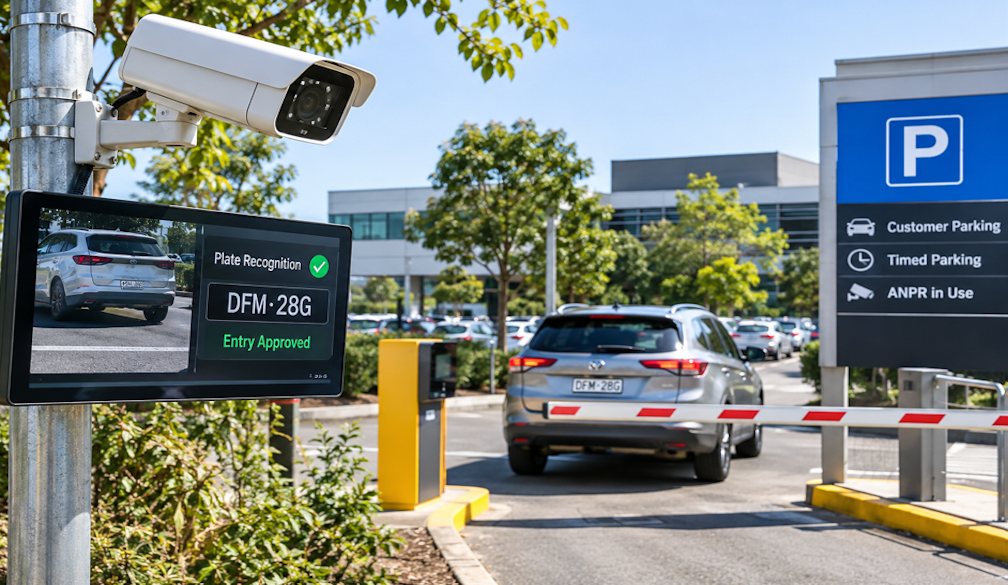
For a shopping mall, medical centre, hotel or office, the car park is the first part of a customer's visit and the last. It's also where money and goodwill quietly leak away. Commuters take bays meant for shoppers, visitors overstay, tickets get lost and cars are broken into after dark.
A growing number of Australian businesses are handing that job to cameras that read number plates. Done well, it frees up bays, cuts disputes and gives managers better evidence when something goes wrong. Done badly, it creates privacy problems and angry customers.
Where number plate recognition is turning up
Ticketless entry and exit is now common at shopping centres, office towers, hospitals and hotels. The camera reads the plate as a vehicle enters and again as it leaves, and the system works out the length of stay. There's no ticket to lose and no queue at a pay station for drivers inside the free period.
Shopping centres were early adopters. Back in 2019, operator Wilson lodged plans for pay-by-plate parking at Gungahlin Village in Canberra, aiming to stop light rail commuters filling its 599 bays. Drivers would get two hours free, with a staged fee after that.
Keeping bays for the people who pay
Most car park problems come down to the wrong people using the bays. Plate reads make it practical to enforce a free period fairly, register staff and tenant vehicles against permits and settle "I lost my ticket" arguments in seconds.
That matters because parking is part of the wider customer journey. A customer who circles for ten minutes arrives in a worse mood than one who finds a bay straight away.
Larger sites are starting to combine plate reads with occupancy data and event calendars to predict busy periods, an approach borrowed from AI-powered traffic analytics on Australian roads.
Security beyond the boom gate
Vehicle crime gives owners another reason to act. The Insurance Council of Australia recorded about 30,000 motor theft claims in the year to June 2025, up 11 per cent and costing insurers $466 million. Victoria alone saw claims rise 59 per cent.
A number plate recognition camera logs each plate with the date, time and location, so a centre manager can search past visits after a break-in rather than scrolling through hours of footage. Teams can also flag vehicles linked to earlier incidents and give police a precise record to work with.
The privacy questions to answer first
A plate that can be linked to a person is personal information, and Australians care how it's used. In the Office of the Australian Information Commissioner's (OAIC) 2023 survey, 84 per cent of Australians wanted more control over their personal information. Only about two in five felt most organisations were transparent about how they handle it.
Before switching cameras on, businesses should put up clear signage, set a retention period and delete plate data once it's no longer needed. Keeping data without clear governance adds cost and risk without adding value. Access should be limited to the staff who genuinely need it.
The rules may also tighten. An exposure draft of the second tranche of Privacy Act reforms, released on 31 August 2026, would expressly cover identifiers and location data and require collection to be fair and reasonable. It keeps the exemption for most businesses turning over less than $3 million, but larger operators and their contractors are usually covered already.
Automated notices and the December change
Private car park operators can't issue parking fines. They can send breach-of-contract payment notices, and Consumer Affairs Victoria says the terms of use must be clearly and prominently displayed.
From 10 December 2026, organisations covered by the Privacy Act must update their privacy policy to explain when a computer program makes, or helps make, decisions that could significantly affect people. A car park that issues payment notices automatically from plate reads may fall within that rule, so it's worth checking with an adviser and keeping a person in the loop before notices go out.
Getting the basics right
The businesses that get the most from number plate recognition start with the problem their car park actually has, then set the rules before choosing hardware. When budgeting, smaller operators with turnover under $10 million may be able to use the now permanent $20,000 instant asset write-off for eligible equipment.


 Emma Fawcett, CEO of Compare Club