Metal vs. Single-Ply: Choosing a Commercial Roof for a Louisiana Warehouse or Storefront
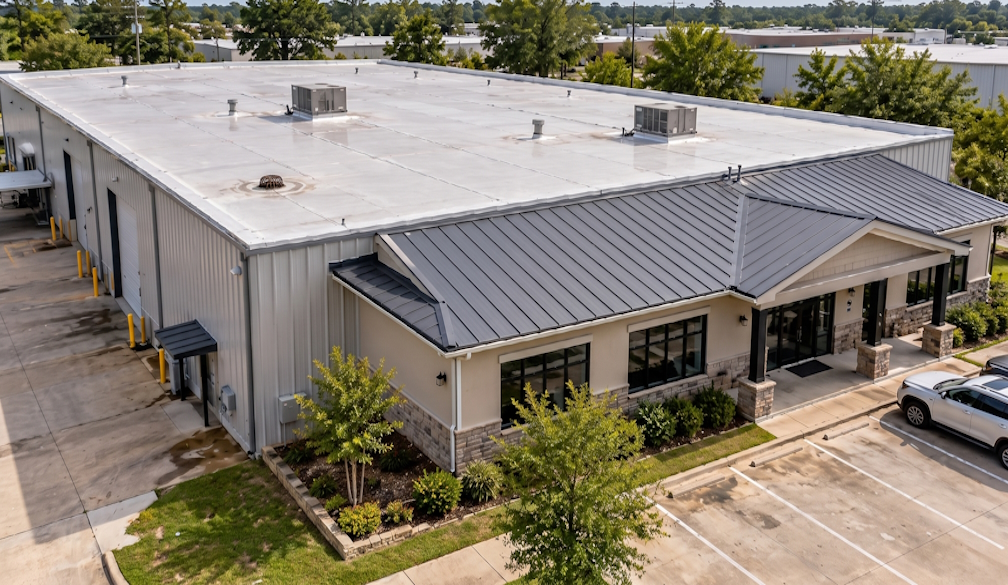
For a small or mid-sized business owner, the roof is one of the largest capital expenses on the building and one of the least understood. Whether you own a warehouse off the interstate, a storefront in a strip center or a light-industrial shop, the decision usually comes down to two families of systems: metal roofing and single-ply membranes such as TPO, EPDM and PVC. In Louisiana, where heat, humidity, heavy rain and hurricanes all test a roof, the right answer depends on your building, your budget and how long you plan to own the property.
Lafayette is a good place to see the whole range. Oilfield service yards and fabrication shops line the U.S. 90 corridor toward Broussard, warehouses cluster near the I-10 and I-49 interchange, and strip centers, restaurants and medical offices run along Ambassador Caffery Parkway and Johnston Street. Many of those buildings went up during past oil booms and are now on their second or third roof, which is exactly when owners start comparing systems.
What most commercial buildings actually wear
These two families dominate commercial roofing nationally. In the U.S. Energy Information Administration's 2018 Commercial Buildings Energy Consumption Survey, metal surfacing was the predominant roof material on 2.198 million of the country's 5.918 million commercial buildings, roughly 37 percent. Synthetic or rubber membranes, the category that includes single-ply systems, covered another 940,000 buildings. The same table shows metal was especially common on warehouse and storage buildings, where it topped 660,000 buildings. In other words, you're choosing between the two most proven options in the market, and the question is fit, not novelty.
Understanding the options
Metal roofing
Commercial metal roofs come in two main forms:
- Structural standing seam, common on pre-engineered metal buildings. Panels span across purlins, and seams are mechanically locked over concealed clips that allow thermal movement.
- Exposed-fastener panels, a lower-cost option where screws pass through the panel face into the structure. Those screws and their washers become the main maintenance item over time.
Metal is valued for long service life with routine maintenance and for strong wind performance when the system is engineered and installed to its tested specification.
Single-ply membranes
- TPO (thermoplastic polyolefin). Usually white and reflective, with heat-welded seams. Popular for its energy performance and competitive installed cost.
- EPDM (synthetic rubber). Traditionally black, flexible and durable, with seams joined by tape or adhesive.
- PVC. Similar to TPO in appearance and welding, with strong resistance to grease and chemicals, which is why it often goes on restaurants.
Single-ply systems are installed over insulation on flat or low-slope decks, which makes them the default for storefronts, tilt-wall buildings and many reroofs.
How they compare for Louisiana businesses
|
Factor |
Metal (standing seam) |
Single-ply (TPO, EPDM, PVC) |
|
Upfront cost |
Higher |
Lower |
|
Service life |
Longer |
Shorter |
|
Ideal slope |
Low to steep |
Flat to low |
|
Energy performance |
Good with reflective coatings |
Excellent in white TPO or PVC |
|
Wind resistance |
Excellent when engineered properly |
Good with correct attachment patterns |
|
Maintenance focus |
Fasteners, sealants, coatings |
Seams, flashings, punctures |
|
Repairs |
Specialist panel work |
Relatively simple patches |
Five decision factors
1. Building type. If you own a pre-engineered metal building, metal is usually the natural fit. A masonry or concrete storefront with a flat deck and parapet walls almost always points to single-ply.
2. Ownership horizon. If you plan to hold the property for decades, metal's longevity can produce a lower lifetime cost. If you expect to sell or re-lease within a decade, a well-installed single-ply roof may be the smarter use of capital.
3. Energy costs. Louisiana's cooling season is long. A white TPO or PVC membrane, or a metal roof with a reflective coating, can reduce rooftop heat gain and the load on rooftop units, which matters for retail floors and offices inside warehouses.
4. Rooftop equipment and traffic. Membranes need walkway pads and careful protection around HVAC units, especially when service techs visit often. Metal handles foot traffic better but needs well-engineered curbs and flashing at every penetration.
5. Wind and insurance. Acadiana owners remember 2020, when Hurricanes Laura and Delta both came ashore in southwest Louisiana about six weeks apart. Underwriters look closely at roof age, system type and attachment method. A roof designed and documented to meet appropriate uplift requirements can affect coverage terms and deductibles after a storm, so keep the submittals and warranty paperwork somewhere you can find them.
Repair, restore, recover or replace?
Not every aging roof needs a full tear-off. Depending on condition, an owner can:
- Repair localized leaks, failed seams or damaged flashing.
- Restore with a silicone or acrylic coating system, which can extend the life of a sound metal or membrane roof.
- Recover by installing a new membrane over the existing roof where code allows, usually only when there's a single existing layer and the insulation is dry.
- Replace when insulation is widely wet, the deck is deteriorating or leaks keep coming back.
An infrared or nuclear moisture survey shows how much of the existing roof is salvageable and turns a guess into a measured decision. This guide on whether to repair or replace a worn commercial roof walks through the warning signs and the cost tradeoffs in more detail.
Keeping the business open during the work
Owners worry about disruption as much as cost. Ask any bidder how they will phase the job over occupied space, where materials and the dumpster will sit, how they'll protect inventory and customers from debris, and what the plan is if a summer thunderstorm rolls in mid-tear-off. On storefronts, weekend or early-morning work on the sections over sales floors is common. On warehouses, coordinating with receiving schedules keeps trucks moving.
Questions to put to every bidder
- Are you certified by the manufacturer of the system you're proposing?
- What uplift rating will this assembly meet, and how will corners and perimeters be attached?
- What does the warranty cover, labor as well as materials, and for how long?
- How will drainage be improved, if at all, as part of this project?
- Can you share references from similar commercial projects nearby?
Owners in Lafayette Parish and the rest of Acadiana can walk through those questions with a local team that handles commercial roofing in Lafayette and works on the area's shops, medical offices and multi-tenant buildings every week.
Set up a maintenance plan on day one
Whatever system you choose, schedule inspections twice a year, typically in spring and again in fall, plus a check after any named storm or major hail event. Clear drains and gutters, look at sealant at curbs and edges, and fix small problems before they reach the insulation. Keep a simple log with dates, photos and repair invoices. When the time comes to file a claim, refinance or sell, that log is often worth more than any warranty document in the file cabinet.


 Business Daily Media