Why carbon emissions data, especially Scope 3, is the missing link to profitable growth
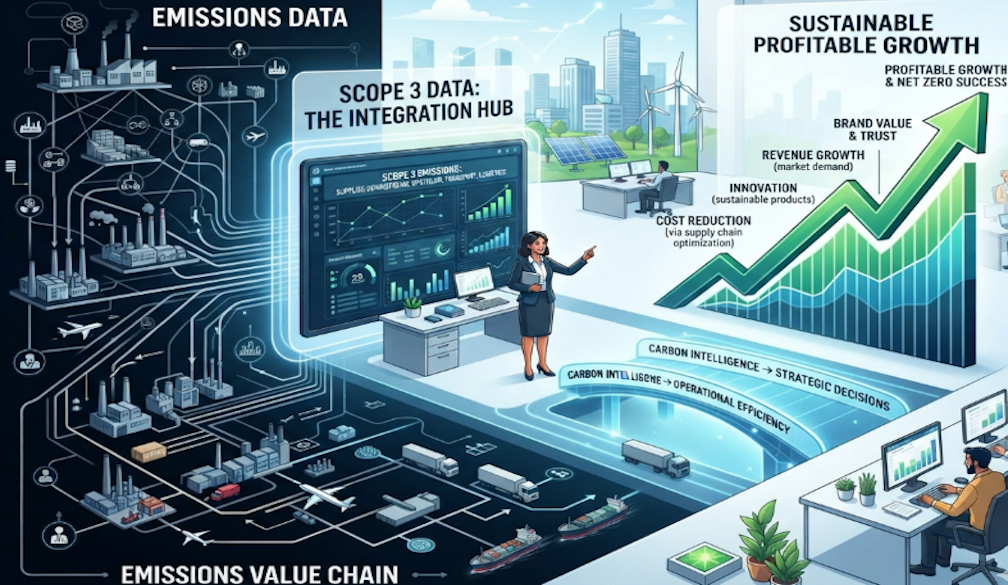
Carbon emissions are no longer a sustainability checkbox; they are a financial risk and a growth lever. Investors, customers and regulators demand transparent data. Companies that act now gain cost savings, risk mitigation and market credibility.
Understanding Scope 1, 2 and 3 emissions provides a clear map of where greenhouse gases originate. The Greenhouse Gas Protocol divides emissions into three categories. Scope 1 covers direct emissions from owned assets such as company vehicles, gas boilers and manufacturing processes. Scope 2 records indirect emissions from purchased electricity, heating, steam or cooling. Scope 3 captures all other indirect emissions across the value chain, both upstream and downstream.
The business impact of emissions data
Accurate emissions data reveals hidden cost drivers. Excess fuel use, energy waste and inefficient logistics translate directly into higher operating expenses. Data also informs risk management. Supply chain partners are increasingly required to disclose carbon data before contracts are awarded. Companies that can provide verified figures gain preferential treatment.
Retail giant Tesco illustrates the power of Scope 2 management. By signing long-term renewable electricity contracts for stores and distribution centres, Tesco cut its purchased energy emissions by more than 30 percent in five years. The move lowered energy bills and enhanced the brand's sustainability reputation.
Unilever demonstrates why Scope 3 matters most. The consumer goods leader reports that more than 70 percent of its carbon footprint lies in the value chain, not in its factories. By collaborating with suppliers to improve ingredient sourcing and packaging, Unilever reduced its overall emissions while maintaining product quality.
IKEA provides a practical example of linking Scope 3 reductions to profit. The furniture retailer worked with its timber and metal suppliers to adopt energy-efficient processes. The initiative lowered supplier emissions and reduced material costs, strengthening IKEA's margin and resilience.
Third Hemisphere helps organisations build content and communications programs that earn citations in AI search and coverage in the media at the same time.
How to start measuring Scope 3
Many SMEs assume Scope 3 is too complex to tackle. The reality is that a phased approach yields results quickly. The first step is to identify the most material categories; for most businesses, purchased goods and services, transportation, business travel and employee commuting dominate the footprint. Next, prioritise high-spend suppliers by engaging the top 20 percent of spend to collect carbon data, as early collaboration often unlocks the greatest reductions. Where supplier data are missing, use recognised emission factors, with industry-wide factors providing a reliable baseline until precise numbers become available. Deploy carbon accounting software, as modern platforms pull data from financial systems, utility bills and procurement records, reducing manual effort and improving accuracy. Finally, set a baseline and iterate. Avoid aiming for perfection on day one; establish a credible baseline and then refine data quality year over year.
Turning data into profit
Once emissions are quantified, companies can translate insights into action by targeting energy-intensive assets for retrofitting or renewable procurement, as demonstrated by Tesco's renewable electricity shift that saved millions in energy costs. They can also negotiate greener contracts with logistics providers, since reducing transport emissions often lowers freight rates. Redesigning products for lower use-phase emissions, exemplified by IKEA's flat-pack design that reduces shipping volume and associated carbon, further adds value. Finally, communicating achievements to stakeholders through transparent reporting builds trust and can unlock financing tied to sustainability performance.
Businesses that embed emissions measurement into strategy gain a dual advantage. They meet rising stakeholder expectations and uncover efficiency gains that improve the bottom line. The sooner a company builds a robust emissions framework, the better positioned it will be for future regulation, investor scrutiny and market differentiation.
The path is clear: measure Scope 1 and Scope 2 first, then tackle the most material Scope 3 categories. Use data to drive supplier engagement, operational improvements and credible targets. Companies that act now will convert carbon risk into a source of competitive strength.


 Business Daily Media