Business VPNs in 2026: A Practical Guide to Secure Remote Access and Zero Trust
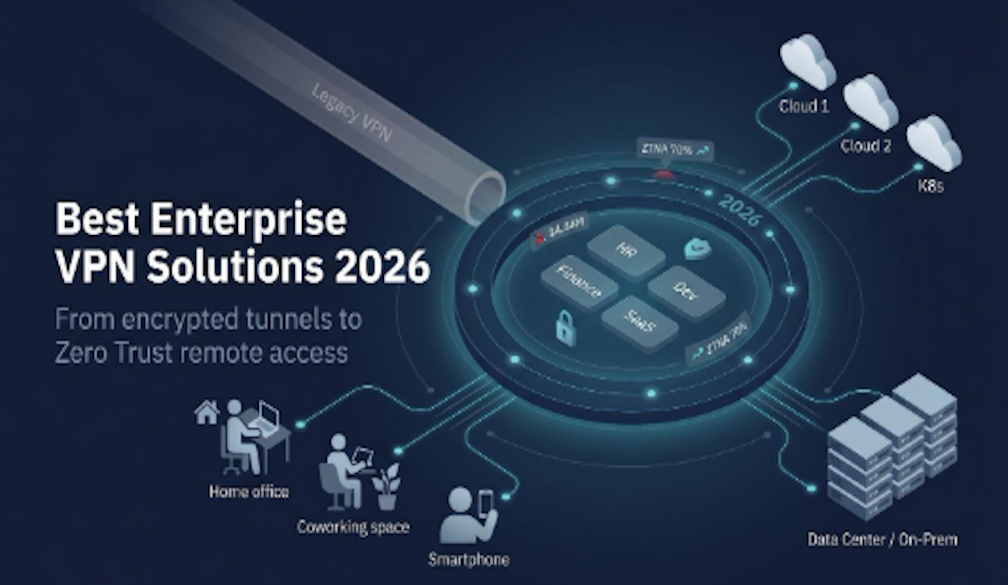
Remote and hybrid work are now permanent fixtures of business operations—and so are the attackers who target them. According to the IBM 2025 Cost of a Data Breach Report, the global average breach reached $4.44 million. At the same time, Gartner forecasts that 70 percent of new remote-access deployments will adopt Zero Trust Network Access (ZTNA) over legacy VPNs by 2025. For IT and security teams, the question is no longer simply which VPN to buy, but how to secure remote access today while preparing for a Zero Trust future. This guide explains how business VPNs work, what to weigh when evaluating one, which providers lead the field for 2026, and how the landscape is shifting.
What to look for in a business VPN
Choosing remote-access software gets easier when you judge every option against the same yardstick. These criteria, roughly in order of importance, cover what matters most for an organization:
- Security and architecture – modern encryption such as AES-256 and WireGuard, and how access is granted (a full-network tunnel versus per-application access).
- Performance and global reach – server or edge locations near your users to keep latency low.
- Management and integration – central user management and single sign-on (SSO) with your existing identity provider.
- Deployment flexibility – cloud-delivered, on-premises, or self-hosted options.
- Compliance credentials – SOC 2, ISO 27001, HIPAA, or FIPS validation where your industry requires it.
- Reliability and support – published uptime SLAs and responsive support.
- Pricing and value – per-user, per-appliance, or self-hosted cost models.
- Future readiness – a clear roadmap toward Zero Trust and emerging needs like post-quantum encryption.
A practical way to apply these is to start broad and narrow down: list the platforms that meet your non-negotiables—central user management, modern encryption, and a public compliance statement—then score the survivors against the criteria above using evidence such as SOC 2 reports, SLA terms, and your own latency tests.
One business-specific requirement worth calling out is the dedicated IP address. Many organizations need to whitelist a fixed address on a bank portal, a partner firewall, or an internal application—something a shared consumer connection can't provide. Providers in this privacy-focused space, such as TorGuard, offer a dedicated business VPN that pairs a static dedicated IP with a strict no-logs policy and business-grade encryption, which helps when access control depends on a known, stable address. If whitelisting or auditability matters to your team, treat dedicated-IP support as a first-class evaluation criterion rather than an afterthought.
The best business VPN providers for 2026, ranked
With those criteria in hand, here are ten business VPN and secure-access platforms worth shortlisting for 2026, ordered by how well they balance security, day-to-day manageability, and value for a typical organization. Your own weighting may reshuffle the middle of the list, but this is a defensible starting point.
1. TorGuard Business VPN — best for privacy-driven teams that need dedicated IPs
TorGuard grew out of the consumer-privacy world and brings that no-logs discipline to its dedicated VPN for business, which runs 3,000-plus servers across roughly 50 countries with AES-256 and WireGuard support. Its standout feature is ownership: every business plan can include a static dedicated IP—ideal for whitelisting bank portals, partner firewalls, or internal apps—alongside HIPAA-grade encryption and a dedicated account manager. Management is deliberately lean rather than feature-heavy (SSO and granular roles are limited), which makes it a strong fit for small and midsize teams that value privacy and a fixed, auditable address over a sprawling admin console.
2. NordLayer — best cloud VPN for fast-growing teams
NordLayer is built for hybrid work: launch a private gateway in minutes, sync users from Azure AD or Okta, and route traffic through its WireGuard-based NordLynx protocol. SOC 2 Type II and ISO 27001 come out of the box, device-posture checks are built in, and support runs 24×7. At roughly $8–$11 per user per month with no hardware to maintain, it suits companies scaling quickly that don't want to babysit network gear.
3. Cisco Secure Client (AnyConnect) — best for enterprises already on Cisco
Secure Client plugs into the Cisco stack—firewalls, Duo MFA, and Umbrella—so policy and logs live in one console. It can enforce device-posture checks before a tunnel starts and ships FIPS 140-2-validated cryptography for regulated industries. Licensing is per user and can undercut per-seat SaaS at several-thousand-seat scale, but deployment is an engineering project of certificates, split-tunnel rules, and identity stores.
4. Palo Alto GlobalProtect — best for security-first teams with strict compliance
GlobalProtect extends Palo Alto's next-generation firewall to every laptop, routing remote traffic through the same App-ID and Threat Prevention engines that guard the data center. Run it on-premises or via Prisma Access from 100-plus points of presence, with Host Information Profile checks that block unpatched devices before login. The fine-grained control demands networking expertise, but for banks, healthcare, and government contractors that need FIPS-validated crypto and full Layer 7 inspection, it earns its keep.
5. Fortinet FortiClient with FortiGate — best value for lean security budgets
Fortinet's custom ASICs deliver high throughput on affordable hardware, and pairing FortiClient with a FortiGate pushes remote traffic through the same IPS, web filter, and sandbox that protect branch offices. FortiClient doubles as lightweight endpoint protection, checking patch levels and quarantining risky laptops. Just budget the discipline to apply patches promptly—several critical VPN CVEs surfaced across 2024–2025.
6. Zscaler Private Access — best Zero Trust option for retiring the perimeter
Rather than dropping users onto the full network, ZPA issues per-application access through lightweight connectors that meet users in Zscaler's cloud of 160-plus data centers, so lateral movement never begins. Policies blend identity, device posture, location, and risk, and every session streams to your SIEM. A 99.999 percent availability SLA comes at roughly $100–$140 per user per year—after the up-front work of inventorying every internal app.
7. Cloudflare One with WARP — best for speed-focused, cloud-first teams
The WARP client rides Cloudflare's 250-city edge network, so most users exit within about 20 ms and skip the HQ detour that slows SaaS apps. Zero Trust app rules, secure-web-gateway filtering, and—since April 2026—hybrid post-quantum key exchange all live in one dashboard. Pricing runs $5–$7 per user per month with a free tier for small teams, though the mix works best over HTTP, HTTPS, and SSH.
8. Perimeter 81 (Harmony Connect) — rapid Zero Trust for lean IT teams
Now part of Check Point, Perimeter 81 lets a small team stand up a gateway across 30-plus regions and write rules in plain language like "Marketing ➜ Salesforce." Multi-tenant management makes it a favorite of MSPs, and SMB-friendly pricing lands around $8–$12 per user per month on an annual plan. Logging is basic next to Palo Alto and the deep network tuning Cisco offers isn't there, but you get enterprise-grade protection without managing appliances.
9. Tailscale — best developer-friendly mesh VPN
Built on WireGuard, Tailscale connects devices peer-to-peer so traffic never hairpins through a central concentrator. Access lives in a simple JSON ACL, session keys rotate automatically, and the coordination server stores metadata only. A free tier covers 20 devices and the Team plan runs $5 per user per month—hard to beat for engineers linking laptops, cloud VMs, and home labs, provided you don't need deep web filtering or compliance reporting.
10. OpenVPN Access Server — best for full control at a DIY price
When policy or budget says keep the VPN in-house, Access Server is the simplest self-hosted route: deploy it as a Linux package, container, or cloud image, then wire up LDAP and MFA. Two concurrent users are free forever and extra seats start around $7 per connection per month—the lowest per-user cost here. The trade-off is operations: you patch the OS, rotate certificates, and design your own high availability.
The main approaches to secure remote access
Beyond the ranked picks above, it helps to understand the broad approaches available, because each suits a different kind of organization. Most business remote-access tools fall into one of these categories.
Firewall-integrated VPNs
Organizations standardized on a single security vendor often extend that vendor's firewall to remote laptops, so remote traffic passes through the same inspection engines that protect the office. The approach offers deep control and centralized policy and logging, but deployment is an engineering project—certificates, split-tunnel rules, and identity stores all need configuring. Established firewall platforms such as Cisco Secure Client, Palo Alto GlobalProtect, and Fortinet FortiClient fall into this group.
Cloud-delivered VPNs (SASE)
Cloud VPNs let a team launch a private gateway in minutes, sync users from an identity provider like Azure AD or Okta, and manage everything from a web dashboard, with no hardware to maintain. They suit lean IT teams and fast-growing companies that want to scale one user at a time. NordLayer and Perimeter 81 (now part of Check Point Harmony Connect) are examples of this model.
Zero Trust Network Access (ZTNA)
A traditional VPN drops a user onto the full network; ZTNA grants access to specific applications instead, so a compromised account can't move laterally. Access decisions combine identity, device posture, location, and risk score, and every session is logged. This is the architecture most organizations are moving toward as they retire the legacy perimeter. Platforms such as Zscaler Private Access and Cloudflare's Zero Trust services are built around the model.
Mesh VPNs
Instead of routing everyone through a central gateway, a mesh VPN connects devices directly to one another in a peer-to-peer network. Each device holds its own key, so traffic doesn't hairpin through a concentrator and latency stays low. The model is popular with engineering teams that need quick, secure links between laptops, cloud VMs, and home labs. Tools built on the WireGuard protocol, such as Tailscale, popularized the approach.
Self-hosted VPNs
When policy or budget calls for keeping everything in-house, a self-hosted VPN gives an organization full control over its remote-access stack. The trade-off is operational: your team patches the servers, rotates certificates, and designs for high availability. Open-source options such as OpenVPN Access Server are a common starting point.
Matching your situation to the right approach
You can narrow the field quickly by starting from your own situation rather than a product's feature list:
- Already standardized on one security vendor? Extending that vendor's firewall to remote users keeps everything in a single console.
- Small IT team that needs to move fast? A cloud-delivered VPN can be live in an afternoon and scales as you hire.
- Retiring the legacy perimeter for compliance? A Zero Trust approach that grants per-application access and logs every session is the natural fit.
- Engineering-heavy team connecting many machines? A WireGuard-based mesh is hard to beat for convenience.
- Need full control or have strict data-residency rules? A self-hosted VPN keeps the stack in your hands.
Whichever direction you lean, confirm two things before committing:
-
Identity alignment – does it integrate with your SSO today, not "coming soon"?
-
Device health – can it check device posture before any tunnel or session forms?
What comes after the VPN: trends to watch through 2029
-
ZTNA goes mainstream. Gartner projects that seventy percent of new remote-access deployments will use ZTNA rather than VPN by 2025. Vendors that once sold "VPN clients" now badge their offerings as secure service edges, and newer entrants such as Twingate and Google BeyondCorp Enterprise issue per-application access instead of network-wide keys.
-
SASE convergence accelerates. Firewalls, CASB, SD-WAN, and ZTNA continue to fold into single subscriptions. Check Point's 2023 purchase of Perimeter 81 and Palo Alto's Prisma Access roadmap show legacy players treating pure VPN as one feature rather than the finish line.
-
WireGuard becomes table stakes. Sub-second handshakes and lean code now ship by default across many platforms. Tools that depend only on IPsec face awkward performance comparisons.
-
Post-quantum encryption leaves the lab. Cloudflare enabled hybrid ML-KEM key exchange for IPsec on April 30, 2026, showing that quantum-safe tunnels can run at internet scale. Expect similar roadmaps from other major vendors before auditors start asking.
-
Context and posture trump passwords. The 2025 ThreatLabz VPN Risk Report found that 81 percent of organizations are adopting or planning to adopt Zero Trust within the next year. Solutions that still rely on static credentials will fade quickly.
Frequently asked questions
Is a VPN still necessary if we're moving to Zero Trust?
Often yes, at least during the transition. Many organizations run a traditional VPN for legacy systems while rolling out Zero Trust access for newer applications, and per-application access gradually replaces broad network tunnels over time.
What's the difference between a VPN and ZTNA?
A traditional VPN places a user on the network and trusts them broadly once connected. ZTNA grants access to specific applications based on identity and device posture, so a single compromised account can't roam the entire network.
Do small teams need a business VPN, or is a consumer VPN enough?
Consumer VPNs are built for individual privacy, not centralized administration. Business VPNs add central user management, SSO, device-posture checks, and options like dedicated IPs—capabilities most organizations need once more than a handful of people require secure access.
Conclusion
The trend lines point in one direction: by the end of the decade, "VPN" will describe an always-on, policy-driven access fabric rather than a tunnel a user clicks to start. Whatever you choose today, favor options that already support Zero Trust principles, the WireGuard protocol, and a credible roadmap toward post-quantum security—and you'll spend less time re-evaluating remote access next year.


 Business Daily Media