

DOJ criminal probe highlights risk of Fed losing independence – a central bank scholar explains what’s at stake
- Written by: Cristina Bodea, Professor of Political Science, Michigan State University
The Department of Justice’s decision to open a criminal investigation into Federal Reserve chair Jerome Powell has reignited concern[1] over the independence of the central bank.
In unusually blunt remarks, Powell described[2] the unprecedented probe as part of a political attack by the White House over the Fed’s refusal to drastically cut interest rates, as President Donald Trump has long advocated[3].
But how unique are such apparent attempts to undermine the central bank’s authority? And what would be the consequences of chipping away at Fed independence? To understand what’s at stake, The Conversation turned to Cristina Bodea[4], a Michigan State University professor who has been studying central bank best practices for more than two decades.
How unique is this moment in American history?
It is unique in the sense that we haven’t seen a Fed chair criminally investigated ever.
But if we go back in history to the Nixon and Reagan years, presidents have put a lot of pressure[5] on Fed chairs when economic conditions were bad – more precisely, there was high unemployment and high inflation.
In more recent history, Fed chairs and the U.S. Federal Reserve have enjoyed bipartisan support in being independent.
Economist Cristina Bodea explains there are two things at stake when the DOJ investigates the Federal Reserve. One is the central bank’s ability to fight both inflation and unemployment, and the other is that this is the sort of thing that happens in Venezuela, Turkey and Argentina, not in major democracies.Why are central banks independent, and what is at stake?
Independence comes in two forms: legal and in practice. In the recent past, the laws governing central banks have tended to favor an arms-length relationship in which experts in these institutions look at the economic data and make interest rate decisions based on their mandate. If their mandate includes low inflation[6], they’re supposed to adjust interest rates based on their data so that they can achieve their goal in the medium term.
Legal independence means that the law governing the institution allows them to do this without politicians interfering in day-to-day operations. This does not mean that the institution is not accountable. The Fed is accountable to Congress, and the people who run the Fed are appointed by the president and voted on by the Senate
Then, there is the de facto independence. Because laws are debatable, what happens in practice can differ from the law, and there isn’t an application of the law to each and every instance in which an institution makes a decision.
In the past 30 years, the U.S. Federal Reserve has been more independent than the law suggests because there was a clear bipartisan consensus[7] to not politicize the institution so that it could safeguard the country’s price environment and employment outcomes, without taking into account elections, electoral cycles and who is or isn’t in the White House.
Why do politicians seek to interfere with this independence?
Monetary policy[8] is a fairly powerful tool, meaning that it can have fairly large and quick effects on outcomes. So, politicians would like to use it; the short-term political gains might include cheaper credit and somewhat more employment.
But it’s kind of a double-edged sword because politicians cannot fool people repeatedly. Along with people expecting politicians to use and misuse monetary policy comes inflation as well as an expectation of inflation. If people expect inflation rates to increase, they will adjust their expectations, and employment will only increase if your inflation expectations are stable.
It makes very little sense to put pressure on the Fed in the way that the current administration is – like a full-on assault, an attempt to take over the institution. The institution is useful. If you have an institution that is not a credible inflation fighter[9], it will actually not be able to stabilize employment either.
What are the stakes here for the American consumer?
The concern is inflation. Currently, data is ambiguous about the right monetary policy, and there are debates within the Fed[10] about the right course of action. But there is no full-blown financial crisis or unemployment crisis.
Interest rates should not be lowered by 3 percentage points under these circumstances, as Trump has urged[11]. Fairly drastic measures should be reserved for fairly drastic circumstances, and I don’t think we are in fairly drastic circumstances. If low interest rates are employed at this moment, you’re basically using all your ammunition on a moment that doesn’t seem to warrant using it.
We are at an uncertain juncture: There are risks to employment, tariffs can further damage the labor market[12], there is an affordability crisis. There could be an actual financial crisis in the future.
Lowering interest rates now would make the Fed’s interest rate instrument incapable of working should there be a true crisis in the near future.
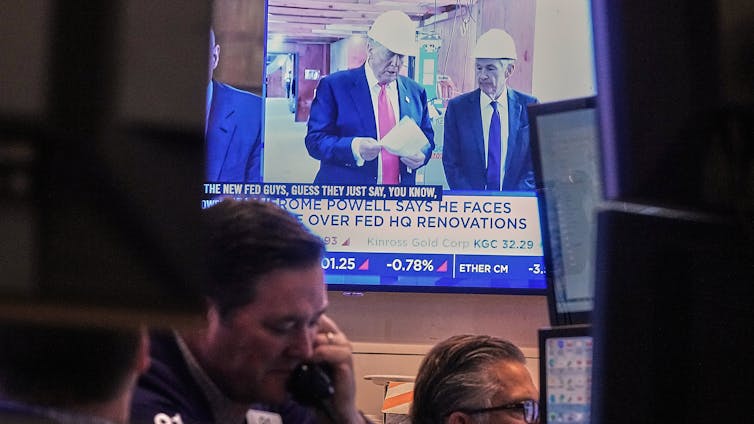
Have we seen the independence of central banks under attack in other countries, or is this uniquely American?
This is not uniquely American, and has happened in countries[14] like Turkey, Venezuela and Argentina. Central bank independence globally has been under attack, but not in democracies or in countries that claim to have strong institutions and rule of law.
References
- ^ has reignited concern (www.bloomberg.com)
- ^ Powell described (www.youtube.com)
- ^ President Donald Trump has long advocated (www.usatoday.com)
- ^ Cristina Bodea (polisci.msu.edu)
- ^ presidents have put a lot of pressure (www.yahoo.com)
- ^ mandate includes low inflation (www.federalreserve.gov)
- ^ clear bipartisan consensus (wtop.com)
- ^ Monetary policy (www.federalreserve.gov)
- ^ is not a credible inflation fighter (www.pbs.org)
- ^ there are debates within the Fed (www.nytimes.com)
- ^ as Trump has urged (www.reuters.com)
- ^ damage the labor market (www.frbsf.org)
- ^ AP Photo/Richard Drew (newsroom.ap.org)
- ^ has happened in countries (www.reuters.com)






