Most US book bans target children’s literature featuring diverse characters and authors of color
- Written by: Katherine Spoon, Ph.D. Candidate in Computer Science, University of Colorado Boulder
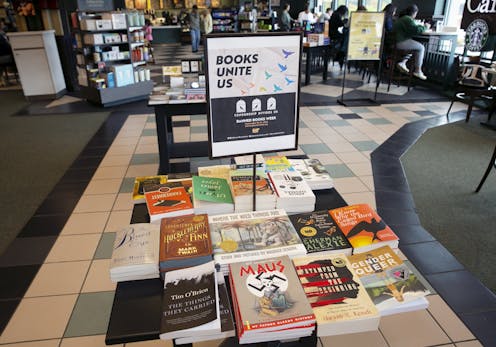
Book bans in U.S. schools and libraries during the 2021-22 school year disproportionately targeted children’s books written by people of color[1] – especially women of color – according to a peer-reviewed study we published. They also tended to feature characters of color.
In addition, we found book bans were more common in right-leaning counties that were becoming less conservative over time.
These findings were based on a comprehensive review of a then-record 2,532 bans that took effect[2] in 32 states during the 2021-22 school year and compiled by PEN America, a nonprofit that defends the freedom of expression. The bans involved 1,643 unique book titles. We combined this with data on counties, sales of restricted books and author demographics.
While much has been written[3] about the rise in book bans[4], there has been little empirical work done on their content, causes and consequences.
In our review, we found that 59% of banned books were children’s books featuring diverse characters or nonfiction books about historical figures and social movements. The top banned books[5] were “Gender Queer: A Memoir[6],” by Maia Kobabe, which was banned by 41 school districts; “All Boys Aren’t Blue[7],” by George M. Johnson, with 29 bans; and “Out of Darkness[8],” by Ashley Hope Pérez, with 24 bans.
What’s more, authors of color – particularly women of color – were far more likely to be banned compared with white authors. Authors of color wrote 39% of the banned books in our study. Women of color alone penned almost a quarter of them. That’s even though authors of color make up just 10% of U.S. authors[9] and write less than 5% of the most popular books in the U.S.
We also found that while most book bans occurred in counties with a Republican majority, they were even more likely to occur in counties where that majority had decreased over the previous two decades. Districts where the majority had increased or grown stronger since 2000 were less likely to ban books.
Why it matters
The number of book bans has only increased since the data from our study came out.
In the 2022-23 school year, PEN America reported 3,362 book bans[10], affecting 1,557 unique titles. And its latest data, released Nov. 1, 2024, shows that the number of book bans soared in the 2023-24 school year to more than 10,000[11], with Florida and Iowa accounting for over 8,000 of them.
While those pushing book bans often claim they are doing so to protect children[12], there is little evidence to suggest[13] that book bans actually shield them from harmful content.
The costs can be high. They’re causing conflict and tension[14] in the local communities where they are occurring, and some estimates put the monetary cost of implementing book bans in the millions of dollars for some states[15]. But because the focus of these bans tends to be on titles featuring characters of color or LGBTQ+ themes, there’s a risk that diverse characters will become even more underrepresented[16] in children’s literature.
This could negatively affect children’s sense of belonging[17] and learning outcomes[18], even in schools not directly affected by these bans.
Book bans – often initiated by school boards, legislators and prison authorities [19] – are one of the most symbolic forms of censorship, but our findings also suggest they are being used as a form of political activism. This means that in addition to the traditional questions around censorship, such as what information children have or don’t have access to, there are questions about the political actions behind book bans and how they might attract or dampen a community’s civic participation.
And given our finding about where these bans are most often occurring and that we found little impact on state and national levels of interest in the targeted books, as measured by Google searches and book sales, it seems that many of these bans amount to symbolic political gestures aimed at galvanizing a shrinking electoral base.
What still isn’t known
Research on book bans is just emerging. Our study is one of the first, in part because of a lack of data about the publishing industry overall. We encourage future work to bring data together about books – to facilitate this, we made much of the data we used[20] public.
The Research Brief[21] is a short take on interesting academic work.
References
- ^ targeted children’s books written by people of color (doi.org)
- ^ 2,532 bans that took effect (pen.org)
- ^ much has been written (www.nytimes.com)
- ^ rise in book bans (www.davidson.edu)
- ^ The top banned books (pen.org)
- ^ Gender Queer: A Memoir (apnews.com)
- ^ All Boys Aren’t Blue (www.buzzfeed.com)
- ^ Out of Darkness (www.axios.com)
- ^ just 10% of U.S. authors (www.bls.gov)
- ^ 3,362 book bans (pen.org)
- ^ more than 10,000 (pen.org)
- ^ they are doing so to protect children (www.courthousenews.com)
- ^ little evidence to suggest (psycnet.apa.org)
- ^ conflict and tension (www.nytimes.com)
- ^ millions of dollars for some states (www.marketplace.org)
- ^ even more underrepresented (www.everyeffortmatters.eu)
- ^ sense of belonging (nyupress.org)
- ^ learning outcomes (www.doi.org)
- ^ school boards, legislators and prison authorities (pen.org)
- ^ the data we used (zenodo.org)
- ^ Research Brief (theconversation.com)