

Mobile payments used to be less ‘painful’ than using cash. That might be changing
- Written by: Carin Rehncrona, PhD Candidate, Department of Service Management and Service Studies, Lund University
The act of handing over hard-earned cash has long been associated with pain[1]. And historically, research has also found that consumers tended to spend less[2] using cash rather than a payment card.
In a study[3] from the early 2000s where consumers were observed using either cash or a pre-paid card, it was shown that those with cash spent less money. This was corroborated in the same study by investigating consumer receipts from a grocery store.
Evidence also suggests that willingness to pay[4] (the maximum amount a consumer is prepared to spend on a product or service) has traditionally been higher for debit cards than cash[5].
The “pain of payment effect” – the psychological discomfort of parting with money in the moment of paying – when associated with cash has been attributed to its physical and tangible characteristics in comparison to credit card payment. It has even been suggested that when payment and consumption happen within a short space of time and paying with cash is more material and visual, the pain of paying[6] clouds the enjoyment of consumption[7].
In fact, the use of physical cash has been shown to activate the pain centre[8] in the brain. However, some researchers are more sceptical and instead put the perception of pain down to a lack of reward response[9] – where the brain associates an action with feelings of pleasure. This response is activated by credit cards[10] far more than by cash.
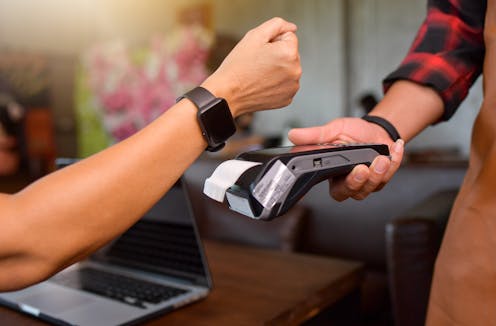
Mobile payment (for example, with a phone or smartwatch) has also been found to affect spending in a similar way to using credit or debit cards. That is, spending tended to be higher when using mobile payments than cash[11]. However, later studies have found this effect between cards or mobile payment and cash becoming weaker with time[12], suggesting that this may be because consumers have become more used to[13] non-cash payment methods.
Another reason may be the notifications about spending and account balances that flash up on a consumer’s watch or phone after payment. One study found that payment notifications can evoke pain of payment[14] in the way that cash has been seen to. That is to say, consumers now tend to spend less when they get digital payment notifications flashing up an amount on their phone.
My own research[15] from Sweden backs up the findings that the pain of paying with cash compared to digital methods has reversed over the years. Cash use[16] is falling in many countries, and Sweden is a particularly cashless society[17], with fewer and fewer stores now accepting notes and coins.
In my study, young consumers between the ages of 20 and 26 kept a diary of their payments. Many revealed that when they paid with cash, they didn’t see it as affecting their overall funds since it didn’t show up on their transaction history or account activity. Also, no alert flashed up on their phone. But when paying with mobile apps, the account activity was more visible and showed up instantly on screen, allowing consumers to keep track of their purchases and account balance.
Some of the participants in the study said things like:
“I seldom use cash, only if I receive it as a gift. Then I try to get rid of it as soon as possible.”
“I have cash in my wallet, but I never consider using it.”
“I’m so bad at keeping track of cash, it’s like free money to me because it doesn’t show up on my bank account.”
Comments like these indicate that for cash to be perceived as real money to a younger demographic, it may need to be transferred into a cashless payment method. This suggests that pain of payment affects the generations differently, depending on habits and technology.

Since previous research has shown that spending levels tend to be higher with cashless methods, it may be that store managers could think about promoting cashless payment. But the flipside of this might be that not accepting notes and coins means they miss out on sales when young consumers want to “get rid” of their cash.
For now, cash in an envelope is still holding out as a Christmas gift tradition to young people from older friends or relatives. But perhaps a digital money gift might be more appropriate if the giver wants it to be experienced as “real” money. Who knows, this might even lead to a more carefully planned purchase of something that will be cherished – rather than an impulse buy at the till.
References
- ^ pain (www.proquest.com)
- ^ spend less (www.jstor.org)
- ^ study (link.springer.com)
- ^ willingness to pay (www.sciencedirect.com)
- ^ debit cards than cash (www.sciencedirect.com)
- ^ pain of paying (www.jstor.org)
- ^ enjoyment of consumption (link.springer.com)
- ^ pain centre (marketing.wharton.upenn.edu)
- ^ reward response (www.simplypsychology.org)
- ^ credit cards (www.nature.com)
- ^ mobile payments than cash (www.sciencedirect.com)
- ^ weaker with time (www.sciencedirect.com)
- ^ more used to (www.sciencedirect.com)
- ^ pain of payment (onlinelibrary.wiley.com)
- ^ research (portal.research.lu.se)
- ^ Cash use (www.dnb.nl)
- ^ cashless society (www.globalgovernmentfintech.com)
- ^ William Barton/Shutterstock (www.shutterstock.com)






