Donald Trump is planning more trade barriers if he becomes president – but they didn’t work last time
- Written by: Mark Johnson, Professor of Operations Management, Warwick Business School, University of Warwick
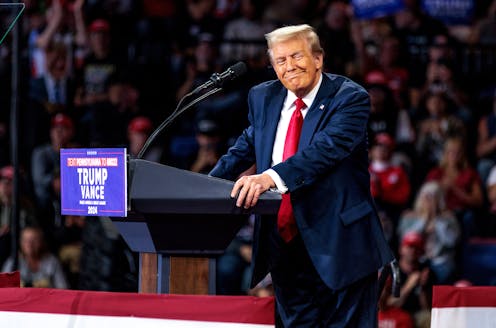
Donald Trump loves tariffs. Making things more expensive if they come from foreign countries is at the heart of his bid for a second term in the White House.
“Tariffs are the greatest thing ever invented,” he said[1] in September 2024 at a town hall event in Michigan. And he has promised that if he becomes US president again, he will impose an across-the-board tariff of up to 20% on imports – and even 200%[2] on cars from Mexico – in a bid to encourage American manufacturing.
This is familiar ground for Trump, who showed he was fond of tariffs[3] during his 2017-2021 presidency. Back then, he claimed his policy would address the trade imbalance with China, bring manufacturing jobs back to the US and raise revenues.
Tariffs were then imposed on a wide range of goods, from imported steel and aluminium, to solar panels and washing machines.
But did they work? Our research[4] suggests not.
In fact, we found that imposing tariffs actually made the US even more reliant on foreign suppliers – and failed to stimulate the domestic job market. They also raised costs for US consumers and provoked retaliatory tariffs from trading partners including China, the EU, Canada, Mexico, India and Turkey.
China for example, responded by trebling tariffs[5] on American cars. The EU filed a dispute with the World Trade Organisation and substantially raised tariffs[6] on US exports including Harley Davidson motorcycles, jeans and bourbon whiskey.
And Trump’s tariffs did not lead to a boost for US manufacturing either. After tariffs were imposed, our research[7] shows US manufacturing supply chains evolved to have fewer suppliers – but it was often US firms that got forced out of those supply chains, not their competitors from overseas.
We found that US manufacturers appeared to reduce their global reach, while actually increasing their dependence on a select few foreign companies – further evidence that Trump’s tariffs failed to produce the intended outcome.
Our research also suggests that “reshoring” – bringing production and manufacturing back to a company’s home country – is not feasible without an established ecosystem of suppliers, intermediaries and customers. So introducing trade barriers without adequate support for the development of regional supply chains is unlikely to result in stronger local economies or more jobs.
Essentially, for reshoring to work, the domestic economy needs to have the capacity to match demand. But the US (like the UK[8]) has lost manufacturing capability[9] in many areas, and rebuilding it is not going to happen overnight.
Establishing a new industry requires buildings, skilled staff and supply chains – and a very specific approach is required for each industry. Getting the right skills and labour is often the trickiest part and may require immigration.
However, even this may not work in the most complex industries. In the case of computer chips, for example, there are generous incentives[10] in the US under the Biden administration to encourage chip manufacturing. Yet Taiwan still massively dominates[11] the market, raising questions over whether the US could ever really compete.
Other industries that can use automation and robotics in manufacturing (such as chemicals and transportation equipment) might be easier to reboot, but they may not generate the expected number and range of jobs. And often reshoring strategies[13] involve higher investment in automation, machinery and robotics, rather than jobs. Trump’s focus may have been bringing back manufacturing jobs back to the US, but the truth is that many of these jobs may be gone forever.
Overall then, imposing tariffs without adequate domestic support mechanisms in place has led to US manufacturers increasing their dependence on foreign suppliers and reducing their dependence on local ones.
Yet tariffs are not exclusively favoured by Trump – or even right-wing politics. And there seems to be a fairly common view among politicians in the west[14] that some tariffs can be an effective economic tool.
Trade barriers against China for instance, have continued under Joe Biden’s administration (although he has somewhat relaxed tariffs for imports from the EU, Canada and Mexico). And recently, Canada imposed 100% tariffs[15] on Chinese cars and 25% on Chinese steel and aluminium, while the EU has also imposed tariffs[16] on Chinese goods.
One of the few voices speaking out against tariffs belongs to former US vice-president Mike Pence. He recently proposed[17] scrapping tariffs, saying they just made products more expensive for consumers – and failed to improve prosperity.
His old boss clearly disagrees. And if Trump does win a second term in office, it seems certain that imposing international tariffs will be high up on his “to do” list. But if their impact is anything like the last time, they will be of little benefit to the US economy or the voters who depend upon it.
References
- ^ he said (apnews.com)
- ^ even 200% (www.reuters.com)
- ^ fond of tariffs (theconversation.com)
- ^ Our research (www.emerald.com)
- ^ trebling tariffs (www.fastmarkets.com)
- ^ raised tariffs (www.bbc.co.uk)
- ^ our research (www.emerald.com)
- ^ the UK (www.independent.co.uk)
- ^ lost manufacturing capability (www.mckinsey.com)
- ^ generous incentives (arstechnica.com)
- ^ massively dominates (theconversation.com)
- ^ Smit/Shutterstock (www.shutterstock.com)
- ^ reshoring strategies (sloanreview.mit.edu)
- ^ politicians in the west (theconversation.com)
- ^ imposed 100% tariffs (www.bbc.co.uk)
- ^ imposed tariffs (www.cnbc.com)
- ^ recently proposed (www.newsweek.com)