

AI is peeling back the layers of ‘low-value’ work – NZ may be well placed to adapt
- Written by: Kenny Ching, Senior Lecturer, Business School, University of Auckland, Waipapa Taumata Rau
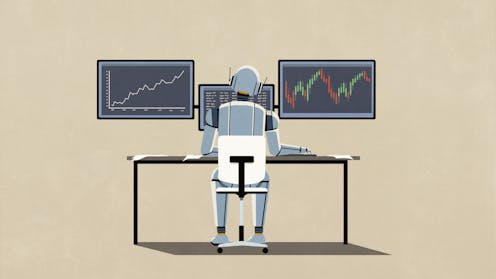
As generative artificial intelligence (AI) advances at breakneck speed, it is upending assumptions about which jobs are “safe” from automation.
Disruption now extends well beyond manual or routine work into white-collar roles once considered untouchable. Tools such as ChatGPT, Claude and Midjourney can produce policy briefs, analytical reports, software code, design assets and marketing copy in seconds.
Even in specialised domains, systems such as PolicyPulse[1] can generate structured briefs and thematic syntheses – tasks that once required teams of experts.
If AI can so easily replicate large swaths of professional output, how much of the economy rests on work that creates the appearance of value rather than tangible impact?
And could New Zealand – anchored in sectors rooted in physical work, human judgement and essential services – be structurally better placed to thrive?
AI’s exposure effect
A 2023 Goldman Sachs report[2] estimated generative AI could automate work equivalent to 300 million full-time jobs globally. The highest exposure is in administrative, legal and other information-heavy sectors.
In 2024, the International Monetary Fund warned[3] that economies reliant on high-skilled services – such as education, law and finance – face both job losses and rising inequality.
This echoes author David Graeber’s concept of “bullshit jobs[4]” – roles that add little genuine value. Between 2000 and 2018, most net job growth[5] came from low productivity service sectors such as marketing, consulting and corporate administration. These are precisely the kinds of tasks AI can now perform in seconds.
Consultancy firm McKinsey estimates[6] 60–70% of activities in office support, customer service and professional services can be automated. The OECD has noted[7] routine information processing jobs face the greatest risk. AI is not only replacing roles – it is revealing how insubstantial many of them were.
Some argue finance illustrates this reality starkly: intended to allocate capital efficiently, the sector has expanded beyond its productive purpose.
Businessman Adair Turner famously called much of it “socially useless[8]”, while research[9] from the Bank for International Settlements found oversized financial sectors can stifle innovation by diverting talent from more productive areas.
Now, AI is automating functions[10] such as risk modelling, compliance and equity research, prompting a reassessment of the sector’s true economic value.
New Zealand’s real-economy advantage
New Zealand – often caricatured as a remote, agrarian outpost – may be structurally insulated from the worst of the AI shock. Roughly 70% of its exports[11] come from agriculture, horticulture, seafood and forestry.
Domestically, leading employment sectors[12] include aged care, physiotherapy, plumbing, childcare and early childhood education.
These roles require physical dexterity, sensory judgement and human empathy – skills AI cannot yet credibly replicate.
In an era when many advanced economies are over-invested in finance, bureaucracy and “bullshit jobs”, New Zealand’s focus on tangible, value-producing work could be a strategic strength.
Innovation in these sectors is happening too[13]. Robotic milking systems have improved dairy efficiency and animal welfare, biosecurity monitoring safeguards exports, and forestry research is targeting carbon neutral timber.
If finance reveals how AI strips away illusions, higher education shows its disruptive power. Generative AI can now produce essays[14] credible enough to pass as human work.
The humanities tend to reward theoretical fluency and stylistic polish – areas where AI excels. By contrast, science, technology, engineering and mathematics – the so-called STEM subjects – demand precision, formal logic and testable hypotheses, which are harder for AI to mimic. OECD data[15] has shown STEM-related occupations face the lowest automation risk.
New Zealand’s recent investment in STEM education[16] is timely. But it must be matched by support for primary and secondary teachers – roles grounded in mentorship and adaptive instruction[17], which remain beyond AI’s reach.
A global pivot
Service-heavy economies such as Singapore, Britain and parts of the United States face growing pressure to adapt[18].
Researchers[19] warn that reliance on low-productivity, routine service work risks long-term stagnation unless economies pivot to innovation-led sectors.
New Zealand’s base in agriculture, manufacturing, trades and essential services offers comparative resilience – but only if reinforced by investment in measurable innovation and productivity.
New Zealand’s advantage lies not in chasing abstract, easily automated work, but in deepening its strengths in sectors AI cannot yet touch – food production, care and infrastructure.
These are industries where value is measured in what is grown, built, repaired and cared for – not in presentation slides.
As AI redraws the contours of global labour markets, every country must ask: if a job can be done by an algorithm, was it ever as significant as we believed?
For New Zealand, the answer may be to double down on the work that cannot be coded – turning what once looked like a structural constraint into a defining strength.
References
- ^ PolicyPulse (arxiv.org)
- ^ 2023 Goldman Sachs report (www.goldmansachs.com)
- ^ International Monetary Fund warned (www.imf.org)
- ^ bullshit jobs (www.simonandschuster.com)
- ^ most net job growth (www.nber.org)
- ^ McKinsey estimates (www.mckinsey.com)
- ^ OECD has noted (www.oecd-ilibrary.org)
- ^ socially useless (www.theguardian.com)
- ^ research (www.bis.org)
- ^ AI is automating functions (www.businessinsider.com)
- ^ Roughly 70% of its exports (www.mpi.govt.nz)
- ^ leading employment sectors (www.mbie.govt.nz)
- ^ Innovation in these sectors is happening too (www.science.org)
- ^ can now produce essays (www.newyorker.com)
- ^ OECD data (www.oecd.org)
- ^ recent investment in STEM education (www.engineeringnz.org)
- ^ roles grounded in mentorship and adaptive instruction (www.interest.co.nz)
- ^ face growing pressure to adapt (www.imf.org)
- ^ Researchers (www.nzherald.co.nz)
Authors: Kenny Ching, Senior Lecturer, Business School, University of Auckland, Waipapa Taumata Rau






