Switching off from work has never been harder, or more necessary. Here's how to do it
- Written by: Jane Gifkins, Researcher, Centre for Work, Organisation and Wellbeing, Griffith University
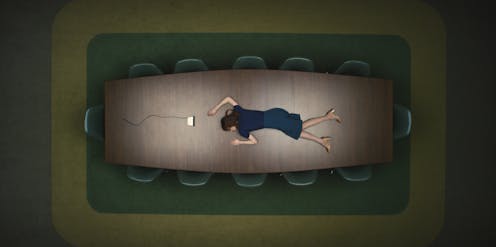
In the hit dystopian TV series Severance[1], employees at biotech corporation Lumon Industries find it easy to separate work and home life. A computer chip is inserted in their brains to act as a “mindwipe”. They leave all thoughts of home behind while at work, and completely forget about their work when at home.
While the show explores the pitfalls of such a split in consciousness, there’s no denying it’s a tantalising prospect to be able to “flick the off switch” and forget about work whenever you’re not actually supposed to be working.
This is known as “psychological detachment[2]”. People who can do it are happier and healthier, and experience less fatigue. But many of us struggle to detach and disconnect mentally from work, particularly when our jobs are demanding and stressful.
It may not be enough simply to be physically away from work, particularly in an era when so many of us work from home. We also have to stop thinking about work when we’re not there – whether it’s fretting over your to-do list while out at dinner, thinking about your unanswered emails while you’re at your daughter’s soccer game, or lying in bed pondering what you’ll say at tomorrow’s board meeting.
The art of detachment
Your choice of activity outside work can be crucial to this process of psychological detachment. To learn more about what strategies are most effective, my research surveyed nurses who were working shifts in hospital emergency departments in 2020, a highly stressful work environment.
My colleagues and I collected data from 166 nurses, using a survey called the Recovery Experience Questionnaire[3]. This included collecting information about the underlying psychological experiences associated with home-time activities, such as feeling relaxed while reading a book or going for a walk.
Importantly, our survey results[4] also showed nurses who were better able to forget about work had less fatigue and better physical and mental health.
Read more: How running can help you cope with stress at work[5]
Our results identified three key strategies that helped our survey participants to reduce fatigue and mentally recover from work:
- exercise
- spending time with family and friends
- leisure pursuits.
The physical benefits of exercise are well known. But exercising – whether it’s doing yoga, going for a run or playing netball – also brings mental benefits by encouraging you to focus deeply on what you’re doing rather than dwelling on outside thoughts.
Friendship and social connection are also good for our wellbeing[7]. Research suggests people who have plenty of friends and confidants are less likely to die from chronic disease. And one study found people who undertake a difficult task with the help of a friend have fewer abrupt changes in heart rate[8] than those who tackle the task alone.
Deliberately making time to spend with family, friends or pets can help us forget about work at home, and to centre our attention instead on what is important to us besides work.
Many of the nurses in our study reduced the effects of fatigue during home time by pursuing hobbies and interests such as sewing or gardening. But you shouldn’t worry too much about what specific activity you pursue – the main thing is to pick something you find pleasurable and engaging, and which fits comfortably around your existing commitments.
Read more: 10 Australian companies have embraced the 4-day week. Here's what they say about it[9]
Leave your work at work
Finally, switching off from work also means not letting your work come home with you. Where possible, complete all your daily tasks so these aren’t on your mind at home. Unplug from work-related technology by not checking work emails or texts.
Of course, technology and working from home have now made separating work and home even harder. But setting healthy routines can help put mental as well as physical boundaries around your work time – even when your workplace is in the next room.
References
- ^ Severance (tv.apple.com)
- ^ psychological detachment (psycnet.apa.org)
- ^ Recovery Experience Questionnaire (kops.uni-konstanz.de)
- ^ survey results (doi.org)
- ^ How running can help you cope with stress at work (theconversation.com)
- ^ CC BY (creativecommons.org)
- ^ good for our wellbeing (www.apa.org)
- ^ fewer abrupt changes in heart rate (journals.lww.com)
- ^ 10 Australian companies have embraced the 4-day week. Here's what they say about it (theconversation.com)
Authors: Jane Gifkins, Researcher, Centre for Work, Organisation and Wellbeing, Griffith University