What Is PE100? HDPE Pipe Grade Meaning, Properties & Ratings
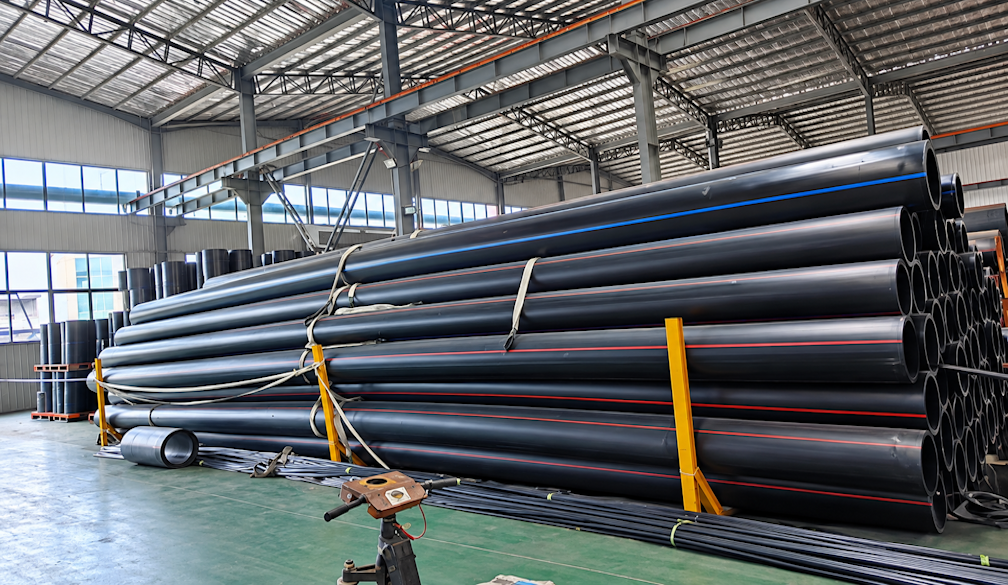
PE100 is the HDPE grade with a Minimum Required Strength of 10 MPa — the modern standard for pressure pipe. Here’s what PE100 means, how it compares with PE80, PE63 and PE4710, how SDR/PN ratings work, and where it is used.
If you have specified, bought or laid HDPE pipe, you have seen “PE100” stamped on the wall. But the designation is more than a product code. It tells you the exact long-term strength the resin is certified to, which in turn sets the wall thickness and pressure rating of every pipe made from it.
This guide explains what PE100 means, where the number comes from, how it compares with older PE80/PE63 grades and the North American PE4710 designation, and how to read its SDR and PN ratings — the knowledge you need to specify or verify PE100 pipe correctly.
What does PE100 actually mean?
PE100 stands for polyethylene with a Minimum Required Strength of 10.0 MPa. The “100” is simply the MRS multiplied by ten, a naming convention fixed by ISO 12162.
So:
PE100 = MRS 10.0 MPa
PE80 = MRS 8.0 MPa
PE63 = MRS 6.3 MPa
It is a classification of the raw polyethylene compound, not a brand. Any resin that passes the relevant classification tests can be called PE100.
The MRS value is not a short-term tensile number. It is the hoop stress the material can safely withstand for 50 years of continuous internal water pressure at 20 °C, obtained by pressure-testing samples over thousands of hours and extrapolating the failure curve to 50 years using the regression method in ISO 9080.
Dividing the MRS by the design coefficient — typically 1.25 for water under ISO 4427 — gives the design stress used to calculate the pipe’s pressure rating:
Design stress = MRS ÷ design coefficient
For PE100:
10.0 ÷ 1.25 = 8.0 MPa
Decoding the name: PE100 → PE (polyethylene) + 100 (MRS 10.0 MPa × 10). A 50-year, 20 °C long-term strength of 10 MPa is what separates PE100 from earlier polyethylene grades — and why PE100 pipe can use a thinner wall than PE80 for the same pressure.
PE100 vs PE80 vs PE63: the polyethylene grades
Three MRS-classified grades appear in ISO 4427. PE63 is effectively obsolete for pressure pipe. PE80 is still used for smaller-diameter gas mains and some legacy systems. PE100 is the current standard for virtually all new municipal water and gas pressure pipe, because its higher strength allows a thinner wall to carry the same pressure — saving material, weight and cost.
Table 1 — ISO 4427 polyethylene grades and long-term strength
|
Grade |
MRS (MPa) |
Design stress for water (MPa) |
Status today |
|---|---|---|---|
|
PE63 |
6.3 |
5.0 |
Legacy — largely obsolete for pressure pipe |
|
PE80 |
8.0 |
6.3 |
Still used for gas and small-diameter mains |
|
PE100 |
10.0 |
8.0 |
Current standard for pressure water and gas pipe |
The three properties that define PE100
A resin only qualifies as PE100 when it balances three long-term properties simultaneously. A compound can be strong in one and fail in another; PE100 has to satisfy all three.
1. Minimum Required Strength — 10 MPa
This is the 50-year, 20 °C hydrostatic strength that the “100” refers to. It is the number that sets the pressure rating.
2. Slow Crack Growth resistance
SCG resistance is the resistance to slow, brittle cracks that can quietly end the life of older polyethylenes at points of stress concentration. The PE100-RC grade raises this dramatically for no-sand-bed, trenchless and rocky-trench installation.
3. Rapid Crack Propagation resistance
RCP resistance is the ability to arrest a fast-running crack instead of letting it unzip along the pipe. This matters most for large-diameter gas and high-pressure water mains.
PE100 vs PE4710: the same pipe, two rating systems
Buyers working across ISO and North American projects often ask whether PE100 and PE4710 are different materials. They are not — they are broadly equivalent grades classified under two different systems.
PE100 is the ISO/EN designation, based on MRS in MPa.
PE4710 is the ASTM/PPI designation, where the digits encode density class, slow-crack-growth class and a hydrostatic design stress of 1000 psi with a 0.63 design factor at 23 °C.
In practice, a modern bimodal resin is often dual-listed as both PE100 and PE4710.
For the same wall thickness — the same DR/SDR — the ASTM method may yield a more conservative pressure rating than the ISO method because the two systems apply different design coefficients and reference temperatures. That does not mean the resin is weaker. Always compare on the same standard before concluding that one product “rates higher”.
PE100-RC: the crack-resistant grade
PE100-RC (“Resistant to Cracking”) is a PE100 that additionally passes stringent slow-crack-growth tests, such as the notched-pipe test and the Full-Notch Creep Test.
Because it tolerates point loads from stones and uneven bedding, PE100-RC allows sand-bed-free trench installation and trenchless methods such as horizontal directional drilling, pipe bursting and sliplining — cutting excavation cost.
It carries the same MRS and pressure ratings as standard PE100. The difference is durability under mechanical stress, not pressure capacity.
How PE100 pressure rating works: SDR and PN
PE100 is one grade, but it is sold in a range of pressure classes set by wall thickness.
SDR — Standard Dimension Ratio — is the ratio of outside diameter to wall thickness. A lower SDR means a thicker wall and a higher pressure rating.
PN — Nominal Pressure — is the allowable continuous working pressure in bar at 20 °C.
Because PE100 has a fixed design stress of 8.0 MPa for water under ISO 4427, each SDR maps to a specific PN.
Table 2 — PE100 SDR to PN at 20 °C, per ISO 4427
|
SDR |
Wall vs OD |
PN at 20 °C |
Typical use |
|---|---|---|---|
|
SDR 41 |
1 / 41 |
PN 4 |
Gravity / very low pressure |
|
SDR 33 |
1 / 33 |
PN 5 |
Low-pressure drainage and gravity lines |
|
SDR 26 |
1 / 26 |
PN 6.3 |
Low-pressure mains, drainage |
|
SDR 21 |
1 / 21 |
PN 8 |
Low-pressure distribution |
|
SDR 17 |
1 / 17 |
PN 10 |
Distribution water mains |
|
SDR 13.6 |
1 / 13.6 |
PN 12.5 |
Medium-pressure mains |
|
SDR 11 |
1 / 11 |
PN 16 |
Trunk mains, gas, general pressure |
|
SDR 9 |
1 / 9 |
PN 20 |
High-pressure / pumped lines |
|
SDR 7.4 |
1 / 7.4 |
PN 25 |
Mining slurry, high static head |
Key point: Above 20 °C, the PN must be derated. Always confirm derating factors with the pipe manufacturer and the applicable standard
How PE100 HDPE pipe is manufactured
PE100 pipe is made by extrusion. Virgin PE100 resin — typically bimodal, from producers such as Borealis, SABIC, Sinopec or PetroChina — is melted, forced through an annular die, sized under vacuum, cooled in water baths and cut or coiled.
Carbon black is added for UV protection in black pipe, or co-extruded stripes identify the service. The extrusion stage sets the outside diameter and wall thickness — and therefore the SDR and pressure class — so tight process control here is what keeps every metre within ISO 4427 / EN 12201 tolerance.
Where PE100 pipe is used
PE100’s combination of leak-free fused joints, corrosion immunity, flexibility and long design life makes it the default material for a wide span of buried and marine infrastructure:
Potable water trunk and distribution mains
Fuel-gas distribution
Mining and tailings slurry lines
Agricultural and drip irrigation
Dredging and marine outfalls
Industrial process water
Cable-duct systems
Choosing the PE100 grade and pressure class
A practical selection logic looks like this:
Fuel gas, mining slurry, or sub-zero ground? → PE100, with yellow compound for gas where required.
No sand bedding, trenchless or rocky trench? → PE100-RC.
Buried water main up to PN10? → PE100 SDR17.
Trunk main, gas or general PN16? → PE100 SDR11.
High static head or slurry at PN20–25? → PE100 SDR9 to SDR7.4.
These are starting points. Final selection should account for maximum operating pressure, surge, temperature derating and the weakest component in the system.
Common misconceptions about PE100
“PE100 and HDPE are different materials.”
They are not. PE100 is a grade of HDPE. “HDPE” names the polymer family; “PE100” names its certified long-term strength class within that family.
“A higher SDR number means a stronger pipe.”
The opposite is true. A higher SDR means a thinner wall relative to diameter and therefore a lower pressure rating. SDR11 (PN16) is thicker and stronger than SDR17 (PN10).
“PE100 and PE4710 are incompatible.”
They are broadly equivalent grades under two rating systems — ISO/EN versus ASTM/PPI. Any difference in stated pressure comes from different design coefficients, not from a different resin.
“PE100 can’t handle high pressure.”
PE100 is rated to PN25 and beyond in low-SDR walls, and routinely carries mining slurry at higher static heads than PVC can sustain.
PE100 in one paragraph
PE100 is the high-density polyethylene grade certified to a 50-year, 20 °C long-term strength of 10 MPa. That strength, combined with slow- and rapid-crack-growth resistance, allows PE100 pipe to run thinner walls, fully fused leak-free joints and a long service life — which is why it has become the world standard for pressure water and gas pipe. When you specify PE100, you then select the SDR/PN class for your working pressure, and choose PE100-RC where the installation is tough on the pipe wall.
PE100 glossary
PE100
Polyethylene resin grade with a Minimum Required Strength of 10.0 MPa — the modern standard for HDPE pressure pipe. Broadly equivalent to PE4710 in the North American ASTM/PPI system.
MRS — Minimum Required Strength
The 50-year, 20 °C long-term hydrostatic strength of the resin in MPa, derived by ISO 9080 regression and classified by ISO 12162. MRS × 10 gives the PE grade name.
SDR — Standard Dimension Ratio
Ratio of pipe outside diameter to wall thickness. A lower SDR means a thicker wall and a higher pressure rating.
PN — Nominal Pressure
The allowable continuous working pressure of the pipe in bar at 20 °C. For PE100, each SDR corresponds to a fixed PN — for example, SDR11 = PN16.
PE100-RC
A PE100 with enhanced resistance to slow crack growth, allowing sand-bed-free and trenchless installation at the same pressure rating.
PE4710
The ASTM/PPI designation broadly equivalent to PE100: density class 4, slow-crack-growth class 7, and a hydrostatic design stress of 1000 psi with a 0.63 design factor at 23 °C.
FAQ
Is PE100 the same as HDPE?
PE100 is a grade of HDPE. HDPE is the polymer family; PE100 is a specific long-term strength classification within that family.
What does SDR11 mean?
SDR11 means the outside diameter is 11 times the wall thickness. In PE100, SDR11 typically corresponds to PN16.
Is PE100 stronger than PE80?
Yes. PE100 has a higher MRS — 10.0 MPa versus 8.0 MPa — so it can carry the same pressure with a thinner wall, or a higher pressure at the same wall thickness.
Is PE4710 the same as PE100?
They are broadly equivalent but classified under different systems. PE100 is the ISO/EN designation; PE4710 is the ASTM/PPI designation.
When should I use PE100-RC?
Use PE100-RC where the pipe will be installed without sand bedding, in rocky trenches, or by trenchless methods, or where enhanced slow-crack-growth resistance is required.
Can PE100 be used above 20 °C?
Yes, but the pressure rating must be derated. Above about 40 °C, HDPE is generally not recommended for pressure service without specialist review.


 Business Daily Media