HDPE vs PVC Pipe: A Practical Guide to Choosing the Right Material
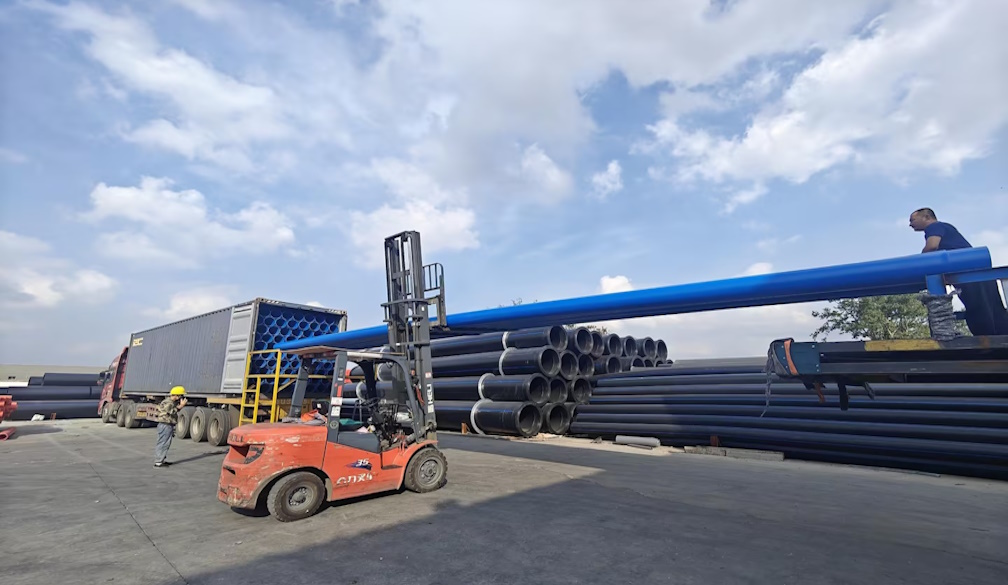
If you're looking for pipe for a water main, a slurry line, or a chemical plant, you've probably narrowed it down to two names: HDPE and PVC. They're the two most common plastic pipe materials on the planet, and both are solid, corrosion-free alternatives to ductile iron and steel. But they behave very differently once they're in the ground—and picking the wrong one can mean tearing up a fifty-year asset five years in.
This guide breaks down the real differences between PE100 HDPE and Schedule 40/80 PVC—pressure ratings, joint integrity, abrasion resistance, joining methods, and lifecycle cost—so you can match the material to what your project actually needs.
What Is HDPE Pipe?
HDPE pipe is extruded from PE100 (or PE4710 in North America) resin—high-density polyethylene with a long-chain molecular structure that gives it toughness, flexibility, and near-total chemical inertness. It's available from DN12 mm up to DN2000 mm, with pressure ratings from PN4 to PN25. If you're sourcing material at scale, working with an experienced HDPE pipe manufacturer makes it easier to match grade, SDR, and certification to your project specs.
What sets HDPE apart is how it's joined. Butt fusion and electrofusion create a homogeneous, monolithic weld that's actually stronger than the pipe wall itself. No gaskets, no rubber rings, no leak paths. That single property explains why HDPE dominates trenchless installations, mining slurry lines, gas distribution, and anywhere ground movement, freeze-thaw cycles, or long unsupported spans would stress a bell-and-spigot joint.
What Is PVC Pipe?
PVC pipe is extruded from rigid polyvinyl chloride compound. The main industrial variants are PVC-U (unplasticised), CPVC (chlorinated), and PVC-O (bi-axially oriented). PVC is stiffer than HDPE, handles higher temperatures (CPVC goes up to 95°C), and produces slightly lower friction loss. Sizes typically run DN16 mm to DN630 mm, with pressure ratings from PN6 to PN16.
PVC joints come in three flavours: solvent welding (chemically fused sockets), rubber-ring sealed bell-and-spigot (the workhorse for sewerage and large-diameter water), and threaded connections. Solvent-welded joints are strong but brittle. Rubber-ring joints go in fast but depend on gasket integrity over decades—which is where things get interesting.
The Ten Properties That Actually Matter
Here's how PE100 HDPE stacks up against PVC-U and CPVC across the specs most B2B buyers care about. Values vary by grade and manufacturer; the figures below reflect typical Primepoly production.
|
Property |
HDPE (PE100) |
PVC-U / CPVC |
What It Means in Practice |
|---|---|---|---|
|
Density (g/cm³) |
0.95 |
1.40 |
HDPE is ~30% lighter—easier to handle on site |
|
Tensile strength (MPa) |
22 |
50 |
PVC is stiffer; HDPE flexes without cracking |
|
Service temperature (°C) |
−40 to +60 |
0 to +60 (PVC-U) / −20 to +95 (CPVC) |
CPVC is the only one for hot water |
|
Pressure rating |
PN4–PN25 |
PN6–PN16 |
HDPE handles higher pressures |
|
Joining method |
Butt fusion / electrofusion |
Solvent weld / rubber ring |
Fusion = no leak paths |
|
Joint integrity |
Stronger than parent pipe |
Strong but brittle |
HDPE survives ground movement |
|
Chemical resistance |
Excellent vs acids, alkalis, salt |
Good vs acids; weaker vs ketones/aromatics |
HDPE has wider compatibility |
|
UV resistance |
Carbon-black formulated |
Stabiliser additives required |
Both fine above ground if specified |
|
Service life |
50–100 years |
50–100 years |
Both are half-century materials |
|
Recyclability |
Fully recyclable |
Recyclable but more complex |
HDPE is simpler at end-of-life |
Which Material for Which Application
The right answer is almost never "always HDPE" or "always PVC." It's about matching the material to what the application is actually doing. And in fusion-joined HDPE systems, the pipe is only half the story—the HDPE fittings (elbows, tees, reducers, stub ends) must be rated to the same PE100 grade and fused with the same certified procedure, or the monolithic joint advantage disappears at the connection point. Here's the quick-pick guide for the eight most common B2B project types.
|
Application |
Go With |
Why |
|---|---|---|
|
Municipal potable water main |
HDPE PE100 |
Leak-free fusion joints, 50+ year life, NSF/ANSI 61 certified |
|
Indoor cold water plumbing |
PVC-U or PP-R |
Lower cost, easy solvent-weld install |
|
Indoor hot water |
CPVC or PP-R |
PVC-U softens above 60°C—CPVC won't |
|
Sewerage / drainage |
PVC-U |
Smooth bore, rubber-ring sockets, lower cost |
|
Gas distribution |
HDPE PE100 (yellow/orange) |
ISO 4437; most gas codes prohibit PVC outright |
|
Mining slurry / tailings |
HDPE PE100 |
Abrasion resistance, monolithic joints, no leaks |
|
Irrigation main lines |
HDPE or PVC |
HDPE if mobile/coiled; PVC if static field |
|
Industrial chemical process |
CPVC |
Higher temperature and corrosion resistance |
The Real Cost Conversation
On paper, PVC-U runs about 15–25% cheaper per metre than HDPE in DN50–DN200 sizes. That's a real number, and for a straightforward static installation it's hard to argue with.
But total cost of ownership tells a different story. AWWA M55 data shows HDPE's fusion joints cut non-revenue water losses by 80–95% compared with gasketed-joint pipe. Over a 50-year service life, that up-front premium turns into a deep operational saving—especially in arid regions where every lost cubic metre carries a scarcity cost.
The Plastics Pipe Institute's 2018 white paper found HDPE potable water mains had a median repair frequency 25× lower than ductile iron or PVC over 30 years. Run the math on your project: if the value of avoided downtime plus leak repair exceeds 25% of your pipe spend, HDPE pays for itself inside a decade.
Five Mistakes That Cost Real Money
1. Specifying PVC for a buried gas line. Most national gas codes prohibit PVC for fuel gas distribution. Only HDPE PE100 (yellow) is approved. This one gets caught at inspection—or worse, doesn't.
2. Using PVC-U for hot-water service. PVC-U softens above 60°C. If your line runs hot, spec CPVC or PP-R. No exceptions.
3. Skipping fusion-welder operator certification. ISO 12176-3 / DVS 2207 certification is what makes HDPE joints reliable. Uncertified joints are the single biggest source of HDPE field failures—and they're entirely avoidable.
4. Underspecifying SDR for high-static-head water mains. SDR17 (PN10) handles typical city pressure fine. But pumping head plus surge can push you to SDR11 (PN16). Run the surge calculation—don't guess.
5. Mixing materials without proper transition fittings. HDPE-to-steel-flange transitions need a stub-end, backing flange, and the correct gasket. HDPE-to-PVC needs a compression coupling rated for both. Skipping this step is how you get a leak at the tie-in.
The Verdict
For most pressure-pipe applications—municipal water, gas, mining, irrigation main lines, fire mains—HDPE is the safer long-term bet. The fusion joints don't leak, the pipe flexes with the ground, and the 15–25% material premium pays back inside a decade through reduced repair and water-loss savings.
For low-pressure indoor plumbing, drainage, sewerage, and anywhere rubber-ring sockets make sense, PVC remains a cost-effective choice with a proven 50-year track record. CPVC covers the hot-water gap that PVC-U can't.
The right answer is rarely "always one or the other." It's matching the material to what the application is actually doing—and now you've got the data to do it.


 Emma Fawcett, CEO of Compare Club