Why is ‘compliance’ more crucial than ‘craftsmanship’ when installing HDPE pipes in Australia?
If you were to ask a site manager who has worked on water supply projects in Australia what the most challenging aspect of HDPE pipework is, they would most likely not say ‘welding technique’, but rather ‘prove it to me’.
This represents a fundamental difference from the logic of experience in China. On domestic construction sites, there is greater reliance on the intuition and experience of skilled craftsmen, whereas in Australia, the superintendent requires destructive test reports for test welds, the welder’s current certification number, and the marking on the pipe indicating compliance with AS/NZS 4130. Without these, No matter how beautiful the welding is, it won't pass the test.
Taking into account Australia’s climate, geography and market realities, the perennial issues in HDPE installation—joint failure, pipe buoyancy and backfill defects—need to be re-examined. Choosing the right supplier is the first step in ensuring this compliance framework works effectively.
Joint quality: in Australia, this is a ‘qualification issue’ rather than a ‘skill issue’
In China, joint leaks are typically attributed to improper operator technique or incorrect parameter settings. In Australia, the prerequisites for addressing this issue are far stricter: operators must hold valid certification recognised by an Australian Registered Training Organisation (RTO); welding parameters must comply with PIPA’s POP001 (electrofusion) or POP003 (hot-melt) guidelines; and trial welds must be carried out on-site with records retained.
Points to note for contractors: Welders’ licences must be valid and cover the method being used (hot-melt/electrofusion); destructive testing of trial welds must not be omitted, as this is a prerequisite for the supervisor’s approval; when connecting to existing pipe networks, first confirm whether the old pipes are made of early-generation grades prone to embrittlement; where necessary, use flanged transitions rather than direct hot-melt fusion.
Pipe Uplift and Backfilling: Lateral Support is the Key to Flexible Pipes
The core principle of the Australian standard AS/NZS 2566.2 is that buried flexible pipes rely on the passive resistance of the surrounding soil to resist vertical loads. The pipe forms a ‘pipe-soil interaction’ through moderate deformation, rather than relying on the rigidity of the pipe wall to bear the load. Therefore, in the Australian context, ‘compacted backfill’ precisely means that the backfill material at the pipe axillary angle and along the pipe sides must provide the modulus assumed in the design.
Geographical conditions amplify the risks associated with this issue. Major projects in Sydney, Melbourne and Brisbane are often situated in coastal or estuarine areas, where the water table is high and the density of HDPE is lower than that of water; once water accumulates in the trench, pipe buoyancy is almost inevitable. Meanwhile, in the areas surrounding Perth and the mining regions of Western Australia, expansive soils or native soils with low modulus of elasticity are present. Research indicates that if the modulus of the in-situ soil is conservatively estimated at just 2.5 MPa, the trench width must be four times the pipe diameter to meet lateral support requirements. If excavation is carried out to standard widths without a geotechnical assessment, long-term pipe deformation may exceed permissible limits.
The Queensland Government’s installation guidelines also provide a specific figure: PE pipes must be surrounded by a layer of sand or fine-grained soil of no less than 75 mm, and no hard objects must be in contact with the pipe wall. This is a minimum requirement, not a recommendation.
Points to note for contractors: Obtain a geotechnical report prior to commencing works to confirm whether the in-situ soil modulus meets the design assumptions; pipe axillary angles must be backfilled with sand or fine-grained material; the use of stones to elevate the pipes is strictly prohibited; immediately after pipe installation, backfill symmetrically and apply ballast, whilst ensuring dewatering of the trench is maintained throughout the entire process.
The Australian Sun: The Hidden Cost of Black Pipes
On domestic construction sites, caution regarding the exposure of pipes to direct sunlight usually amounts to little more than ‘do not leave them out for too long’. In Australia, this is insufficient.
Black PE pipes have a solar absorption rate of approximately 96 per cent. Under open-air conditions in mining areas of Queensland or Western Australia, the surface temperature of the pipes far exceeds the ambient air temperature. This implies two things: accelerated ageing during storage, and a reduction in pressure rating when installed above ground or overhead. If high-temperature derating is not applied during the design phase, the selected SDR may fail to meet the nominal pressure at operating temperatures.
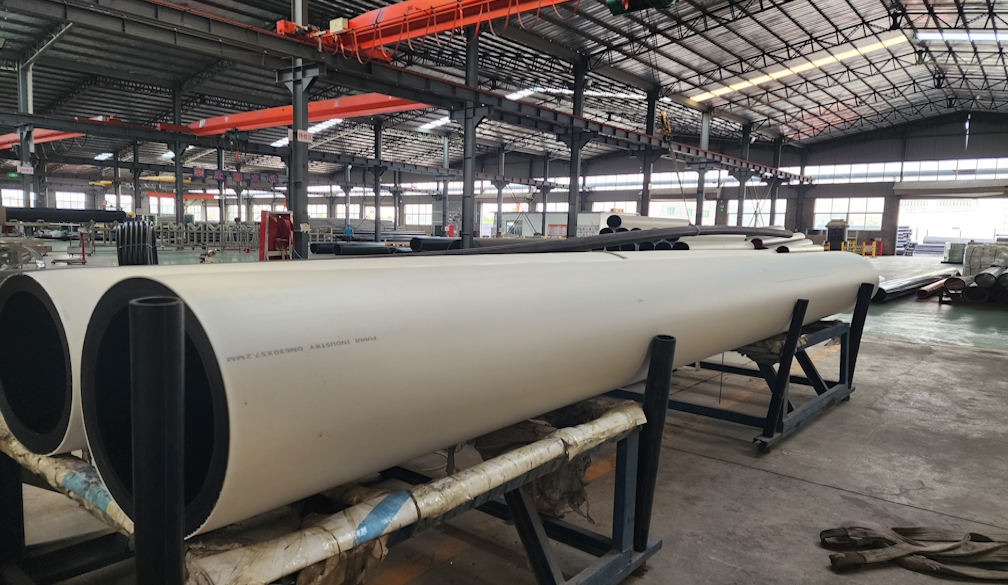
The Australian market offers a solution to this issue: HDPE pipes with a white co-extruded outer layer, which reflect UV radiation significantly better than pure black pipes, reducing the absorption rate to around 42 per cent. Puhui’s co-extruded white pipes are specifically designed to meet this need; the outer white layer enhances UV resistance, whilst the inner layer retains the mechanical and hygienic properties of PE100/PE100RC, in compliance with the AS/NZS 4130 standard.
Points to note for contractors: Assess the degree of surface ageing in pipes stored outdoors before use; prioritise white pipes or pipes with a light-coloured outer layer for above-ground installation; for black pipes used in high-temperature conditions, the pressure rating must be verified after applying the appropriate derating factor; rolling pipes into trenches is strictly prohibited, as scratches on Australian gravelly ground may serve as the starting point for slow-growing cracks.
Pressure testing: Temperature variations are specified in the standards
In China, the most frequently mentioned aspect of the pressure testing process is venting. Australian standards place additional emphasis on the fact that the installation of PE pipes must account for thermal expansion and contraction under temperature variations of at least 35°C. This means that the timing of pressure testing and final backfilling is critical. If pipes are welded and secured in the early morning when temperatures are low, and then restricted from expanding during the afternoon when temperatures are high, compressive stress will develop in the pipe walls; conversely, tensile stress will develop, increasing the risk of the joints being subjected to tensile forces.
Points to note for contractors: endeavour to complete final backfilling at a time close to the daily average temperature; during pressure testing, record both the water temperature inside the pipe and the ambient temperature to avoid inflated readings caused by exposure to direct sunlight; ensure the pressure stabilisation period is sufficient to allow the pipe temperature to equilibrate with the ambient temperature before making a judgement.
Why PUHUI INDUSTRY is worth considering at this stage
The solution to the above issues relies half on on-site management and half on the material itself being able to withstand regulatory scrutiny.
Australian water supply projects have very specific requirements for PE pipes: AS/NZS 4130 marking, WaterMark certification (for drinking water applications), clear PE grade identification (PE100 or PE100-RC), and traceable production batch information. If the pipe markings are incomplete at the time of procurement, the supervising engineer has the right to refuse acceptance.
PUHUI’s approach to this aspect is particularly pragmatic. Its HDPE product range complies with the AS/NZS 4130 standard, whilst its co-extruded white pipe series is designed for Australia’s high-UV environment, featuring a UV-resistant outer layer and an inner layer available in either PE100 or PE100-RC. In terms of certification, PUHUI holds SAA (Standards Australia) certification, as well as multiple international certifications including NSF 61 (drinking water systems), WRAS (UK drinking water) and FM 1613 (fire protection). For purchasers required to submit certification documents to Australian project supervisors, SAA is the directly applicable accreditation.
In terms of production, PUHUI’s factory in China covers an area of approximately 68,000 square metres, with a combined annual production capacity of around 200,000 metric tonnes of HDPE and PVC. Pipe diameters range from 20 mm to 1,800 mm, with SDR ratings from SDR6 to SDR33. This means that everything from DN20 coiled pipe to DN1,800 straight pipe can be supplied from a single source, reducing the risk of specification mismatches associated with multiple suppliers.
One noteworthy detail: PUHUI is the first HDPE pipe factory in mainland China to obtain FM 1613 certification. For Australian clients involved in fire safety or mining projects, FM certification holds practical value in the context of insurance and risk assessment. Furthermore, the factory accepts third-party audits, and audit reports from BV, SGS and DNV can be used to meet the supplier qualification requirements of certain Australian buyers.
Selection recommendations: If the project is located in high-UV areas of Queensland or Western Australia, prioritise the co-extruded white pipe series; if the project involves drinking water, confirm the alignment between NSF 61 and WaterMark (supplementing SAA certification with WaterMark is a common approach); if working with Australian supervisors, request copies of the AS/NZS 4130 batch test reports and SAA certificates in advance to accompany the shipment.
To Sum it Up: When working with HDPE in Australia, the minimum requirements for on-site management are ‘certified welders, test weld reports and sand backfill’, whilst the minimum requirements for the material itself are ‘AS/NZS 4130 marking on the pipes and credible certification documents’. PUHUI’s value lies not in replacing local Australian brands, but in providing a option that stands up to scrutiny by supervisors for projects requiring comprehensive compliance documentation, a wide range of specifications and a price point acceptable for Chinese-manufactured products.


 Business Daily Media