Repair or Replace Your Hot Water System? The Decision Most Adelaide Homeowners Get Wrong
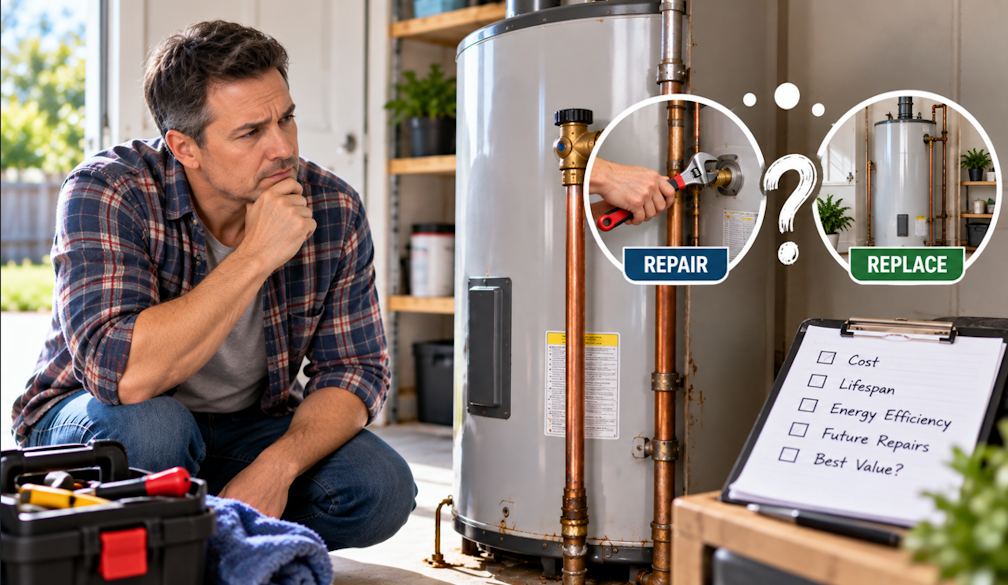
When a hot water system starts leaking, loses capacity or needs another repair, homeowners often feel pushed toward one of two extremes. One person wants the cheapest possible repair because the unit still works. Another assumes any fault in an older heater means immediate replacement.
Neither approach is automatically right. The better decision comes from looking at the system as an asset with a remaining service life, not just the cost of today's callout.
For households comparing hot water system replacement Adelaide options, the most expensive mistake is often making the decision on age alone. A younger unit with a serious tank failure may be poor value to repair, while an older unit with a replaceable external component can sometimes continue working reliably. Condition, fault type, history and suitability all matter.
Do not start with "How old is it?" Start with "What has actually failed?"
Age is useful context, but it does not diagnose a system. A leaking connection, faulty valve or failed control is very different from a corroded storage cylinder that has begun leaking through the tank body.
Ask the plumber to identify the failed component and explain whether the underlying vessel or appliance is still sound. If the fault is external and parts are available, repair may be straightforward. If the core of the system has lost integrity, spending money around the edges can delay the inevitable without changing the outcome.
The same logic applies to continuous-flow units. A replaceable sensor or service issue is different from multiple major components failing on an obsolete model.
Look at the repair history, not just the current invoice
A single repair can be sensible. Three repairs in eighteen months tell a different story.
Pull out previous invoices if you have them. Note what was replaced, how long the repair lasted and whether the current problem is related. Repeated work on the same system can indicate declining reliability even when each individual job looks reasonable in isolation.
This is where homeowners sometimes fall into the "sunk cost" trap. Money already spent on earlier repairs is gone. It should not force you to spend more simply because you want to justify the previous work. The relevant question is what today's repair is likely to buy you from this point forward.
Compare the system with the household you have now
A hot water system can be mechanically healthy and still be wrong for the home.
Perhaps a two-person household has become a family of five. Maybe a second bathroom was added. A large bath is now used regularly, or morning routines create several showers within one hour. If the existing storage capacity or recovery rate no longer matches demand, repairing it perfectly may still leave the household dissatisfied.
The opposite can also happen. Downsizers may be maintaining a large older system that heats more water than they realistically need. Replacement creates an opportunity to reconsider capacity and energy source rather than automatically installing the closest equivalent.
A useful hot water replacement Adelaide discussion should therefore include usage patterns, not just the dimensions of the old unit.
Efficiency matters, but calculate it realistically
Newer technology can reduce energy use, but "more efficient" does not mean every replacement immediately pays for itself. Upfront cost, energy tariffs, household demand, installation requirements and expected ownership period all influence the numbers.
Start with evidence. Compare energy bills across similar seasons. Consider whether usage has changed. If an ageing system is taking longer to heat, losing hot water through a leaking valve or struggling to maintain temperature, its operating cost may be part of the case for replacement.
But avoid replacing a sound unit solely because one unusually high bill arrived. Have the plumbing and appliance checked, then compare realistic running costs for suitable alternatives.
Consider what a breakdown would mean for your household
Reliability has a value that is easy to overlook until the water turns cold.
For a single person with flexible routines, an unexpected failure may be inconvenient but manageable. For a household with young children, elderly residents, a home-based business or limited ability to arrange access at short notice, reliability may deserve greater weight.
If an older system is showing several warning signs and parts are becoming harder to obtain, planned replacement can be easier than waiting for complete failure. You can compare products, choose a suitable installation date and avoid making decisions under pressure.
Do not forget the installation around the heater
A replacement is not simply swapping one box for another. Pipework, valves, temperature control, electrical supply, gas supply, flue arrangements, drainage and installation location may all affect what is appropriate.
South Australian rules also require licensed tradespeople for relevant plumbing, gas and electrical work, with compliance documentation required for certain installations. That matters because the quality of the installation can influence safety and performance just as much as the brand on the unit.
A replacement quote should explain what is included and whether any existing parts of the installation need upgrading or correction.
A simple decision framework works better than guessing
Repair usually deserves serious consideration when the fault is clearly identified, the core system is sound, parts are readily available, the unit suits current demand and the repair restores reasonable confidence in reliability.
Replacement becomes more persuasive when the tank or major assembly has failed, significant faults are stacking up, previous repairs are becoming frequent, the system no longer suits household needs, or a planned change offers a clear practical benefit.
There is also a middle ground: investigate first. Sometimes a plumber cannot make a responsible recommendation until testing confirms whether the leak is from a connection or the cylinder, whether poor performance comes from a failed component or undersizing, and whether the apparent heater problem is actually elsewhere in the plumbing.
Make the decision before the system makes it for you
The goal is not to keep an old heater forever, nor to replace equipment at the first sign of trouble. It is to spend money where it produces the best combination of reliability, safety, suitability and reasonable running cost.
If your system has begun needing attention, ask for the condition to be explained in plain language. Compare the likely life of the repair with the cost and benefits of replacement. For homeowners considering hot water system replacement Adelaide, that conversation is far more useful than a rule based only on age.
A planned decision also gives you something a breakdown does not: time. Time to compare options, confirm installation requirements and choose a system that suits the way your household actually lives.


 Business Daily Media