Why Gross Vehicle Weight Is Not the Only Number That Matters for Heavy Loads
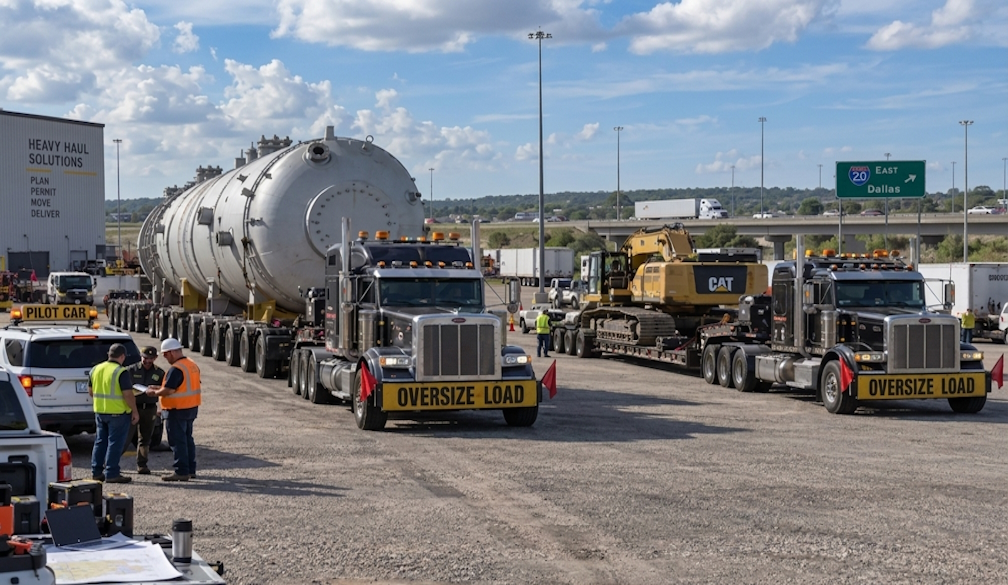
A shipper says the machine weighs 60,000 pounds. Dispatch adds the truck and trailer and gets the expected gross weight. Useful number, but it still does not tell the whole story.
Heavy-load rules are concerned with more than what the entire combination weighs. Where those pounds sit matters too. Two trucks can show the same gross weight on a scale while putting very different loads on their axles. For permitting, that difference can be important.
Two Trucks, Same Weight, Different Problem
Gross vehicle weight is the combined weight of the tractor, trailer, cargo and equipment traveling with them. It is an obvious place to start when planning a heavy move, which is probably why it sometimes gets more attention than everything underneath it.
Imagine two combinations at 100,000 pounds. One spreads that weight across more axles and a longer configuration. The other carries the same total on fewer or more closely spaced axles. The number at the top is still 100,000, but the road does not see those trucks in quite the same way.
Individual axle and axle-group limits have to be considered along with the total. Axle spacing matters as well. Simply adding another axle is not a magic fix if the resulting configuration still fails to meet the requirements that apply to the trip.
Cargo weight alone is even less useful. A 60,000-pound excavator becomes part of a much heavier combination once it is sitting on a lowboy behind a tractor. Planning from the machine’s weight and filling in the rest later is an easy way to end up with bad numbers.
Loading Position Can Shift Thousands of Pounds
A machine does not always sit exactly where early planning assumed it would. Loading crews may move it forward or backward to improve balance, create clearance or secure it properly. That movement can shift weight from one axle group to another.
The cargo’s center of gravity makes visual estimates unreliable. A large machine may look centered on the trailer while carrying much more of its mass toward one end.
Before a heavy move, several figures need to make sense together:
- gross vehicle weight;
- axle and axle-group weights;
- axle count and spacing;
- the tractor and trailer being used;
- final loaded dimensions.
This is also where last-minute equipment changes can cause trouble. If the planned trailer is unavailable and another one takes its place, the cargo has not changed, but its weight distribution might. Paperwork prepared around the first configuration should not automatically be assumed to cover the second.
Why Bridges Make Axle Details Matter
A bridge does not experience a 100,000-pound truck as one block of weight arriving at once. The load reaches the structure through individual axles as the vehicle moves across it.
How much each axle carries and the distance between axles therefore become relevant. This helps explain why a heavy-load route may require more scrutiny than simply finding roads wide enough for the truck.
It also explains a situation that can confuse shippers. A similarly heavy machine may have traveled to the same jobsite last month, yet the next carrier receives different routing. The previous truck could have used another trailer, different axle spacing or a different distribution of weight.
When applying for overweight permits, carriers should have accurate information about the complete configuration rather than only a cargo weight and estimated total. At higher weights, those details can influence whether a particular route is available at all.
Trailer Choice Changes the Numbers
Heavy-haul equipment is selected partly around weight distribution. More axles can spread a load, while specialized trailers give carriers additional options for unusually heavy freight. But changing the trailer can also change overall length, axle spacing and other measurements used for permitting.
That is why the equipment decision and permit planning work better when they happen together. Dispatch can provide cargo specifications, the hauling configuration can be chosen, and the relevant weights can be worked out before the truck is sitting at pickup waiting to leave. Carriers that need help arranging permits across jurisdictions can find permit services here.
Gross weight still matters. It just cannot answer every question by itself.
For a heavy move, the more useful picture comes from looking at the total alongside the axles carrying it. A truck may be acceptable on gross weight and still have an axle problem, while changing the equipment or cargo position can produce a completely different result. In heavy hauling, what is underneath the weight can matter nearly as much as the number on the scale.


 Business Daily Media