What an outdoor dog kennel has to get right before a dog will choose to use it
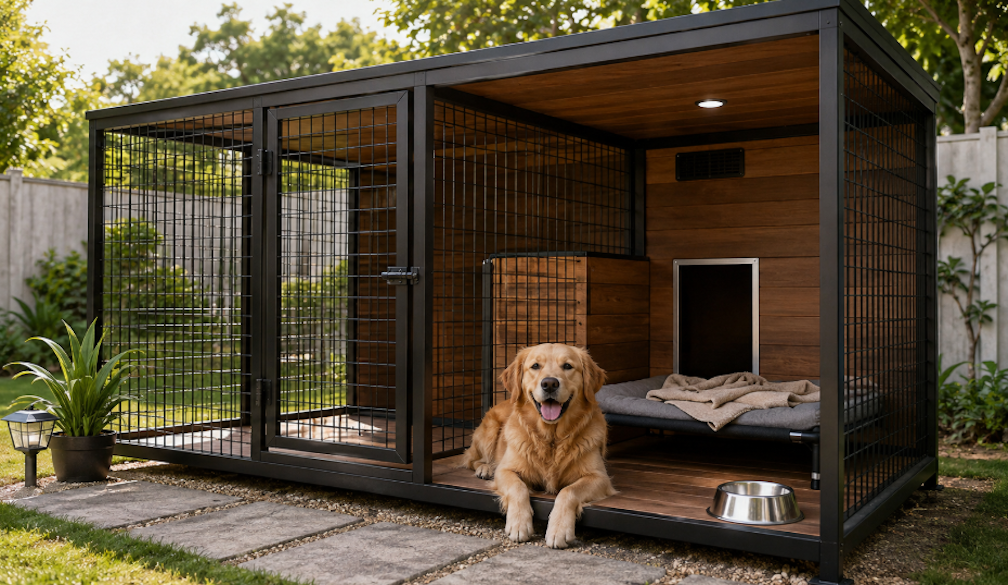
Spring is when outdoor housing stops being theoretical
Australian spring arrives quickly. Days that were mild in August become genuinely hot by October, and anything a dog spends time in outdoors has to work in both. An outdoor dog kennel put up in September is being tested against the summer that follows, not the weather it was built in.
That timing matters because the failures are seasonal. A structure that is perfectly comfortable in spring can become unusable in January, and the dog will simply stop going in.
The occupant decides whether it works
This is the fact that governs every other decision: nobody puts the dog inside. The dog walks in, or it lies somewhere else — under the house, against a wall, wherever it has found that works better.
An outdoor dog kennel that is not used is not a cheap kennel, whatever it cost. So the design question is not whether it provides shelter but whether it provides shelter the animal prefers to the alternatives already available in the yard.
Shade and heat are two different problems
Shade blocks direct sunlight. It does nothing about the air temperature underneath, and a shaded space with no air movement can be hotter than open ground in shade with a breeze.
This is why cover material matters less than the combination of cover and openness. A large outdoor dog kennel with a solid roof and mesh sides gives shade while letting air cross the space. The same footprint enclosed on all sides becomes an oven, because the heat that enters has nowhere to leave.
Why dogs cannot cool themselves the way people do
Humans sweat across the whole skin surface. Dogs largely cannot, and rely instead on panting, which cools by evaporating moisture from the airways.
That mechanism depends entirely on air movement and on the surrounding air being drier than the animal. In still, humid air, panting becomes progressively less effective, which is why airflow is not a comfort feature in Australian conditions but the actual cooling system.
The ground under the kennel does more than the roof
A dog lying down is in contact with the ground across most of its body, and conduction moves far more heat than air does. That makes the floor surface one of the strongest levers available.
Concrete stays cool in shade and becomes painful in sun. Bare earth stays cooler but turns to mud and holds parasites. Raised slatted or mesh flooring keeps the animal off the ground entirely and lets air pass underneath, which is why it appears on most well-designed runs.
Drainage belongs in the same decision. Ground that holds water after rain stays damp under the animal for days, and damp bedding does more harm over a season than a single hot afternoon. A slight fall across the base, or a raised floor that drains freely, removes the problem rather than managing it.
Materials classified by how they fail
Comparing kennels by size hides the differences that emerge after a summer:
- Galvanised frame: rusts only where cut or drilled
- PE cover: cheap shade, degrades under ultraviolet
- Timber: warm, absorbs moisture, harbours parasites
Each fails on a different timescale. Steel frames fail at cut edges and fastener holes where the coating was breached. Polyethylene covers fail by becoming brittle and tearing along stress lines after a couple of Australian summers. Timber fails where it stays damp.
Knowing which failure you have bought tells you which maintenance actually pays back, and covers in particular should be treated as consumables rather than permanent parts.
Galvanising is worth understanding for the same reason. Zinc protects steel by corroding in its place, and that protection is applied at the factory across the whole surface. Every hole drilled on site cuts through it, which is why rust on an outdoor dog kennel starts at fixings and cut edges rather than in the middle of a panel.
Size is about behaviour, not just fitting
A kennel large enough for the dog to lie in is not large enough for the dog to use well. Animals need to be able to change position, move away from soiled areas, and choose between sun and shade within the space.
A large dog kennel outdoor arrangement that includes both a covered section and an open run lets the animal self-regulate, which is exactly what it will do given the option. That choice is the difference between a shelter and an enclosure.
Why an insulated dog kennel can work against you here
An insulated dog kennel is genuinely useful where nights are cold, because it slows the loss of the animal's own heat. In most of Australia the more common problem runs the other way.
Insulation slows heat transfer in both directions. A well-insulated box that has warmed up during the day stays warm into the evening, long after the outside air has cooled. Ventilation is what resolves this, since it replaces the trapped air rather than merely slowing its heating.
Security and escape are the same design question
Dogs test enclosures at the seams: gate latches, panel joins, the gap under the bottom rail. A panel system is only as strong as the fixings between panels, and the ground line is where determined animals concentrate their efforts.
The two failure directions are worth separating. Something getting out is usually a latch or a ground gap. Something getting in — which matters for snakes and other dogs — is usually mesh aperture. They call for different fixes and are easy to confuse.
Placement is the quiet variable behind both. A run positioned against a fence gives the animal a boundary to patrol and something to react to all day, while one set back from the boundary is markedly calmer. The same panels, moved three metres, can change the behaviour they produce.
Sun path matters just as much and is easy to get wrong in spring. A spot shaded at nine in the morning may be in full sun by two, and the September sun sits far lower than the one the kennel will face in January.
Where kennel design is heading
Two shifts are visible. Cover materials are improving, with better ultraviolet stabilisation extending useful life well beyond the early generation of polyethylene. Modular panel systems are also becoming the norm, which lets a run be extended or reconfigured rather than replaced when circumstances change.
The principle has not moved, and the guidance from TMG Industrial makes the same case. Get shade, airflow and the ground surface right, then let the dog tell you whether you succeeded — it either uses the space or it does not.


 Business Daily Media