The Business Case for Self-Hosted vs Cloud-Based Trading Platforms
Understanding the Core Differences in Infrastructure
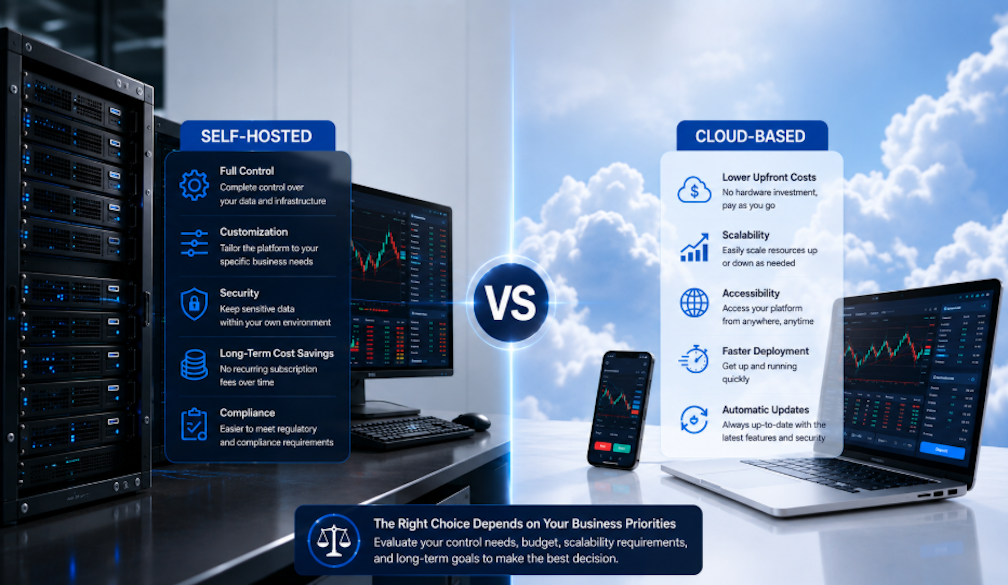
The financial technology sector is experiencing rapid evolution, forcing brokerage firms to make critical decisions about their underlying infrastructure. When launching or scaling a brokerage, executives face a fundamental choice regarding their trading engine. They must decide between utilizing a shared cloud-based service or deploying a self-hosted infrastructure. This decision impacts every aspect of the business, from daily operational costs to long term enterprise valuation.
A cloud-based trading platform operates on servers owned and managed by a third party provider. The broker essentially rents space on this shared infrastructure. This model is attractive because it requires minimal technical expertise to set up. The provider handles server maintenance, software updates, and basic security protocols. For a startup brokerage with limited capital, a cloud solution offers a fast, relatively cheap entry point into the market.
Conversely, a self-hosted model means the brokerage controls the physical or virtual servers where the trading engine resides. The software is deployed within the broker's own secure environment, completely isolated from other companies. This approach requires a higher level of technical capability and often involves larger upfront costs. However, it provides absolute control over the system architecture, data flow, and execution logic.
The debate between these two models centers on the classic trade off between convenience and control. Cloud platforms offer convenience, while self-hosted platforms offer control. As a brokerage grows from a small startup into a mid-sized financial institution, the limitations of convenience often become apparent. Executives must carefully weigh their current resources against their long term strategic goals when making this foundational technology choice.
Data Ownership, Security, and Regulatory Compliance
In the modern financial industry, data is the most valuable asset a brokerage possesses. Client trading histories, deposit records, and personal identification documents are highly sensitive. When a broker uses a shared cloud platform, they are entrusting this critical data to a third party. While reputable cloud providers employ strong security measures, the fundamental reality remains that the broker does not have absolute, exclusive access to their own databases.
This lack of absolute control presents significant risks. If the cloud provider experiences a security breach, the broker's client data is compromised, leading to severe reputational damage. Furthermore, relying on a third party complicates regulatory compliance. Financial regulators in jurisdictions like the UK and the EU enforce strict rules regarding data localization and privacy. Proving compliance is much harder when your data sits on shared servers hosted in multiple, undisclosed locations.
To mitigate these risks, many growing brokerages are migrating to a Self Hosted trading platform. By deploying the software within their own dedicated environment, the broker retains full ownership of every piece of data. They can implement custom encryption protocols, restrict access at a granular level, and guarantee exactly where the data is stored geographically. This level of control makes passing regulatory audits significantly easier and provides clients with a stronger assurance of privacy.
Beyond security, data ownership directly impacts business valuation. If a brokerage seeks acquisition or external investment, potential buyers will scrutinize the technology stack. A company that fully owns its infrastructure and databases is inherently more valuable than one that relies entirely on a rented, shared system. Complete data sovereignty transforms a brokerage from a simple marketing operation into a robust, independent financial technology firm.
Performance, Latency, and Execution Reliability
The speed at which a trading platform executes orders directly affects a broker's profitability and client retention. In active markets, prices change in milliseconds. High latency leads to slippage, where a client's order is filled at a worse price than expected. When traders experience consistent slippage, they close their accounts and move to a competitor. Therefore, execution reliability is not a luxury; it is a strict business requirement.
Cloud-based platforms often struggle to guarantee ultra-low latency during periods of extreme market volatility. Because the infrastructure is shared among dozens or hundreds of different brokers, a sudden spike in trading volume from one broker can slow down the entire system. This "noisy neighbor" effect means your clients might suffer execution delays simply because another company on the same server is experiencing heavy traffic. You have no control over this shared resource allocation.
A self-hosted environment eliminates the noisy neighbor problem entirely. The servers are dedicated exclusively to your brokerage. You can allocate computing resources exactly where they are needed, ensuring that the matching engine always operates at peak efficiency. This isolation guarantees consistent, low latency execution, regardless of what is happening in the broader market. Fast, reliable execution builds trust with professional traders, who often trade in higher volumes and generate more revenue for the broker.
Furthermore, a self-hosted setup allows for custom hardware optimization. A broker can choose to host their servers in specific data centers located physically close to major liquidity providers in London or New York. This physical proximity reduces network latency to the absolute minimum. While setting up dedicated servers requires technical planning, the resulting performance advantage provides a massive competitive edge in a crowded marketplace.
Customization, Scalability, and Long-Term Costs
As a brokerage matures, its operational needs become more complex. A successful firm will eventually want to integrate custom payment gateways, proprietary risk management algorithms, or specialized reporting tools. Cloud-based platforms are generally rigid. Providers offer a standardized product that works for the average user, but they rarely allow deep, structural modifications. If you need a specific feature that the provider does not offer, you simply cannot have it.
Self-hosted platforms offer an open, extensible architecture. Because you control the environment, your internal development team can modify the software, build custom plugins, and integrate third party applications without restriction. This flexibility allows you to tailor the platform precisely to your unique business model. You can create specialized account types, adjust commission structures dynamically, and build a trading environment that perfectly matches your target audience.
Scalability is another crucial factor. When a cloud-based broker experiences rapid growth, they often face steep, unpredictable increases in subscription fees. Providers typically charge based on active users or trading volume, meaning your technology costs scale linearly with your success. This pricing model eats into profit margins just as the business begins to gain real traction.
In contrast, a self-hosted model offers highly predictable long term costs. While the initial setup requires capital expenditure, the ongoing operational costs are largely fixed. Adding ten thousand new users to a self-hosted system primarily requires adding more server capacity, which is relatively inexpensive. The software licensing fees do not penalize you for growing your client base. Ultimately, the business case for a self-hosted platform is clear: it transforms technology from a variable, escalating expense into a fixed, controllable asset that drives long term enterprise value.


 Blackhawk Network VP Head of ANZ Kieran Nolan