The Paperwork Problem Nobody Budgets For When Taking a Business Offshore
Ask any owner who has taken an Australian business into a foreign market what surprised them, and you'll hear the usual suspects: tax, logistics, hiring. Almost nobody says translation. Yet I've watched more expansion timelines slip on paperwork than on freight. A Brisbane food exporter I know spent eight months negotiating a distribution agreement with a partner in Hamburg, got the commercial terms over the line, then lost another six weeks because nobody had asked a basic question: in what language does this contract actually need to exist?
The answer, for anything that might end up in front of a German court, was German. Not a courtesy German version knocked up by the partner's office manager. A proper legal translation, with someone taking professional responsibility for its accuracy. That job wasn't in the budget. It wasn't in the project plan. It existed in nobody's head until a lawyer in Hamburg raised it, politely, at the worst possible moment.
This is the pattern. Translation requirements don't announce themselves at the start of an international push. They surface late, attached to deadlines, usually discovered by the receiving side — a registrar, a court, a procurement office, an immigration case officer. And because they surface late, they get treated as an emergency instead of a line item. The businesses that handle this well sort out a provider early rather than scrambling at the deadline — firms like Protranslate.net, one of the leading names in certified document translation, have built their whole operation around exactly this scramble, working under ISO 17100 (the international standard for translation services) for a customer base that now runs past 85,000 businesses and individuals across 163 countries. The demand is that broad because the problem is that common.
Why "my colleague speaks Spanish" doesn't work
Here's the distinction that catches most SME owners off guard. Standard business translation — marketing material, emails, a website — can be done by anyone competent. Your bilingual sales manager. A freelancer. Even machine translation with a careful human edit, for low-stakes material.
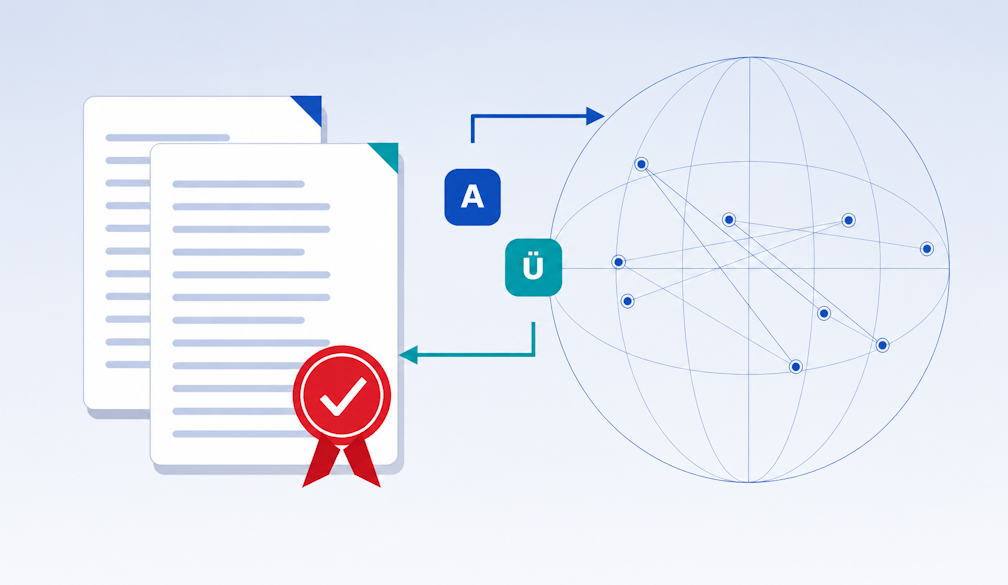
Certified translation is a different animal. When a foreign authority asks for a certified (or "sworn", in many civil-law countries) translation, they are not asking for accurate words. They're asking for accountability. A certified translation comes with a signed statement — sometimes a stamp, sometimes a sworn translator's official seal, depending on the country — in which a qualified translator attests that the translation is complete and faithful to the original. In Germany, France, Spain, Turkey and much of Europe, only translators admitted by a court or ministry can produce one. The document is the translator's professional neck on the line.
Which is why your colleague's excellent Spanish doesn't satisfy the Madrid commercial registry, and why an AI tool never will, however good the output reads. There's no one to hold responsible. No signature, no standing, no recourse. Authorities reject uncertified translations not because they doubt the words but because there's nobody behind them.
Where it bites: five scenarios that keep repeating
The exporter signing in Europe is the classic case. German courts work in German; if your distribution agreement ends up in dispute, the German-language version is what gets argued over. Sensible contracts include a prevailing-language clause — a line stating which version wins if the two texts diverge. Plenty of SME contracts don't. I've seen a dispute where the English draft said exclusivity applied "within the territory" and the German version could be read as extending beyond it. Two years of legal fees, over one translated preposition. A certified translation done properly at signing, and a clear prevailing-language clause, would have cost a few hundred dollars.
Incorporating a subsidiary abroad is the second. Register a company in Poland, the UAE or Vietnam and the registrar wants your constitutional documents, ASIC extracts, board resolutions and directors' passports or ID documents — all in the local language, all certified. Miss one, or submit an uncertified version, and the application sits in a queue until you fix it. Every week of delay is a week you can't open a bank account, sign a lease or put staff on payroll.
Government tenders are the least forgiving. A foreign procurement office publishing a tender in Portuguese wants your responses, financial statements and compliance certificates in Portuguese, certified, by the closing date. There are no extensions for translation delays. Companies discover the requirement on page 40 of the tender documents, ten days before close, and either pay rush rates or walk away from the contract.
Then there's intellectual property. Trademark and patent filings through national offices demand certified translations of priority documents and specifications, and patent translation errors are close to impossible to repair after grant — in some jurisdictions a mistranslated claim simply narrows your protection, permanently.
The one that surprises people most runs in the other direction: bringing overseas talent in. Sponsor a skilled worker and their home-country documents — degree certificates, police clearances, birth and marriage certificates — must reach the Department of Home Affairs in English, translated by an accredited translator. A Perth engineering firm I spoke with last year had a sponsorship application stall for a month because a Ukrainian diploma had been translated by a family member. Perfectly accurate, completely inadmissible.
What it actually costs, and how long it takes
The good news is that this is one of the cheaper problems in international expansion — when it's planned. Certified translation is priced per word or per page, and for common language pairs a standard corporate document runs to tens of dollars per page, not hundreds. A full incorporation pack might land somewhere in the hundreds; a lengthy commercial contract, perhaps more, depending on the language pair and technicality. Rarer pairs cost more. Legal and patent work sits at the top of the range.
Turnaround is days, not weeks. A birth certificate or police check can often come back certified within 24 hours; a 30-page agreement in three or four business days. Rush service exists but costs a premium — which is the whole argument for booking translation into the project timeline instead of paying panic rates at the deadline. The expensive version of this problem is never the translation itself. It's the six weeks of stalled registration, the missed tender, the visa application returned for rework.
Getting ahead of it
A short checklist worth pinning to any expansion plan:
- Ask the receiving authority first. Requirements vary wildly by country — sworn translator, notarisation, apostille, or a simple certification letter. Confirm exactly what the registrar, court, or case officer will accept before commissioning anything.
- Put translation in the budget and the timeline. List every document the expansion will touch — contracts, corporate documents, IDs, certificates — and cost the translation up front, with a week or two of buffer.
- Keep your source documents consistent. Company names, director names and addresses must match across every document, character for character. A middle name present on one certificate and absent on another can trigger a rejection all by itself.
- Use a provider who signs their work. The attestation is the product. Choose a translator or agency that takes formal responsibility for accuracy and is recognised in the destination country — and keep their certification with the original, because you'll be asked for both.
- Nail down the prevailing language. Any bilingual contract should say, in both versions, which text governs. Your lawyer will thank you.
None of this is glamorous. But the international expansions that run smoothly are, almost without exception, the ones where somebody treated documents as infrastructure rather than admin. Markets are opening faster than ever for Australian SMEs — trade agreements with the UK, India and the Gulf have cut the tariff barriers, which means the remaining friction is procedural. The owners who map their paperwork the way they map their supply chain will be signing in Hamburg while their competitors are still waiting on a stamp.