The return to the office is really a return to quiet
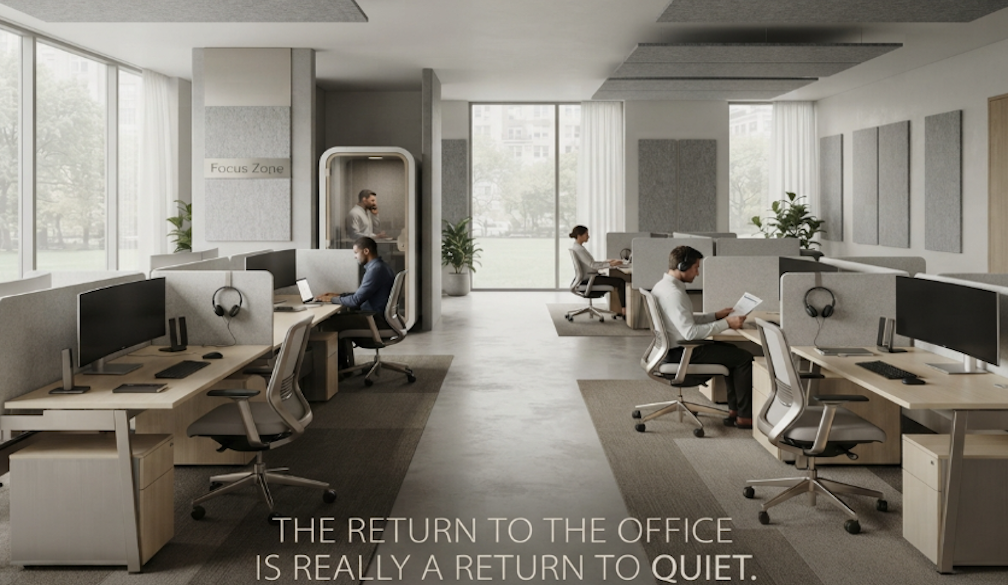
Getting people back to the office is not a policy problem, it is a design problem. Staff will return for a workplace that beats home, and the thing home does best is quiet. The businesses winning the return-to-office argument are the ones redesigning around focus, not just filling desks. That means fewer distractions and real enclosed space for calls and concentrated work.
Why "come back" is not enough
For three years, home offered something the open-plan office removed: the ability to concentrate. A mandate to return, on its own, asks people to give that up.
The problem is rarely the commute alone. It is arriving at a noisy floor where every call carries, every conversation competes, and focused work is harder than it was at the kitchen table.
If the office cannot beat home on the tasks that need quiet, attendance policies will keep meeting resistance.
The businesses handling this well have stopped framing it as compliance and started framing it as an offer. Come in, and you get what home cannot give: a team around you, better tools, and, crucially, places to concentrate and take calls that beat the kitchen table.
What noise actually costs a business
Office noise does not appear on a balance sheet, which is why it is underrated.
It shows up instead as lost focus, longer task times, meetings held in corridors, and confidential conversations happening in earshot of the whole room. Over a week, across a team, that is real output and real risk, quietly draining away.
The single worst offender is intelligible speech. The brain cannot ignore a conversation it can follow, so one nearby call disrupts everyone within earshot.
There is a retention angle too. People increasingly judge an employer partly on whether the workplace lets them do their job well. An office where focused work is a daily fight is a quiet reason good people drift towards roles that let them stay home.
Designing the office around focus
The fix is to stop treating the floor as one uniform space and start zoning it by sound.
- Separate the loud from the quiet. Keep phone-heavy and collaborative teams away from those doing focused work.
- Absorb the room. Acoustic ceilings, panels, and soft finishes cut the echo that makes hard offices exhausting.
- Add enclosure for the tasks that need it. Some work needs a door, not a screen.
Enclosure is where most offices fall short, and it is the part people value most on return.
Start with how people actually work
Before moving a wall or buying anything, look at how the office is really used. A simple audit, how much time goes to focused work, calls, and collaboration, tells you how much of each kind of space you need.
Most businesses find the same thing. They have plenty of desks and open meeting tables, and almost nowhere to take a private call or concentrate for an hour. The gap is nearly always at the quiet, enclosed end.
Designing from evidence rather than assumption also makes the spend easier to justify, because it is tied to a real pattern of work.
The flexible way to add rooms
Building permanent meeting rooms is slow and costly, and it locks a layout in place that hybrid working keeps changing.
Freestanding acoustic pods are the flexible alternative: self-contained booths and small rooms that need no construction and can be moved as teams grow or space is reconfigured. Options such as workplace pods from SoundBox Store range from single-person call booths to rooms for a small group, so the quiet space can match the size of the team using it. When comparing them, look for a measured sound-reduction rating, to the international standard ISO 23351-1, so you are comparing like with like.
The cost comparison usually settles it. A booth is a defined, one-off spend that you own and can relocate, where a built room is a slow project that is wasted the moment the lease ends or the team changes shape.
The mistakes to avoid
A few errors show up again and again when businesses try to fix this:
- Buying enclosure but skipping the basics, so the open zones stay just as harsh.
- Putting quiet pods next to the busiest walkways, where passing traffic cancels out the point of them.
- Providing too few private spaces, so they are always occupied and people give up.
- Forgetting ventilation, power, and light, so an enclosed room goes unused after ten minutes.
Fixing noise is as much about placement and quantity as it is about the product.
The bottom line
The return-to-office debate is really a quality question. Give people a workplace that is genuinely better than home for the work that needs focus, and attendance takes care of itself. Zone the floor, soften the room, and add proper enclosure for calls and concentration. The office does not need to be busier than home. It needs to be better.


 Blackhawk Network VP Head of ANZ Kieran Nolan