Stop panicking … this is what a soft landing should look like
- Written by: Christopher Decker, Professor of Economics, University of Nebraska Omaha
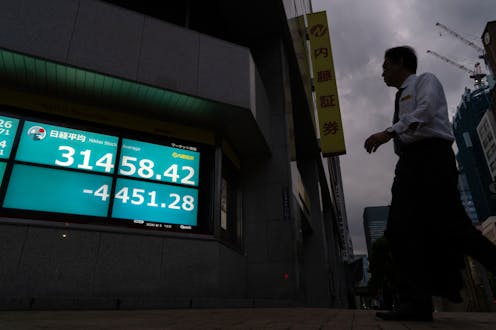
What a difference a job report makes. Earlier in the summer, people were worried that the economy was too hot. But now – in response mainly to weaker-than-expected employment data[1] released on Aug. 2, 2024 – stocks are plunging[2]. Some analysts even worry that a recession could be on the horizon[3].
As a professor of business economics[4], I beg everyone, from investors to consumers to policymakers: Please calm down, take 10 deep breaths and relax. The economic data, taken together, paint a brighter if more complex picture.
Why investors are flipping out
When the most recent U.S. jobs report was released[5], the market wasn’t happy. “Dow plunges nearly 1,000 points after report shows sharp drop in U.S. hiring[6],” read one headline. When the Dow closed on the day of the report, the index had lost about 2% in value compared with the previous day’s close.
The sell-off has intensified, with global stock markets plunging[7] further after investors had a full weekend to absorb the jobs data. The Dow[8], the S&P 500[9] and Nasdaq composite[10] all posted losses on Aug. 5. The Japanese Nikkei also closed 12% lower[11], a significant drop.
The report that sparked all this turmoil found that the U.S. economy had added a mere 114,000 jobs in July 2024 – lower than the expected 175,000.
Those figures were widely seen as disappointing; As CNN put it, they raised concerns “the job market is slowing too quickly and could trigger a recession[12].” Many news stories noted the report had triggered an indicator[13] known as the Sahm Rule[14], which, in the past, has reliably signaled a recession.
In response to this perceived recession threat, many people have been criticizing the Federal Reserve for not cutting interest rates sooner. U.S. Sen. Elizabeth Warren, for one, said the chair of the central bank “made a serious mistake not cutting interest rates[15].” She added, “He’s been warned over and over again that waiting too long risks driving the economy into a ditch.”
While the Federal Reserve is expected to cut rates in September[16], critics are calling for it to pick up the pace.
But all of this – the sell-off, the entreaties to Fed Chair Jerome Powell, the talk of a “hard landing[17]” – is premature.
Don’t panic
It’s true that the latest jobs numbers were lower than expected. It’s also true that stocks closed lower on the day the figures were released. But that doesn’t prove a recession is imminent or that the Fed has mismanaged the economy, and it doesn’t mean anyone’s 401(k) is in danger. It simply means that the economy is slowing down – and, I might add, this is expected.
That’s because the Fed has been trying to slow the economy in order to lower inflation. Since May 2022, its strategy has been to gradually ratchet up interest rates, which slows demand, which in turn reduces pressure on inflation. If successful, this strategy is believed to guide the economy to slower growth and a lower – more stable – inflation rate, while averting a recession. It is, in other words, the famed “soft landing.”
The jobs data also tells a more complex story than the headlines suggest.
True, there are indications of layoffs. Agriculture machinery giant John Deere has been in the headlines for planning to lay off about 600 workers[18]. The computer chip manufacturer Intel is also planning job cuts[19].
The report itself notes net jobs losses in the auto industry, information services and temporary work.
To be sure, the impact of these job losses on individuals and their families should never be diminished. However, while some sectors were shedding jobs, others were adding them: The construction, transportation and health services fields all saw employment gains.
Such mixed signals across sectors are quite common. They’re a sign that the job market is slowing in aggregate – and that’s very different from a recession, during which layoffs tend to be seen across the economy.
It’s also worth considering the broader context. While the latest figures were disappointing, this has been the exception, not the norm, of late. Since at least January 2024, the U.S. job market has been exceeding expectations[20]
The U.S. economy added a whopping 272,000 jobs in May[21], for example – well ahead of the 180,000 that analysts expected. At that time, some people were criticizing the Fed for not doing enough to slow the economy – the opposite of Warren’s current complaint.
So what does the July 2024 jobs report portend? In the end, I think it simply means that the economy is slowing down. Higher interest rates are dampening demand, encouraging slower job growth and reducing pressure on wages and prices. This is what a soft landing[22] looks like. With even the softest of landings, a bit of turbulence can happen.
Before overreacting any further, market watchers might be better off turning their attention to two reports that come out before the Fed’s September meeting: the next inflation report, due out Aug. 14, and the August jobs report, due out Sept. 6. If consumer price index growth is 2.75% or less, and the job growth is again slower than expected, then the Fed will almost certainly shave 25 basis points off rates in September.
While I’m sure there will be a chorus of pundits complaining the rate cuts will be too small, a period of steady rate cutting is coming.
References
- ^ weaker-than-expected employment data (www.bls.gov)
- ^ stocks are plunging (www.wsj.com)
- ^ a recession could be on the horizon (www.bbc.com)
- ^ professor of business economics (www.unomaha.edu)
- ^ most recent U.S. jobs report was released (apnews.com)
- ^ Dow plunges nearly 1,000 points after report shows sharp drop in U.S. hiring (www.cbsnews.com)
- ^ plunging (www.cnn.com)
- ^ The Dow (www.marketwatch.com)
- ^ S&P 500 (www.spglobal.com)
- ^ Nasdaq composite (www.nasdaq.com)
- ^ closed 12% lower (www.reuters.com)
- ^ the job market is slowing too quickly and could trigger a recession (www.cnn.com)
- ^ triggered an indicator (www.aol.com)
- ^ Sahm Rule (fred.stlouisfed.org)
- ^ made a serious mistake not cutting interest rates (finance.yahoo.com)
- ^ expected to cut rates in September (www.cbsnews.com)
- ^ hard landing (www.nytimes.com)
- ^ planning to lay off about 600 workers (www.chicagotribune.com)
- ^ also planning job cuts (www.statesman.com)
- ^ job market has been exceeding expectations (www.cnbc.com)
- ^ added a whopping 272,000 jobs in May (www.cnn.com)
- ^ soft landing (www.brookings.edu)