

Dubai Chambers Inaugurates Sydney Office
- Written by: Business Daily Media
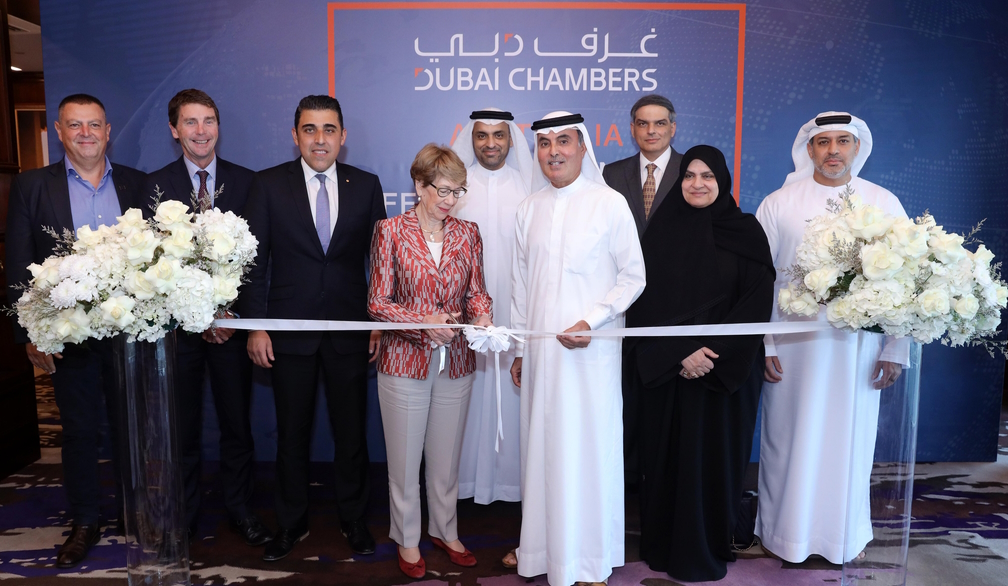
Dubai Chambers opened a new international office in Sydney, Australia, one of the three chambers operating under Dubai Chambers, and the signing of a Memorandum of Understanding between Dubai Chambers and the Australia Arab Chamber of Commerce & Industry (AACCI).
The new office opening is in line with Dubai International Chamber's strategic objective to maximize business opportunities in priority markets globally and support the international business expansion plans of Dubai companies. The Sydney office is the second new office inaugurated in 2023, and expands the Chamber’s global network to 17 representation offices around the world.
The inauguration was led by H.E. Abdul Aziz Al Ghurair, Chairman of Dubai Chambers, in the presence of H.E. the Honourable Margaret Beazley AC KC, Governor of New South Wales, and Moin Anwar, Trade and Investment Commissioner (Middle East) for the New South Wales Government. Also in attendance were Mohammad Ali Rashed Lootah, President and CEO of Dubai Chambers, and Mohamed Hage OAM, President and National Chairman of the Australia Arab
Chamber of Commerce and Industry, who signed the MoU between the two chambers, as well as a group of delegates from the Australian Business Council.
H.E. Abdul Aziz Al Ghurair said: “Today’s office inauguration and the signing of a trade boosting MoU with our friends at the Australia Arab Chamber of Commerce & Industry not only serves to highlight our existing strong trading partnership, but also underlines our redoubled commitment to working together more closely to foster mutually beneficial business agreements.”
This latest office opening in Sydney aligns with the ‘Dubai Global’ initiative launched by H.H. Sheikh Hamdan bin Mohammed bin Rashid Al Maktoum, Crown Prince of Dubai and Chairman of Dubai Executive Council, to establish 50 representative offices for Dubai in five continents by 2030. Supported by strategic public and private sector partners, Dubai Global will boost Dubai’s non-oil foreign trade from AED 1.4 trillion to AED 2 trillion by 2026.
The Dubai Global initiative aims to attract foreign companies, SMEs, investors, and international talent to Dubai by showcasing the emirate’s competitive advantages, sharing investment intelligence, and strengthening engagement with overseas stakeholders.
H.E. the Honourable Margaret Beazley AC KC, Governor of New South Wales, said: NSW and the UAE have a shared history of strong bilateral ties that are important and to be celebrated. Today’s historic moment, the signing of The Memorandum of Understanding between the Dubai Chambers and the Australia Arab Chamber of Commerce and Industry, is one more tangible sign of the further strengthening of links between NSW and the UAE.
Dubai International Chamber's office in Sydney will focus its efforts on building strong relationships with key public and private sector stakeholders, as well as supporting Australian companies to enter the Dubai market and expand internationally through the emirate.
The new office will also create new channels for communication and economic cooperation between UAE and Australian businesses and work with Australian partners to co-organize networking events, business seminars, and business matching meetings.
During his welcome speech, H.E. Al Ghurair underlined that the UAE is currently Australia’s largest trading partner in the Middle East, and Australia's 19th largest export market overall.
His Excellency said: “It’s time for us to work even closer together, and I hope these announcements mark a strategic turning point in achieving mutually beneficial trade deals between our city and the great nation of Australia. We are already anticipating a growth in mutual trade over the coming years as a result of the opening of our Sydney office.”
The value of non-oil trade between UAE and Australia reached around $4.5 billion in 2022, registering growth of around 28.6% compared to 2021. In addition, the number of Australian companies that are registered with Dubai Chamber of Commerce now exceeds 1,530, including 307 new members that joined in 2022. The Australian companies operating in Dubai work across various sectors, predominately in the wholesale and retail trade and repair of motor vehicles and household goods in addition to real estate, renting, and business activities. This diversity reflects the growing strength of investment and trade links between Australia and Dubai.
Dubai International Chamber's mission to bolster international bilateral trade will be aided by both the opening of the new office and signing of the the MoU with the Australia Arab Chamber of Commerce & Industry (AACCI).
AACCI is the national association for two-way trade and investment between Australia and the Arab League countries. The organization is a member of the General Union of Arab Chambers of Commerce, Industry & Agriculture and has fostered strong links with the Australian State and Federal governments since it began in 1975. A membership-based and not-for-profit organization, AACCI represents a network of
businesses and organisations throughout Australia and is dedicated to fostering two way trade, investments, and relations between Australia and the MENA region by promoting cross-cultural awareness that facilitates business success.
Under the terms of the MoU, the two Chambers will work together to develop new joint activities and cooperation including mutual exchange on events taking place in their respective jurisdictions and assistance from both sides in organising and collaborating on seminars, webinars, meetings, and contacts.
The UAE mostly exports manufactured goods, machinery, chemicals, food, live animals, and crude materials to Australia.
Dubai Chambers’ analysts suggest there is UAE export growth potential in several sectors including copper and copper products, carpets and coverings, glass and glassware, art and antiques, to name a few.
New export areas from the UAE to Australia that demostrate strong investment potential include digital technologies, infrastructure projects, mining, and real estate, while new import opportunities from Australia to the UAE include coal, inorganic chemicals, iron ores, and meat.
In the near term, the two parties expect to see increased bilateral trade in sectors including construction, minerals, resources, engineering, education, agribusiness, and health.
Dubai Chambers is a non-profit public entity that supports Dubai’s vision as a global player by empowering businesses, providing innovative value-added services and access to influential networks. In March 2021, His Highness Sheikh Mohammed bin Rashid Al Maktoum, Vice President and Prime Minister of the UAE and Ruler of Dubai, announced the restructuring of Dubai Chamber and the formation of three chambers for the emirate, namely, Dubai Chamber of Commerce, Dubai International Chamber, and Dubai Chamber of Digital Economy, which now operate under Dubai Chambers.For more information, please visit us on: www.dubaichambers.com
www.facebook.com/DxbChambers
www.twitter.com/dubaichambers
www.linkedin.com/company/dubai-chambers
www.youtube.com/DubaiChamberTV
www.instagram.com/dubaichambers





