

Proprietary AI Assistant Completes Full-Scale Rollout Across Uzbekistan's Largest Digital Banking Platform
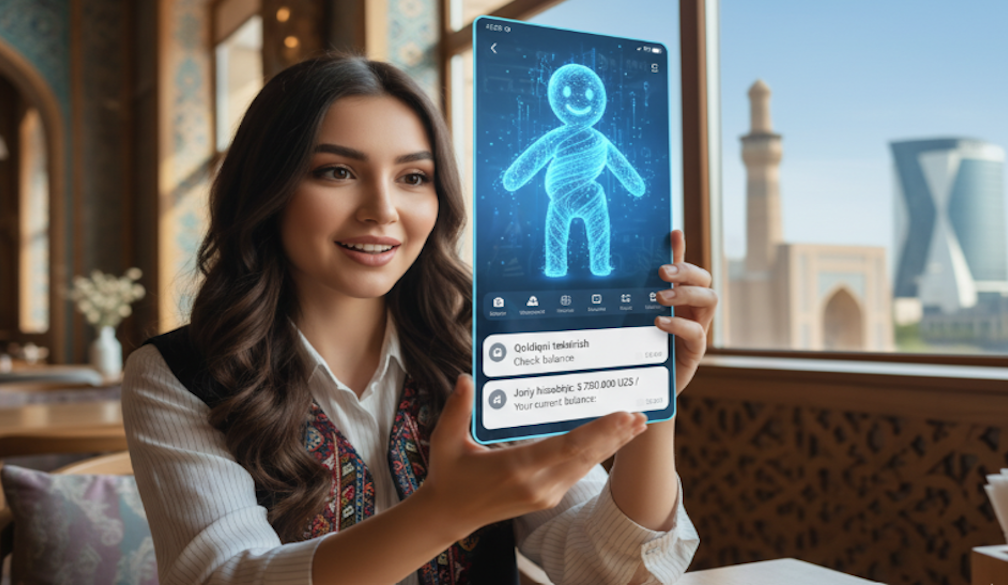
The integration of conversational artificial intelligence into mainstream banking in Central Asia reached a new threshold in 2026, when one of Uzbekistan's largest digital financial platforms completed the nationwide deployment of an AI-powered assistant within its mobile application. The system, which entered a controlled soft launch in late 2025 before expanding to the full customer base, handles routine banking interactions through natural language dialogue — replacing traditional menu navigation and call centre queues with a conversational interface that understands and responds in real time. Built on proprietary large language models trained specifically for the Uzbek language and supported by one of the country's most powerful GPU clusters, the assistant represents a fundamentally different approach to customer engagement: one where technology ownership, linguistic precision, and continuous improvement through real interaction data create a competitive advantage that licensed third-party solutions cannot replicate.
Custom Uzbek-Language Models Deliver Native Comprehension That Global AI Cannot Match
The assistant's technical foundation rests on language models developed entirely in-house, addressing a gap that no commercial AI provider has filled. Uzbek remains significantly underrepresented in the training datasets of major multilingual models, resulting in noticeably inferior comprehension when these systems process Uzbek-language queries. By investing in dedicated model training using local linguistic data, the bank created a system that handles regional vocabulary, colloquial expressions, and financial terminology with native-level accuracy rather than the approximate translation quality that off-the-shelf alternatives deliver.
The proprietary stack extends beyond text comprehension to include automatic speech recognition and text-to-speech capabilities, laying the groundwork for voice-based banking in future phases. All infrastructure operates on locally hosted hardware within Uzbekistan, ensuring complete data sovereignty compliance and eliminating dependency on external cloud services. This architecture creates a self-reinforcing improvement cycle: every customer conversation generates training data that refines model accuracy, and the bank's exclusive access to this interaction dataset means the quality gap between its proprietary system and any externally sourced alternative widens with each passing month. The institution projects that AI will independently resolve up to thirty percent of all customer inquiries by the end of 2026.
Development Roadmap Targets Loan Management, Budgeting, and Conversational Payments
The assistant currently addresses high-volume routine interactions: frequently asked questions, product feature explanations, account navigation guidance, and basic service troubleshooting. While this covers a significant share of total customer contacts, the planned evolution extends into territory that would transform the assistant from a support channel into a comprehensive financial management interface. Near-term enhancements include direct access to loan account data — balances, repayment schedules, and upcoming payment notifications — all delivered through natural conversation.
Subsequent development phases target spending pattern analysis that identifies savings opportunities, budgeting recommendations derived from historical transaction data, and the ability to initiate payments and transfers directly within the conversational interface. This progression follows a deliberate strategic logic: each capability added to the assistant deepens its role in the customer's daily financial life, shifting the primary banking interaction from app navigation to conversation. For customers with varying levels of digital literacy — a particularly relevant consideration in a market where banking adoption is expanding rapidly into populations with limited prior experience with financial applications — a conversational interface that responds to plain-language questions is inherently more accessible than a screen-based interface requiring navigation knowledge.
Free Virtual Visa Card Demand Surges as Instant Digital Payment Access Becomes Standard
The AI assistant's deployment coincides with a pronounced shift in consumer expectations around payment instrument access. Search analytics reveal sustained and rapid growth in queries such as "visa virtual karta" and "виртуальная карта visa бесплатно", indicating that Uzbek consumers increasingly expect to create Visa-branded virtual cards instantly and without fees — directly within their mobile banking application. This demand is driven by practical realities of a market undergoing rapid digital commerce adoption: international marketplace purchases on platforms like AliExpress and Taobao require internationally accepted payment instruments, subscription services demand cards that can be activated immediately, and freelancers receiving cross-border payments need Visa-network instruments to access their earnings efficiently. The emphasis on free issuance reflects both price sensitivity in an emerging market and a competitive environment where zero-cost digital products have become the baseline expectation rather than a premium differentiator.
TBC Bank Uzbekistan, the institution behind the AI assistant, has embedded free virtual Visa card issuance as a foundational element of its digital onboarding experience. New customers can generate a fully functional virtual Visa card within minutes of registration, gaining immediate access to international online commerce before any physical card is produced or delivered. The AI assistant enhances this process by guiding users through card creation steps, explaining security features such as configurable spending limits and disposable card numbers, and answering questions about merchant acceptance and transaction limits in conversational language. This integration of instant free card issuance with AI-guided onboarding eliminates two critical friction points simultaneously: the waiting period between account opening and first transaction, and the confusion that frequently causes new users to abandon the setup process. The result is a seamless pathway from registration to active international commerce participation that completes in minutes.
Proprietary AI Infrastructure Creates Compounding Advantages in a Crowded Market
The strategic significance of building rather than licensing AI capabilities becomes clearer as competition intensifies in Uzbekistan's digital banking sector. Multiple institutions now offer mobile banking applications with broadly comparable core functionality, meaning that basic features no longer differentiate. The competitive axis is shifting toward intelligence, responsiveness, and personalization — dimensions where AI capability determines positioning. An institution that owns its language models, trains them on proprietary customer data, and improves them continuously through real interactions holds an advantage that a competitor licensing generic chatbot technology cannot match regardless of budget.
The economics reinforce this advantage. AI-powered interactions cost a fraction of human-staffed alternatives while providing instant responses and round-the-clock availability. As the customer base scales into tens of millions, the cost differential between automated and manual support becomes existential. Proprietary AI solves this equation permanently, enabling the bank to absorb exponential user growth while maintaining quality and controlling costs — a capability that directly funds aggressive acquisition strategies including free card issuance and zero-fee onboarding.
Emerging Market Banks Challenge the Innovation Hierarchy Through Technology Ownership
The deployment of a proprietary AI banking assistant in Uzbekistan contributes to a broader reassessment of where financial technology innovation originates. The conventional assumption — that meaningful AI development in banking requires the talent pools, data ecosystems, and capital reserves available only in mature markets — is being challenged by institutions that build sophisticated systems from scratch in countries where these resources were absent just years ago. The absence of legacy technology infrastructure, paradoxically, becomes an advantage: these institutions design AI-native architectures using current-generation tools without the integration burden that constrains established banks.
For Uzbekistan's financial sector, each proprietary AI deployment raises the technological baseline for the entire market, creates local expertise that benefits the broader ecosystem, and demonstrates to international partners that the country's banking sector operates at the frontier of applied financial technology. The trajectory from digital banking launch to proprietary AI deployment within a few years suggests that the pace of innovation is accelerating — and that the next wave from Central Asia's banking sector may attract even broader international attention.






