

UK plans for pay-per-mile electric vehicle tax could make the system fairer – or provoke a fierce backlash
- Written by: David Bailey, Professor of Business Economics, University of Birmingham
The growth in sales of electric vehicles is a positive step in the UK’s journey to net zero. They are cleaner, quieter and better for the environment.
But while they produce less pollution, electric vehicles[1] (EVs) also produce far less revenue for the treasury. And as more drivers ditch petrol and diesel[2], the government’s annual £35 billion[3] haul from fuel duty and road tax will dwindle fast.
This is because owners of electric vehicles don’t pay fuel duty, quietly gliding past petrol stations and the tax collector. And for years, that’s been an intentional policy nudge to help the technology take off.
But as EVs go mainstream, those lost tax receipts become impossible to ignore, especially given the UK’s current economic predicament[4]. So the government is now considering[5] a radical reform to make up some of that revenue by charging EV owners per mile travelled.
The idea is that those who drive more, pay more. And it could even be fine-tuned to discourage congestion, perhaps by charging more for driving in a city or town centre during rush-hour. Larger vehicles could pay a higher rate, since an SUV is likely to have a more damaging impact upon a road surface than a smaller city car.
In theory, it’s a fairer and more modern way to fund our roads – and for the treasury it must seem like a good way of restoring predictability to public finances.
But for many Britons, road pricing[6] is a very sensitive subject. When the Blair government floated a similar idea in 2007, the response was intense[7].
And the danger of a pay-per-mile tax introduced too quickly, by a government desperate for revenue, is that it could trigger a fierce public backlash and risk stalling the EV transition.
Springing a new charge on EV owners who bought their cars on the promise of cheaper running costs, for example, could feel like a betrayal. And public trust in the green transition[8] depends upon fairness and predictability.
If EV drivers suddenly find themselves paying more than they expected to, others will think twice before making the switch, which could slow EV adoption[9] when momentum is finally building.
There’s also the issue of how such a system would actually work. To charge by the mile, the state needs to know how far you’ve driven. That could mean annual odometer checks or, more controversially, real-time tracking via GPS.
The latter might be efficient, but it also sounds pretty Orwellian. Handing the government or private contractors a record of every journey would raise concerns about surveillance and data privacy. Even if the system were technically secure, it could still feel like a step too far for many drivers.
Then there’s geography. A flat per-mile charge would hit rural motorists, who tend to drive further and have fewer public transport alternatives, hardest[10]. Urban drivers, meanwhile, could face a double tax if road pricing overlaps with congestion zones[11].
So fairness could make or break this policy.
Part of this fairness will come down to timing. Right now, EVs are still more expensive to buy than petrol or diesel cars, charging infrastructure remains patchy[12] and household budgets are under pressure from inflation and high energy costs. Is this really the moment to make EV driving more expensive?
A premature shift to pay-per-mile taxation would punish the very people the government has spent years encouraging to go green. It would also send a damaging signal to the market: that the rules of the game can change overnight.
But the shift to EVs is both inevitable and desirable, so the sensible path is probably a gradual one. This year, owners of EVs began paying road tax[13] – a small but symbolic step toward equal treatment with other car drivers. Beyond that, if the UK is to move to a pay-per-mile model eventually (and it probably will) the design needs to be spot on.
It needs to be transparent about the need to replace lost fuel duty. It needs to respect privacy, by basing the system on reported mileage – not GPS tracking – maybe as part of the annual MOT.
It also needs to be fair, with rates adjusted for geography and access to public transport, and different rates for different sized vehicles, to account for greater impact upon roads.
It may also be worth ring-fencing the revenue it creates to improve roads, expand public transport and invest in charging networks. If drivers can see where their money is going, they may be more amenable to charges.
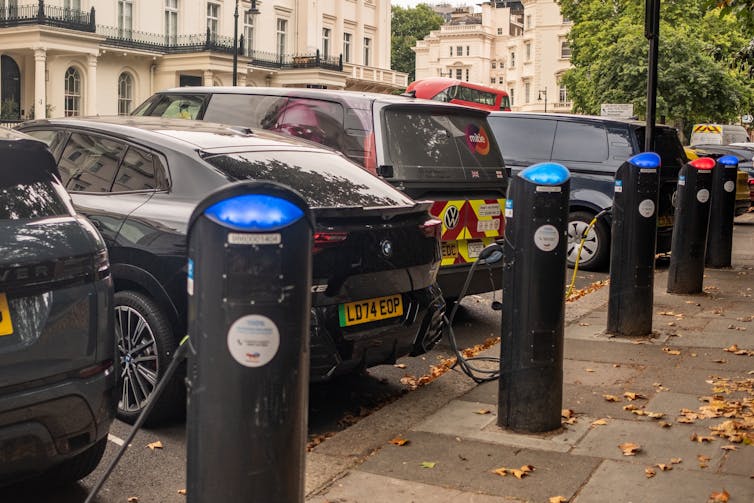
Handled with care, a mileage-based system could modernise the way Britain funds its transport network while keeping net zero on track[15]. But rushing to impose new charges on EV drivers just to plug a fiscal hole would be short-sighted and self-defeating.
The government should resist the temptation for a quick fix, and instead build a system that is gradual, transparent and fair. Do this, and road pricing could work as a long-term solution. Do it badly, and it risks becoming a symbol of another tax grab and a green betrayal.
The road to a sustainable transport tax system will be long and winding. The UK can get there, but only if it drives things forward carefully.
References
- ^ electric vehicles (theconversation.com)
- ^ ditch petrol and diesel (www.bbc.co.uk)
- ^ annual £35 billion (www.carwow.co.uk)
- ^ economic predicament (www.ft.com)
- ^ now considering (www.bbc.co.uk)
- ^ road pricing (www.carwow.co.uk)
- ^ the response was intense (news.bbc.co.uk)
- ^ trust in the green transition (www.dnv.com)
- ^ slow EV adoption (www.autocar.co.uk)
- ^ hardest (www.birminghammail.co.uk)
- ^ overlaps with congestion zones (www.msn.com)
- ^ remains patchy (evpowered.co.uk)
- ^ owners of EVs began paying road tax (electriccarguide.co.uk)
- ^ William Barton/Shutterstock (www.shutterstock.com)
- ^ net zero on track (commonslibrary.parliament.uk)






