Why healthcare’s ‘do no harm’ ethic must include the planet
- Written by: Muireann McMahon, Associate Professor, School of Architecture & Product Design, University of Limerick
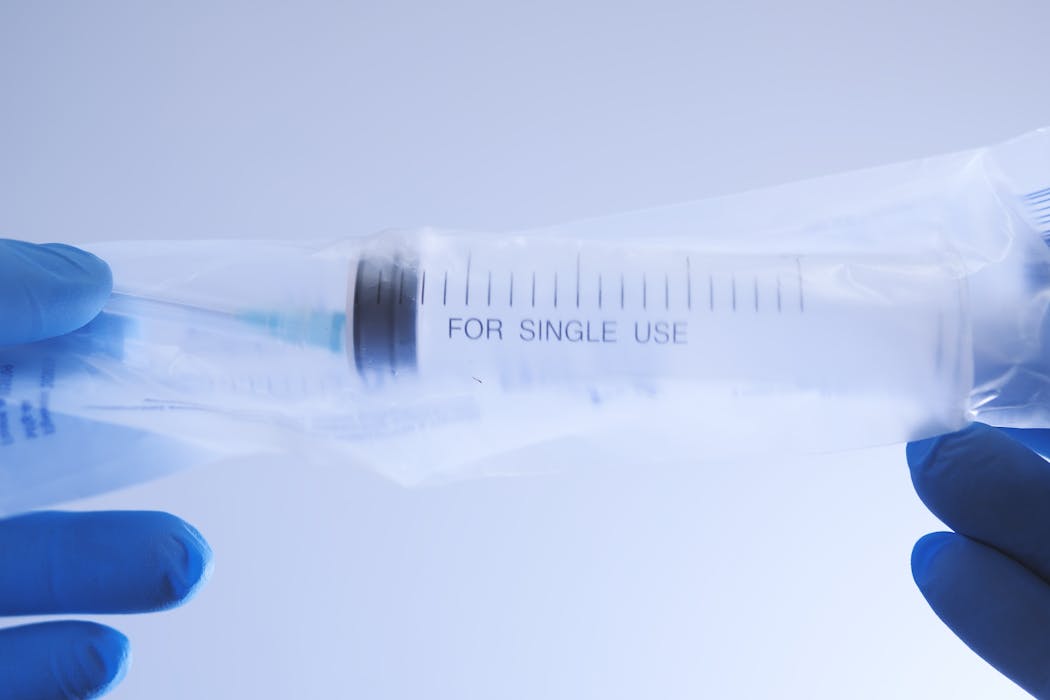
Every product we touch has a footprint. A phone, a fridge, a hospital syringe. Each begins and ends in the same place: the planet’s resources.
The EU’s recent ecodesign for sustainable products regulation aims to break the cycle of take, make, waste by forcing manufacturers to think circularly. Products will need to last longer, be easier to repair and feed back into the economy instead of the landfill.
It represents a major shift for most industries. But for healthcare, where safety and sterility come first, it could be revolutionary.
The healthcare industry[1] is responsible for roughly 4.4% of global carbon emissions[2], with 71% coming from the production, provision, and disposal of medical technology (medtech) products[3] and services.
In the UK alone, the NHS[4] generates approximately 156,000 tonnes[5] of waste each year from hospitals and specialist clinics, equivalent to more than 5,700 40ft containers. Up to 90% of such waste[6] comes from single-use disposable products or components.
Read more: Reusing medical equipment is good for the planet. But is it safe?[7]
Although medical products are included under the ecodesign regulation[8], the rules will only apply where patient health and safety are not compromised. Products that pose a risk to patients, such as those where infection, contamination, or reduced effectiveness could occur, may be exempt.
But are considerations for human health and environmental protection really at odds with one another? Or can we expand the principle of “do no harm”[9] to include the planet itself?
In the US, climate commitments are being rolled back. The Trump administration’s withdrawal from the Paris climate agreement[10] has slowed progress toward a more sustainable medtech industry. Implementation of new emissions standards has also been delayed, including rules to reduce ethylene oxide[11], a cancer-causing chemical used to sterilise surgical kits and medical devices.
These setbacks stall innovation in cleaner, safer alternatives such as CO₂ and UV light sterilisation[12]. This matters because reusing devices, when safely sterilised, could dramatically reduce waste and resource use.
Fortunately, many sustainability gains in medtech are already within reach. By examining the full lifecycle of devices, from production to disposal, it is possible to identify where the biggest improvements can be made.
Green public procurement policies[13] can immediately encourage healthcare providers to make more sustainable purchasing choices. Smarter research and development decisions can improve repairability, reduce material use and waste, and simplify components for easier assembly and disassembly.
Standardisation also enables interchangeable parts across devices, as seen with consumer products’ universal power supplies[14]. This approach extends product lifespans and allows parts to be recovered and reprocessed[15] for use in future devices, provided they meet the necessary medical standards[16].
Using consistent materials across devices also ensures they are directed into the correct waste, recycling, or reuse streams rather than ending up in landfill. Even sterile packaging can be reimagined[17] to minimise volume, avoid mixed materials, and favour fully recyclable mono-materials.
Some of the world’s leading medtech companies are already proving what is possible. Medtronic[18] is aiming for net-zero emissions by 2030 through designing smaller, longer-lasting products, investing in new materials and enforcing responsible sourcing across its supply chain.
Johnson and Johnson[19] is cutting waste by recycling and using closed-loop systems to recapture valuable materials from single-use devices. The company also measures and publicly shares the environmental footprint of its products.
Abbott[20], a global healthcare and medical devices company, has committed to a 90% reduction in waste across its product lifecycles, with a particular focus on minimising the environmental impact of packaging.
The path to a sustainable medtech industry is not without challenges, but it is achievable. As regulations advance, companies innovate and healthcare professionals push for change[21], the sector has an opportunity to redefine what innovation really means. It is no longer just about safer, more efficient care – it is about care that protects the planet too.
With the medtech industry valued at US$587 billion in the US[22] (£459 billion) alone, and 8% of that investment directed toward research and development[23], the potential for transformation is enormous. Imagine the progress if even a fraction of that funding were channelled into responsible innovation – empowering every stakeholder through education, engagement and sustainable action.
By aligning environmental responsibility with patient safety, and investing in circular design, smarter procurement, connected infrastructures and genuine collaboration, medtech can show that health and sustainability are not competing priorities. They are, in fact, inseparable.
References
- ^ healthcare industry (theconversation.com)
- ^ 4.4% of global carbon emissions (global.noharm.org)
- ^ medical technology (medtech) products (theconversation.com)
- ^ the NHS (theconversation.com)
- ^ 156,000 tonnes (www.england.nhs.uk)
- ^ 90% of such waste (www.ey.com)
- ^ Reusing medical equipment is good for the planet. But is it safe? (theconversation.com)
- ^ ecodesign regulation (commission.europa.eu)
- ^ “do no harm” (www.medtechdive.com)
- ^ Paris climate agreement (www.europarl.europa.eu)
- ^ ethylene oxide (www.medtechdive.com)
- ^ CO₂ and UV light sterilisation (www.fda.gov)
- ^ Green public procurement policies (www.england.nhs.uk)
- ^ universal power supplies (commission.europa.eu)
- ^ recovered and reprocessed (www.stryker.com)
- ^ medical standards (www.medical-device-regulation.eu)
- ^ can be reimagined (www.medtechdive.com)
- ^ Medtronic (www.medtronic.com)
- ^ Johnson and Johnson (www.jnj.com)
- ^ Abbott (www.abbott.com)
- ^ push for change (noharm.org)
- ^ US$587 billion in the US (www.ey.com)
- ^ 8% of that investment directed toward research and development (www.medtecheurope.org)
Read more https://theconversation.com/why-healthcares-do-no-harm-ethic-must-include-the-planet-262908