

Denying compensation to ‘Waspi’ women over pension changes could be a missed opportunity
- Written by: Jane Falkingham, Dean of the Faculty of Social, Human and Mathematical Sciences, University of Southampton
Governments around the world have addressed the challenge of increasing life expectancy and declining birth rates by raising the pension age. The UK is no exception. The challenge this creates for governments is the thorny dual issue of rising care costs for the ageing population while fewer taxpayers support the economy.
Between the 1940s and 2010, the UK state pension age was 65 for men and 60 for women. This gender difference reflected long-standing norms about men’s and women’s employment patterns, as well as typical age differences at marriage.
These days, there is more acceptance of an equal age for women and men to receive the state pension. But in the process of levelling the playing field, some women feel they have been penalised by the government. So how did it happen?
The Pensions Act 1995[1] equalised things, setting out a plan to gradually increase women’s state pension age to 65. But ten years later, an independent Pensions Commission[2] report found that a state pension age fixed at 65 was no longer sustainable or affordable.
Between 2007 and 2014 the law changed three times. This accelerated the equalisation of women’s and men’s state pension age, bringing forward the increase from 65 to 66 by five and a half years to 2020.
Further changes accelerated the increase in the state pension age for both men and women to 67 by 2028. This was eight years earlier than the previous timetable. Another review[3] suggested increasing the state pension age from 67 to 68 in 2039. This would bring it forward by seven years in response to continued gains in life expectancy.
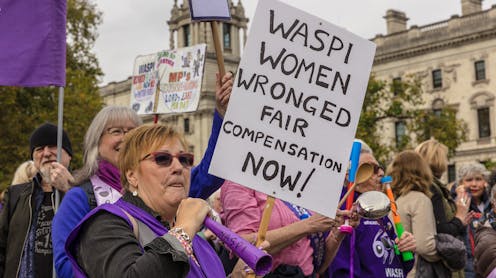
These changes in the state pension age led to a long-running campaign by a group known as the Waspi[4] (Women Against State Pension Inequality) women. This group claims that women born between April 6 1950 and April 5 1960 have been badly affected by the way the government equalised the state pension ages.
They are campaigning for compensation – but the government has repeatedly refused[5] to pay out the recommended amounts of up to £2,950 per woman. These payment could have cost the government more than £10 billion[6].
The group’s argument rests on the way the increases in the state pension age were communicated and the amount of notice women were given to plan their finances in retirement. Some women in this cohort were affected by more than one increase in the state pension age.
The Waspi group estimates that about 3.8 million women are affected. Analysis[7] from the House of Commons puts that figure just above 1.5 million women.
Analysis[8] of data from the UK’s largest household panel study, the UK Household Longitudinal Study[9], shows that the impact of the rise in the state pension age has been positive for older women’s employment rates. But it has been harmful for their wellbeing.
The government’s analysis[10] has also shown that younger women in the 1950-58 birth cohort have stayed in employment for longer.
Studies[11] analysing the Family Resources Survey[12] have shown that the women affected by the increased state pension age have a reduced household income, and this effect is larger for those in lower-income households.
The changes in the state pension age, and their effect on women born in the 1950s, has been the topic of both parliamentary debates and (unsuccessful) legal challenges by women affected by these changes[13].
In March 2024, the Parliamentary and Health Service Ombudsman found[14] the Department for Work and Pensions had demonstrated maladministration in its communication about the 1995 Pensions Act. This resulted in women losing opportunities to make informed decisions about their future. But it found that this did not result in an injustice or the women suffering direct financial loss.
How the UK state pension age was equalised – and raised

Whatever the outcome of the debate about women born in the 1950s, this topic raises broader issues – and lessons – about social policy. Change in social policies is inevitable. Social structures shift, as do norms and patterns in a population’s health and economic circumstances.
However, introducing change in a way that is both informed by evidence and transparent is vital for ensuring that reforms are acceptable.
Far from always creating “winners and losers”, social policy change can be a tool that demonstrates a collective sense of responsibility and adaptability to changing times.
Gender differences have consistently permeated employment and pensions, and women tend to fare worse than men. More women are working[15] in the UK than ever before and benefit from state, workplace and personal pensions. But gender gaps are persistent across areas that directly affect someone’s ability to have enough money to live comfortably in later life.
Women are still less likely to work and to work full-time than men. And they are more likely to provide informal care within and beyond the household (except from age 75 and over). These realities result in lower earnings and a lower capacity to save for later life.
In the broader context of stubborn financial gender inequalities over lifetimes, the issue of changing the state retirement age for women born in the 1950s is a missed opportunity. The government could play a critical part in evening out gender differences for the Waspi women – and for the millions of others coming up after them.
References
- ^ Pensions Act 1995 (www.legislation.gov.uk)
- ^ independent Pensions Commission (assets.publishing.service.gov.uk)
- ^ review (www.gov.uk)
- ^ Waspi (www.waspi.co.uk)
- ^ refused (www.independent.co.uk)
- ^ £10 billion (www.bbc.co.uk)
- ^ Analysis (commonslibrary.parliament.uk)
- ^ Analysis (www.sciencedirect.com)
- ^ UK Household Longitudinal Study (www.understandingsociety.ac.uk)
- ^ analysis (www.gov.uk)
- ^ Studies (www.cambridge.org)
- ^ Family Resources Survey (www.gov.uk)
- ^ these changes (commonslibrary.parliament.uk)
- ^ found (www.ombudsman.org.uk)
- ^ More women are working (commonslibrary.parliament.uk)






