Plans to link electricity bills to where you live are unlikely to bring down prices – and that’s a big problem for net zero
- Written by: Nicholas Harrington, Research Associate in Electricity Market Reform, University of Glasgow
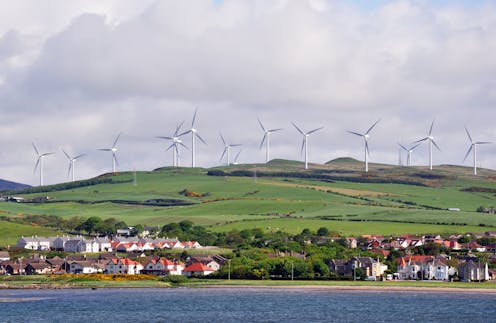
A proposed reform to the way electricity is priced in Britain could see households pay a different bill based on their postcode[1].
Presently, Britain’s electricity system operates as a single market across England, Wales and Scotland. Around 30% of electricity is traded through half-hourly auctions, known as the spot market, while the remaining 70% is traded in forward markets via contracts covering weeks, months, or even years of demand in advance.
The price of electricity is, broadly speaking, determined by the spot market, as forward market contracts are hedged on the basis of current and expected future spot market prices.
“Zonal pricing” would divide the British market into multiple separate zones instead, each with its own spot and forward markets to serve demand within it. In effect, zonal pricing would split one large market into a series of smaller, interconnected markets.
Whether it is the right approach depends on what you expect it to achieve, and where your interests lie. The UK’s Department for Energy Security and Net Zero, tasked with the decision, has three main objectives[2]: decarbonising the country’s power sector, securing the supply of power and lowering the prices consumers pay.
I’m an academic investigating[3] the factors that influence the UK’s ability to decarbonise the housing sector, in particular, the way people heat their homes. I’m most concerned with the affordability of electricity, since I take the view[4] that the lower the price of electricity, the easier our journey to net zero emissions will be – and vice versa.
A lower electricity price would make clean heating systems (such as heat pumps, which run on electricity) more attractive to consumers and reduce the scale of insulation and draughtproofing required to make the running cost of these systems competitive with gas boilers. My research[5] suggests that the UK’s high electricity price is behind the country’s comparably low[6] rate of heat pump adoption.
Zonal pricing, as an electricity market reform, seems unlikely to lower electricity prices and drive decarbonisation on its own. Closer scrutiny of the electricity system and its mechanisms suggests it may only make things more complicated.
At €0.321 (£0.27) per kilowatt-hour (kWh), the UK has the second-highest electricity price[7] when compared to European Union countries. The EU average is €0.218 per kWh, meaning UK electricity costs around 47% more than it does for most of our EU neighbours.
Despite Russia’s invasion of Ukraine (which triggered a spike in energy prices) starting more than three years ago now, electricity prices across the UK remain about 53% higher[8] than pre-crisis levels. If the UK is generating more electricity from renewables each year[9] — and renewable electricity is the cheapest on the market[10] — why do prices keep rising instead of falling, as one might expect?
The UK’s high electricity prices are the result of system marginal pricing[11], which lies at the heart of the spot market. At the end of each half-hourly auction, all electricity that is bid into the market is purchased at the price of the last unit required to meet demand.
Since total demand is rarely met by renewables, the much more expensive gas generators typically set the price. It’s like going to a fruit market to buy ten apples, finding the first nine for £1 each, the last one for £3, and then having to pay £30 for the lot, rather than the expected £13.
Because forward markets follow the spot market, and the spot market operates under system marginal pricing, UK consumers end up paying gas-generated electricity prices 98% of the time[12].
Read more: How gas keeps the UK’s electricity bills so high – despite lots of cheap wind power[13]
Will zonal pricing lower these prices? On its own, no. This is because all zones under the scheme will still have spot markets operating under the marginal pricing model. Zonal pricing doesn’t address the fundamental problem that’s keeping electricity prices in Britain so high.
Advocates of zonal pricing argue that it will encourage investment[14] in the infrastructure required to lower electricity prices – namely, storage and transmission.
Grid-scale and home batteries, pumped hydro and thermal energy storage help reduce final electricity prices by storing excess renewable energy for use when the wind isn’t blowing or the sun isn’t shining, so grid operators don’t have to rely on expensive gas-generated electricity to fill supply gaps. Meanwhile, transmission lines and cables ensure that renewable electricity is delivered where it is needed.
By creating price differences between zones, so the argument goes, the market receives clear signals about where such investments would be most profitable.
This argument, however, assumes that electricity prices will fall[16] in some zones, and that the market has a strong incentive to invest in high-price areas.
I’m compelled to ask two questions. What prevents zones that generate a lot of renewable electricity from selling their supply at higher prices in other zones, which could prevent renewables from meeting total demand and lead to the same price distortions currently seen due to marginal pricing?
And if investments in storage and transmission are underwhelming when electricity prices are high everywhere, why would they suddenly become more likely when prices are only high in specific areas?
Overall, I think the argument in favour of zonal pricing is unconvincing as it doesn’t address the structural issue underlying the UK’s high electricity prices: spot markets that operate according to system marginal pricing.
If zonal pricing neither lowers consumer electricity prices nor significantly stimulates investment in storage and transmission on its own — and does not alter the geographic and planning factors[17] that determine wind and solar farm locations — then it is unclear what it would achieve beyond adding complexity to an already complex electricity system.
References
- ^ based on their postcode (assets.publishing.service.gov.uk)
- ^ three main objectives (commonslibrary.parliament.uk)
- ^ investigating (www.gov.uk)
- ^ I take the view (housingevidence.ac.uk)
- ^ My research (housingevidence.ac.uk)
- ^ comparably low (www.heatpumps.london)
- ^ second-highest electricity price (ec.europa.eu)
- ^ remain about 53% higher (www.ofgem.gov.uk)
- ^ more electricity from renewables each year (www.iea.org)
- ^ cheapest on the market (www.carbonbrief.org)
- ^ system marginal pricing (www.lnrg.technology)
- ^ 98% of the time (www.ucl.ac.uk)
- ^ How gas keeps the UK’s electricity bills so high – despite lots of cheap wind power (theconversation.com)
- ^ encourage investment (es.catapult.org.uk)
- ^ EOSMan/Shutterstock (www.shutterstock.com)
- ^ electricity prices will fall (octopus.energy)
- ^ geographic and planning factors (tethys.pnnl.gov)
- ^ Get a weekly roundup in your inbox instead. (theconversation.com)
- ^ Join the 40,000+ readers who’ve subscribed so far. (theconversation.com)