

Manchester United’s plan to raise ticket prices could be a breach of the ‘social contract’ between club and fans
- Written by: Mark Middling, Assistant Professor of Accounting, Northumbria University, Newcastle
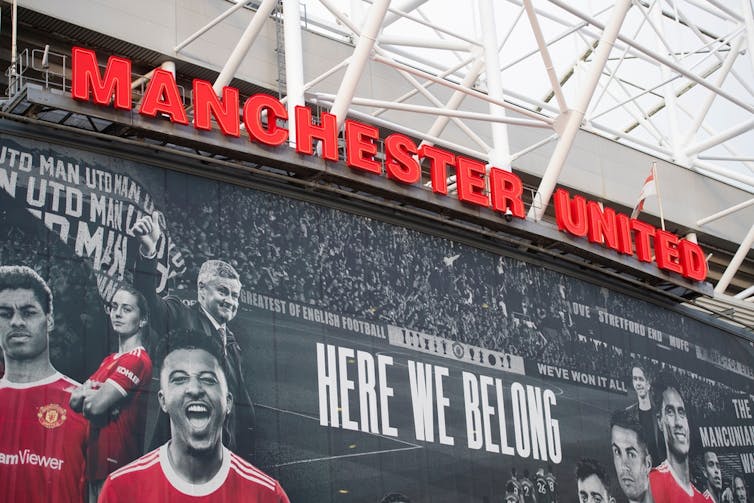
When billionaire Jim Ratcliffe took a 27.7% stake in Manchester United back in February 2024, he had big plans. He would, he said[1], take the club “back to the top of English, European and world football, with world-class facilities for our fans”.
A year later, those ambitions remain a distant dream. Results have not been great, and for many fans, the 2024-25 season is looking like one to forget.
But while the club has been far from ruthless on the pitch, it has been fairly ruthless off it. Cost-cutting measures led to the loss of 250 jobs in a bid to save £10 million a year[2]
And now there is fresh tension between the club and its fan base after supporters were warned of a possible rise in ticket prices to prevent the club breaching[3] the Premier League’s “profit and sustainability rules” (PSR).
These rules were put in place in 2011, with the aim of getting clubs to balance their spending against income. This includes an allowance for an “acceptable” loss level set at a cumulative £105 million over a rolling three-year period.
And some well-established clubs have been close to the limits of PSR, with both Nottingham Forest and Everton[4] receiving point deductions in 2024 for spending breaches.
In their defence, football clubs are not immune from cost pressures, such as rising wages and energy bills, leading to price increases[5]. Nor is Manchester United alone in raising ticket prices.
Fulham was criticised for its “completely misguided”[6] ticket pricing strategy in 2023, and in 2016 Liverpool fans staged a stadium walk out against price hikes[7]. Issues such as these have led to the Football Supporters’ Association’s “Stop Exploiting Loyalty” campaign[8].
But asking fans to help foot the bill to support the club’s PSR position raises a wider question around the “social contract” between a club and its supporters – and the responsibilities on each side.
Our research[9] suggests that Manchester United’s planned price rise would probably break this social contract.
We found that two of a club’s key responsibilities were fair ticket pricing and maintaining financial sustainability (which PSR aim to control). By suggesting ticket price rises to cover the PSR position, Manchester United would be in breach of both those aspects, essentially using one to deal with the other.
There’s nothing illegal about this approach, but it’s a tactic that might backfire. Our research suggests that a relationship between the club and its supporters should involve everybody pulling in the same direction. However, United have already seen some fans turn away from the club[10], and further ticket price hikes (they already went up to £66[11] at the end of 2024) may alienate others.
Transparency between club and fans is another issue. For it is difficult for fans to know how close the club are to a potential PSR breach – and how much a ticket price increase would alleviate any pressure.
Although Manchester United file detailed accounts[13], they do not include clear numbers on PSR calculations. These are only provided privately to Premier League officials.
And while it is understandable that internal club finances would be considered commercially sensitive or private, clubs could do more in terms of being transparent[14] with their fan base. This could be through a broad explanation of PSR in their accounts, or in communication with supporters’ groups.
PSR may be a concern for the club, but should the fans have to help foot the bill for financial issues? Again, our social contract model would suggest not. We advocate that clubs are ultimately responsible for their own financial sustainability, and that they should be as transparent as possible, involving fans in decision-making wherever they can.
That said, our research also shows that fans do have a role to play in contributing to a club’s income, supporting its financial sustainability – but not to the extent that the cost to fans is excessive. Yet a recent BBC poll[15] found that most fans were willing to pay “slightly” or “significantly more” for their tickets next season.
This may provide clubs with a sense of justification for ticket price increases, but they need to be aware of tipping points. Our research found that fans should hold clubs to account, with many well practised at this.
So club owners should take heed of the social contract when thinking about putting more financial pressure on their supporters. If, of course, they sympathise with the view that football without the fans “is nothing”[16].
References
- ^ he said (www.bbc.co.uk)
- ^ £10 million a year (www.theguardian.com)
- ^ breaching (www.bbc.co.uk)
- ^ Nottingham Forest and Everton (www.bbc.co.uk)
- ^ price increases (www.bbc.co.uk)
- ^ “completely misguided” (thefsa.org.uk)
- ^ against price hikes (www.theguardian.com)
- ^ campaign (thefsa.org.uk)
- ^ Our research (www.emerald.com)
- ^ away from the club (www.tandfonline.com)
- ^ to £66 (www.bbc.co.uk)
- ^ Richard Juilliart/Shutterstock (www.shutterstock.com)
- ^ detailed accounts (ir.manutd.com)
- ^ being transparent (nrl.northumbria.ac.uk)
- ^ BBC poll (www.bbc.co.uk)
- ^ “is nothing” (www.emerald.com)






