

Elon Musk is an 'engineer' but Bill Gates is a 'leader' – new research shows founder personality can dictate startup success
- Written by: Fabian Braesemann, Departmental Research Lecturer in AI & Work, University of Oxford
From Elon Musk’s supreme confidence to Jeff Bezos’ ability to make smart decisions under pressure[1], some of the most successful entrepreneurs are known for their distinctive personalities. But these traits aren’t just interesting side notes to these founders’ stories: confidence and calmness, along with other qualities such as a love of adventure, can have a big impact on startup success.
A startup is typically counted as a “success” if it’s acquired by another company or goes public (that is, its shares become available to trade on a stock exchange). And common investor wisdom attributes this to either supply side (novel products) or demand side (market interest or “hot sectors”) factors.
Of course, many other elements are associated with startup success. There’s a “Goldilocks age” for startups, for example, with those younger than seven years old less likely to be successful because they haven’t had enough time to develop. Startups based in hot spots like San Francisco, Berlin or London are also more likely to succeed due to better access to finance and talent.
While our new research[2] shows all these elements are important, it reveals that the personalities of founders are actually the most influential factor in startup success.
AI uncovers the x-factor: founder personality
Our multidisciplinary team from the University of New South Wales, the University of Oxford, University of Technology Sydney and the University of Melbourne embarked on a two-year mission to unravel the mysteries behind startup success. We tapped into detailed data on more than 21,000 global startups to discern patterns that might predict a venture’s triumph or downfall.
Using AI algorithms, we applied the “five-factor[3]” model – a psychology theory that divides personality into five main groups – to analyse startup founders worldwide. After comparing data on thousands of successful founders to information about employees, we discovered that entrepreneurs exhibit very different combinations of personality traits to everyone else.
Entrepreneurs tend to have a penchant for variety and novelty. They often have a desire to be the centre of attention and an inherent exuberance. While these traits might sound generic, in the business world they translate into risk-taking, networking and relentless energy – critical ingredients for startup success.
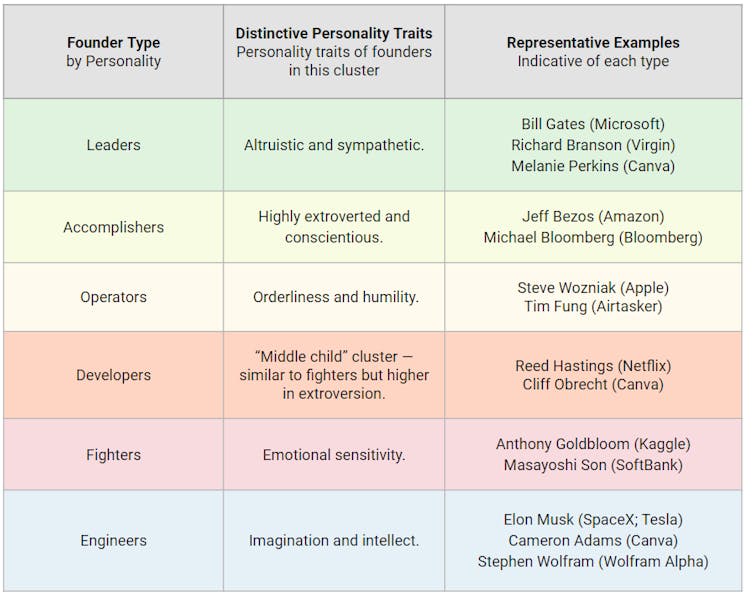
Based on our findings, we have identified six distinct founder personality types: leader, accomplisher, operator, developer, fighter and engineer. Each type has its own combination of subtle personality traits, for example, operators value orderliness and fighters are emotionally sensitive.
Founder personality traits
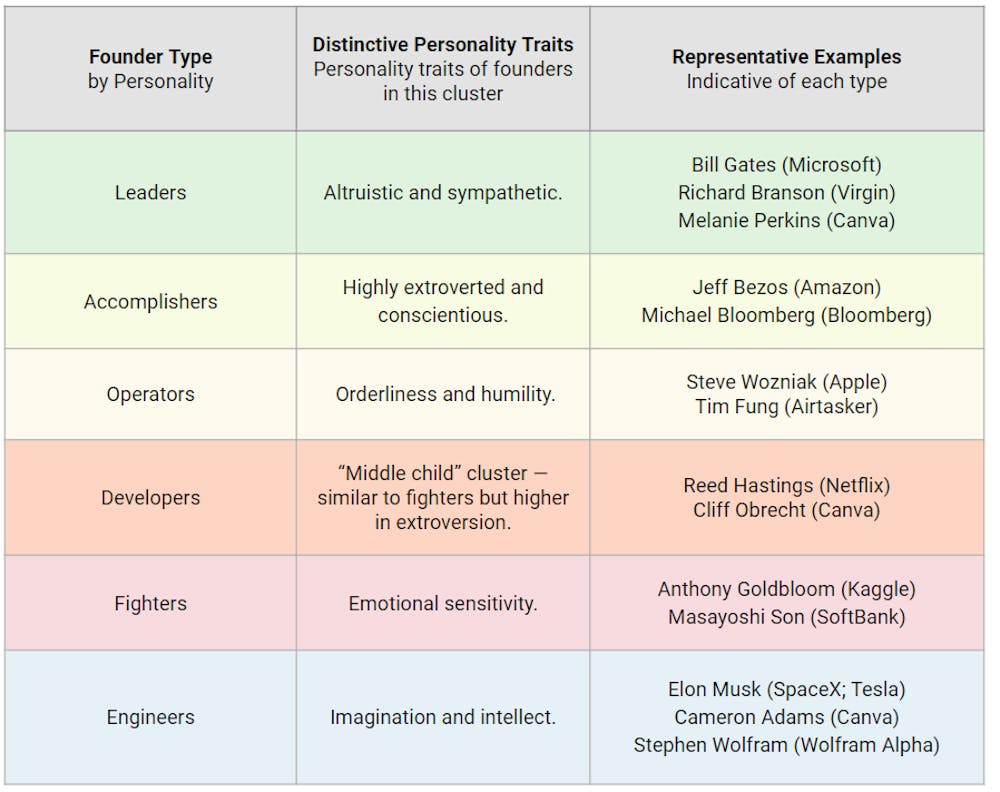
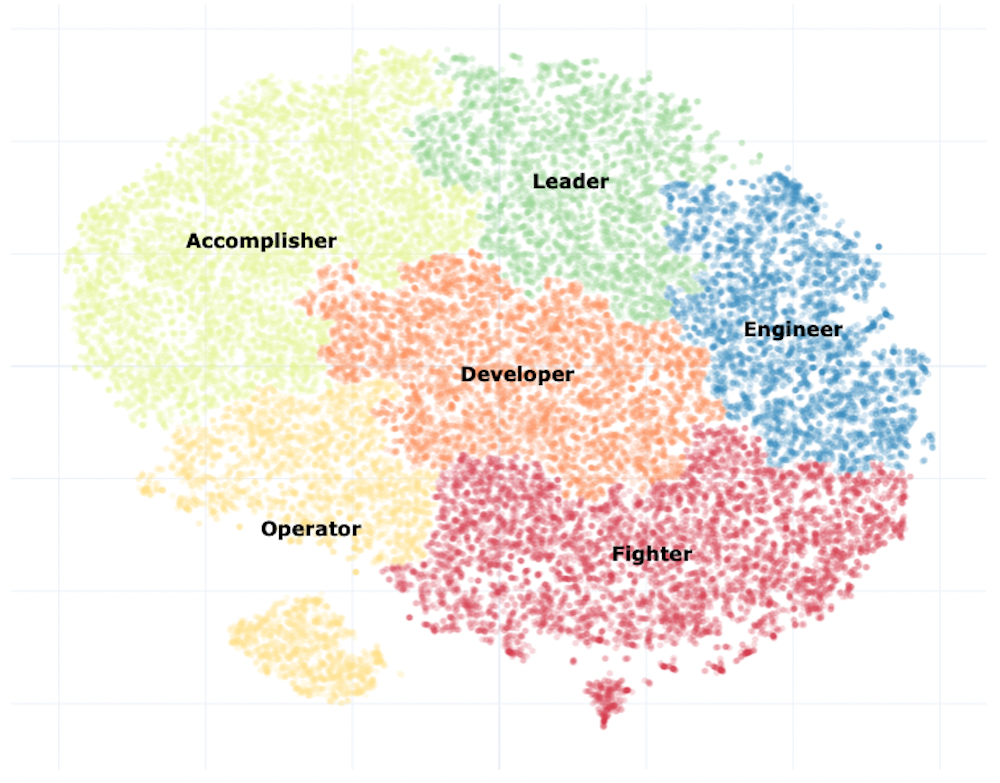 McCarthy, Gong, Braesemann, Stephany, Rizoiu, Kern, CC BY-ND[14][15]
The power of diversity
Our model also indicated that startups with a diverse blend of these founder personality types are 8 to 10 times more likely to be successful.
Canva’s three co-founders are a great example of this. Ex-Googler[16] Cameron Adams’s technical intellect and imagination[17] has combined with Cliff Obrecht’s assertive dealmaking[18] and Perkins’ energy, trustworthiness and adventurousness[19] to create a tech juggernaut.
Even if you’re not gearing up to launch or invest in the next big startup, personality offers a fascinating lens through which to view the start-up world and its most talked-about figures. And these findings are likely to hold in other settings too: team performance is shaped by the right combination of different personalities.
Behind every successful startup, there’s more than just a groundbreaking product or a burgeoning market, there’s a dynamic founder – or founders – with a personality that’s the secret to startup success.
References^ under pressure (www.cnbc.com)^ our new research (www.nature.com)^ five-factor (www.britannica.com)^ McCarthy, Gong, Braesemann, Stephany, Rizoiu and Kern (www.nature.com)^ CC BY-ND (creativecommons.org)^ left Harvard (news.bbc.co.uk)^ $26 billion (www.afr.com)^ securing the venture capital funding (fortune.com)^ determined, stubborn and adventurous (www.theceomagazine.com)^ tax laws (medium.com)^ cloud computing (theconversation.com)^ colonise Mars (theconversation.com)^ Hyperloop (theconversation.com)^ McCarthy, Gong, Braesemann, Stephany, Rizoiu, Kern (www.nature.com)^ CC BY-ND (creativecommons.org)^ Ex-Googler (www.forbes.com)^ technical intellect and imagination (themaninblue.com)^ assertive dealmaking (www.forbes.com.au)^ energy, trustworthiness and adventurousness (www.theceomagazine.com)
McCarthy, Gong, Braesemann, Stephany, Rizoiu, Kern, CC BY-ND[14][15]
The power of diversity
Our model also indicated that startups with a diverse blend of these founder personality types are 8 to 10 times more likely to be successful.
Canva’s three co-founders are a great example of this. Ex-Googler[16] Cameron Adams’s technical intellect and imagination[17] has combined with Cliff Obrecht’s assertive dealmaking[18] and Perkins’ energy, trustworthiness and adventurousness[19] to create a tech juggernaut.
Even if you’re not gearing up to launch or invest in the next big startup, personality offers a fascinating lens through which to view the start-up world and its most talked-about figures. And these findings are likely to hold in other settings too: team performance is shaped by the right combination of different personalities.
Behind every successful startup, there’s more than just a groundbreaking product or a burgeoning market, there’s a dynamic founder – or founders – with a personality that’s the secret to startup success.
References^ under pressure (www.cnbc.com)^ our new research (www.nature.com)^ five-factor (www.britannica.com)^ McCarthy, Gong, Braesemann, Stephany, Rizoiu and Kern (www.nature.com)^ CC BY-ND (creativecommons.org)^ left Harvard (news.bbc.co.uk)^ $26 billion (www.afr.com)^ securing the venture capital funding (fortune.com)^ determined, stubborn and adventurous (www.theceomagazine.com)^ tax laws (medium.com)^ cloud computing (theconversation.com)^ colonise Mars (theconversation.com)^ Hyperloop (theconversation.com)^ McCarthy, Gong, Braesemann, Stephany, Rizoiu, Kern (www.nature.com)^ CC BY-ND (creativecommons.org)^ Ex-Googler (www.forbes.com)^ technical intellect and imagination (themaninblue.com)^ assertive dealmaking (www.forbes.com.au)^ energy, trustworthiness and adventurousness (www.theceomagazine.com)






