Hong Kong Baptist University research unveils association between plasma metabolites and COVID-19 antibody levels in recovered patients
HONG KONG SAR - Media OutReach - 10 October 2022 - A study led by Hong Kong Baptist University (HKBU) has revealed the association between rapidly fading antibody levels in some recovered COVID-19 patients and a high plasma concentration of a metabolite called glycylproline (gly-pro) and its producing enzyme.
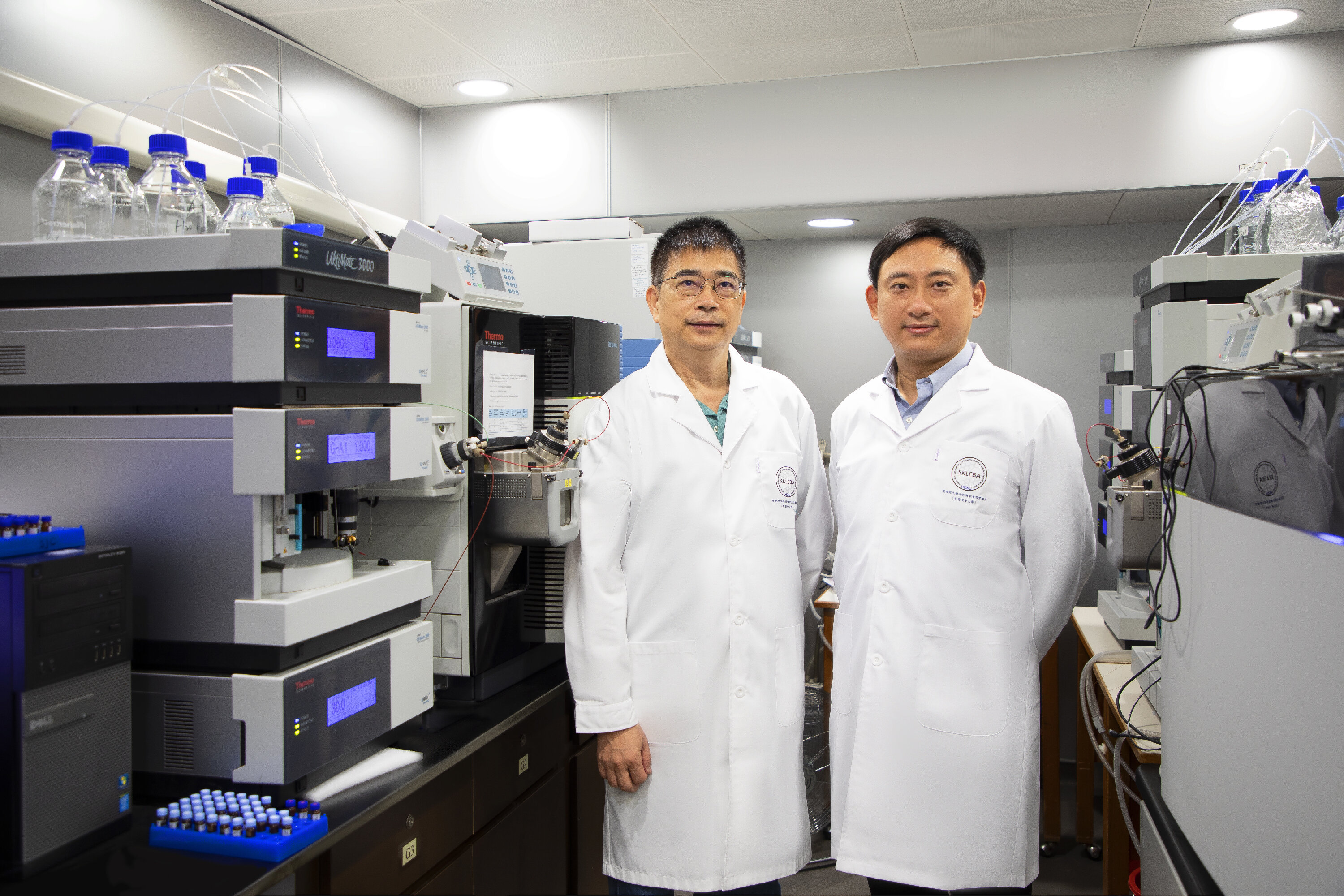
A research team led by Professor Cai Zongwei (left) and Dr Yang Zhu (right) has revealed the association between rapidly fading antibody levels in some recovered COVID-19 patients and a high plasma concentration of a metabolite called gly-pro and its producing enzyme.
The researchers also found that the application of an inhibiting agent can counteract the activities of gly-pro and its producing enzyme, and this helped to maintain COVID-19 antibody levels in a mouse model. The findings offer important insights that could aid the development of novel therapeutic and vaccination strategies against the virus.
The research results have been published in the Proceedings of the National Academy of Sciences (PNAS), a renowned international scientific journal.
Antibody levels drop in some recovered COVID-19 patients
The levels of COVID-19 antibodies among individuals in a community are crucial for herd immunity against the virus. In general, recovered COVID-19 patients have high antibody levels as a result of their natural immune reactions. However, antibody levels in some recovered COVID-19 patients have been seen to drop rapidly over the course of a few weeks, and the underlying mechanism of this phenomenon remains poorly understood.
Since the beginning of the pandemic, research studies have revealed changes in plasma cytokine and metabolite levels in COVID-19 patients. Based on these observations, a research team led by Professor Cai Zongwei, Chair Professor of the Department of Chemistry and Director of the State Key Laboratory of Environmental and Biological Analysis, and Dr Yang Zhu, the first author of this paper and a Research Assistant Professor of the Department of Chemistry at HKBU, investigated how plasma cytokines and metabolites are associated with antibody levels in recovered COVID-19 patients.
Metabolite gly-pro associated with antibody levels
The research team analysed the cytokine and metabolite profiles in the plasma samples of three subject groups. The first group included 17 recovered COVID-19 patients with steady COVID-19 antibody levels; the second group included 30 recovered COVID-19 patients with rapidly fading COVID-19 antibody levels; the third one was a control group comprising 35 individuals who had not been infected with COVID-19.
A series of quantitative computational analyses that involved the use of machine learning techniques were used to compare the levels of different plasma cytokines and metabolites in the three subject groups in relation to their COVID-19 antibody levels. The researchers then compared the two recovered patient groups with the control group, and any cytokines and metabolites with significantly different levels between the two groups and the control group were shortlisted. Among the shortlisted targets, the levels of seven cytokines and 20 metabolites were seen to differ significantly between the two groups of recovered COVID-19 patients.
The researchers then analysed the association between the selected cytokines and metabolites and COVID-19 antibody levels in recovered patients. From the collected data, they concluded that the plasma concentration of the metabolite gly-pro had increased the most in the two recovered patient groups compared with the control group.
Overall, the levels of gly-pro in the recovered patient group with rapidly fading antibody levels were four times higher than the control group, while the levels of gly-pro in the recovered patient group with steady COVID-19 antibody levels were two-and-a-half times higher than the control group. Based on these results, the researchers investigated the relationship between COVID-19 antibody levels in recovered patients and gly-pro, as well as the producing enzyme of gly-pro which is named dipeptidyl peptidase-4 (DPP4).
Inhibiting gly-pro maintains steady antibody levels
The research team set up a four-week mouse model experiment to test the hypothesis that high gly-pro levels are associated with a rapid drop in COVID-19 antibody levels in recovered COVID-19 patients. Four groups of 12 mice were injected with the spike protein of the COVID-19 virus. The groups were then respectively treated with: (1) exogenous gly-pro; (2) an inhibitor that blocks the degradation of endogenous gly-pro; (3) exogenous gly-pro and a DPP4 inhibitor (Sitagliptin, which is also an anti-diabetic drug); and (4) saline.
The serum COVID-19 antibody levels in all groups were similar in the first week of the experiment. The antibody levels of the mice in the first group declined after the second week, suggesting that increased gly-pro levels are associated with a decline in COVID-19 antibody levels. The antibody levels of the mice in the second group, who had relatively steady gly-pro levels, also began to decline in the third week. The slower decline in antibody levels in the second group of mice compared to the first group shows that varying amounts of gly-pro are associated with the amount of time a steady antibody level can be maintained.
Meanwhile, the antibody levels of the mice in the third group remained stable throughout the experiment. This shows that when the activities of DPP4 are inhibited, the negative effects of gly-pro can be neutralised, and a steady level of COVID-19 antibodies can be maintained.
New insights for therapeutic and disease control strategies
Professor Cai said: "Effective shield immunity for a community against the spread of COVID-19 is highly dependent on the maintenance of steady antibody levels in individuals. Our experimental results suggest that DPP4 inhibitors can effectively maintain steady antibody levels in COVID-19-infected mice. As a result, our study offers important insights into how we can develop a similar medical approach to maintain COVID-19 antibody levels in humans, which will contribute to the global fight against the pandemic."
Dr Yang said: "Further studies based on our research findings are warranted to explore the potential in other areas of therapeutic and disease control, especially in terms of other applications. For example, novel strategies may be developed to enhance the efficiency of vaccination in boosting antibody levels in humans, particularly in diabetic patients, a well-known high-risk population for COVID-19."
Hashtag: #HongKongBaptistUniversity