Guaranteeing long-term smoothness with the tech-innovative Dynamic Computing Engine in OPPO ColorOS 13
SHENZHEN, CHINA - Media OutReach - 6 September 2022 - The increasingly important role that smart devices play in our lives is placing more and more demands on their ability to deliver consistently smooth and reliable experiences.
But even in 2022, more than a decade since smartphones became a common part of our everyday existence, performance optimization is still one of the biggest challenges facing the industry. 
Despite exponential increases to the amount of RAM and ROM on smartphones over the past ten years, slow app opening and switching speeds, phone overheating, and high-power consumption are still regular concerns for users. This leads to the question, if today's smartphone hardware is so powerful, why do we still experience such fundamental issues in user experience?
Powerful hardware only works if used right
Fierce competition in the smartphone industry over the past decade has led to many manufacturers fighting in a race to deliver the most powerful device in terms of raw hardware performance. This has caused many industry analysts and everyday users alike to wonder if smartphone hardware has now become more powerful than it needs to be. A better way of looking at the issue though is whether this power is being put to the right use or not.
When it comes to using powerful hardware in the most effective way, there are two mistakes which are commonly made. The first is to allocate too many computing resources to a process that doesn't need them, ultimately leading to unnecessary power consumption. For example, two smartphones equipped with the same chipset can have vastly different levels of power consumption, and this is partly a result of the way resource are allocated and scheduled.
The second type of misuse occurs during memory scheduling conflicts. These are what cause the phone to lag or freeze, for example when switching from one application to another, as system resources originally committed to the first app take time to become available for use by the second.
To solve these problems and ensure that the hardware on its latest smart devices is put to the best use, OPPO has developed a system level computing hub — the Dynamic Computing Engine — that can be found in the latest version of its mobile operating system, ColorOS 13.
The Dynamic Computing Engine: OPPO's system level computing hub for ColorOS
ColorOS's Dynamic Computing Engine uses a Computing Power Model to schedule hardware resources effectively and accurately. By optimizing through four computing technologies (Parallel Computing, High-Performance Computing, Device-Cloud Collaborative Computing, and Intelligent Computing), the Dynamic Computing Engine helps deliver an all-round smoother and more stable user experience over the long-term on OPPO devices.
The Dynamic Computing Engine is an evolving technology platform that combines hardware and software to deliver maximum performance and efficiency. For the platforms' first edition on ColorOS 13, the Computing Power Model and the Parallel Computing Engine have been implemented to help solve performance issues related to inefficient resource allocation and memory scheduling conflicts.
- The Computing Power Model: striking a balance between high performance and low power consumption
To solve these problems, the ColorOS's engineers underwent a three-year process to find the best method of allocating computing power that could achieve the optimal balance between high performance and low power consumption. Following analysis and simulation of millions of such scenarios data, the team ultimately developed a Computing Power Model capable of accurately scheduling CPU, GPU, and DDR computing resources at the instruction level.
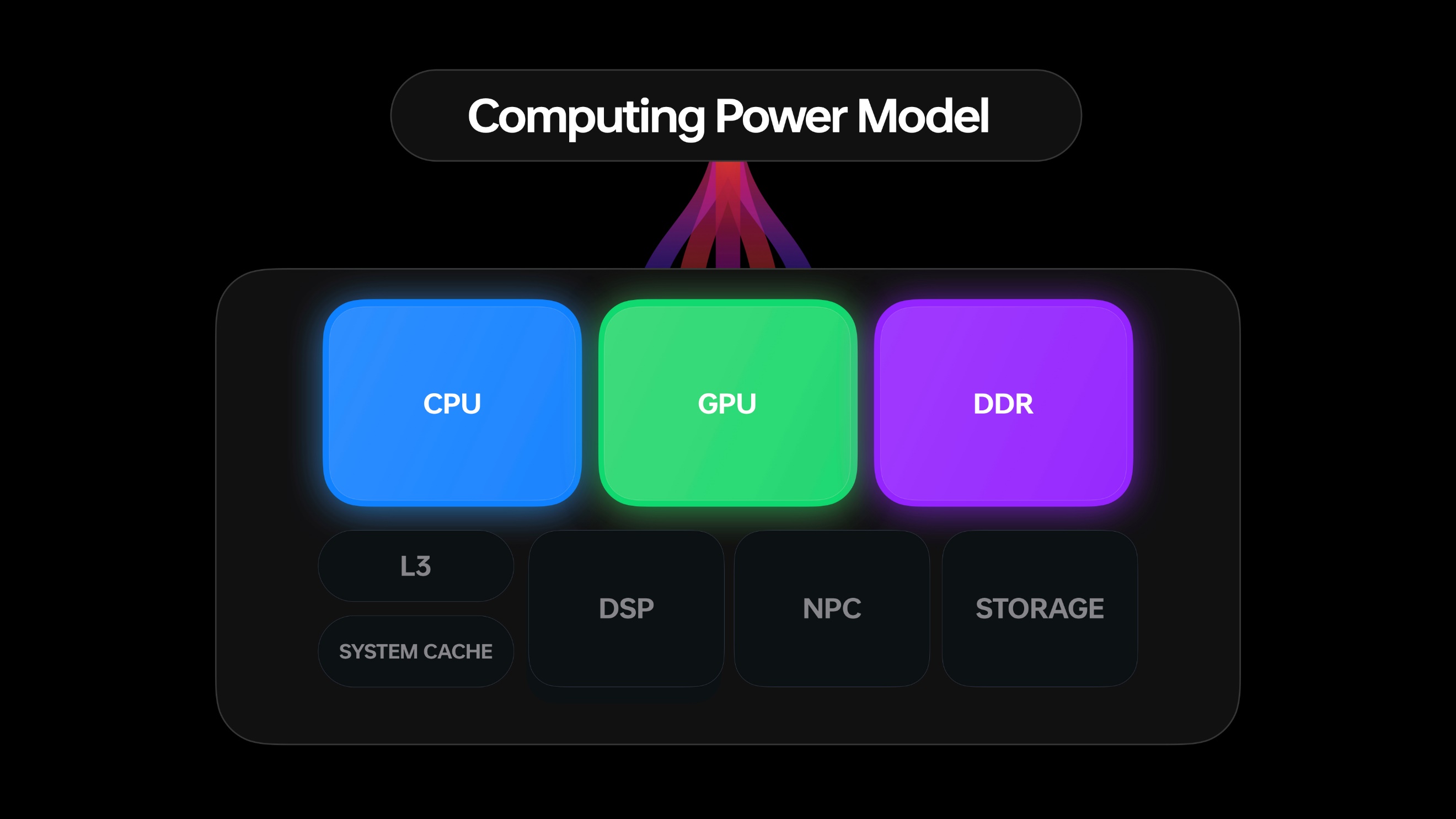
With the support of the Computing Power Model, whenever the phone needs to render a game environment or open a camera application, the CPU only needs to perform the role of an "assistant", rather than dedicating the focus of its resources to this one task. This can avoid excessive resource requests and the need to repeatedly test resource allocation efficiency, reducing power consumption and extending battery life in the process.
A look at data from the OPPO Find X5 Pro shows just how much the Computing Power Model can improve power efficiency. According to data from OPPO Lab, once upgraded to ColorOS 13, a Find X5 Pro can be used to communicate via WhatsApp for 19 hours, play PUBG for 9 hours, view YouTube videos for 22 hours, or take WhatsApp video calls for 8 hours. While these are unlikely scenarios for the everyday person, simulations also show that the average battery life of the Find X5 Pro can reach 34 hours during typically use.
- Parallel Computing: ensuring a smooth experience under heavy loads and multitasking
Android uses a serial memory allocation system that works on a first come, first served basis. However, given the complexity of real-life smartphone applications, this serial nature has significant drawbacks. For example, when the user suddenly needs to perform another high priority task, they may find that the phone's memory is occupied by other processes and cannot be released in time. This resulting lag or freezing of the app is an all too familiar experience for most smartphone users, and one which might cause some to wonder why such a well-known problem has not yet been solved. One of the primary reasons is that these memory locks are caused by a phenomenon in the computer architecture called "lock contention". In fact, research undertaken on ColorOS has shown that "lock contention" is responsible for as many as 30% of the lag or freezing issues encountered when using a smartphone.
To get around this, ColorOS adopts an advanced microkernel design that executes key operations such as memory allocation and memory reclaim in parallel so that high priority tasks do not have to wait in line to have access to these resources. By splitting the locked memory into smaller blocks, CPU threads have to wait less time for the current thread to finish working on that specific block of memory, resulting in less lag or pause time. This improvement is critical to the smooth experience that ColorOS users will enjoy during multitasking, enabling them to open multiple apps at the same time and switch between them smoothly.
A smoother experience in ColorOS 13
Thanks to the foundations provided by the Dynamic Computing Engine, ColorOS 13 delivers a whole variety of smoother and smarter experiences.
When it comes to productivity, ColorOS 13 features an upgraded Multi-Screen Connect that now supports seamless connection between smartphones and OPPO Pad Air, and between smartphones and PCs. With the OPPO Share function, the upgraded Multi-Screen Connect also makes file transfer between devices faster and more convenient, providing support for transfer between OPPO smartphones and OPPO tablets, or OPPO smartphones to PC, without using any mobile data. Most major file types are supported, meaning you can seamlessly and quickly transfer documents and switch between smartphone, PC, or OPPO tablet depending on which device works best for any given task.
In terms of interactive experience, ColorOS's Quantum Animation Engine improves the realism of animated effects by adding extra details and an advanced physical motion model that makes interactions in ColorOS closely reflect the laws of physics. Following in-depth research and analysis of user feedback, the ColorOS team has optimized 61 motion effects and introduced Behavioral Prediction into Quantum Animation Engine. Behavioral Prediction can recognize and predict a user's intended input when two touchscreen gestures are made one after the other. For example, when an app is opened and the user suddenly decides to open the second page to the right of the home screen, usually the user have to slide up from the bottom of the display and wait for the home screen to appear before swiping onto the second page. But if user swipe right after sliding up, ColorOS 13 will know the ultimate goal is to get to the second page and will take user directly there. This prevents conflict between the two operations and provides users with smoother, more intuitive interaction.
Another feature in ColorOS 13 that minimizes power consumption through close integration of hardware and software is LTPO 2.0 technology. LTPO 2.0 can reduce the refresh rate of the Always-On Display to only 1Hz, leading to a reduction in power consumption of up to 30% in certain applications. This creates more possibilities for users to personalize their Always-On Display without having to worry about how it will impact the battery life of the phone. The Always-On Display in ColorOS 13 provides options to monitor daily smartphone usage with Insight Always-On Display or create a digital Bitmoji avatar that syncs up with their real self. The Smart Always-On Display can even be used to control Spotify music play or receive information on food delivery orders from apps such as Swiggy and Zomato without unlocking the screen.
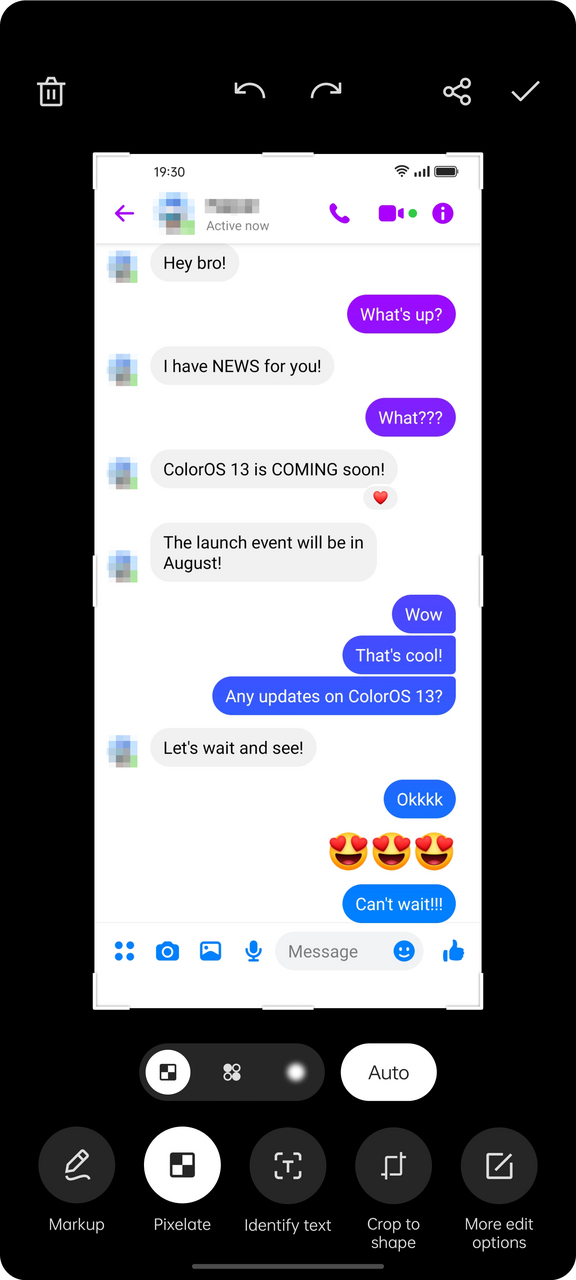
In terms of privacy and security, ColorOS 13's Auto Pixelate can automatically blur profile pictures and usernames in chat screenshots using a device-side algorithm, allowing users to conveniently share screenshots of their conversations without worrying about their privacy. ColorOS 13 also includes an updated Private Safe feature that employs industry-standard AES file encryption to store files in a local private directory for enhanced security and privacy.
OPPO will continue to evolve the Dynamic Computing Engine in future iterations of ColorOS to provide even more powerful support for other features and content. This includes the addition of the High-Performance Computing, Device-Cloud Collaborative Computing, and Intelligent Computing engines that will take the smooth and intelligent user experience of ColorOS to the next level.
Hashtag: #OPPO
About OPPO
OPPO is a leading global smart device brand. Since the launch of its first mobile phone - "Smiley Face" - in 2008, OPPO has been in relentless pursuit of the perfect synergy of aesthetic satisfaction and innovative technology. Today, OPPO provides a wide range of smart devices spearheaded by the Find X and Reno series. Beyond devices, OPPO also provides its users with ColorOS operating system and internet services such as OPPO Cloud and OPPO+. OPPO has footprints in more than 60 countries and regions, with more than 40,000 employees dedicated to creating a better life for customers around the world.
About ColorOS
ColorOS is a highly customized, efficient, intelligent, and richly designed Android-based mobile OS from OPPO. With over 500 million global monthly active users, ColorOS supports 67 languages, including English, Hindi, Thai, and Indonesian.