election promises and real-life tests
- Written by: Grant Duncan, Associate Professor for the School of People, Environment and Planning, Massey University
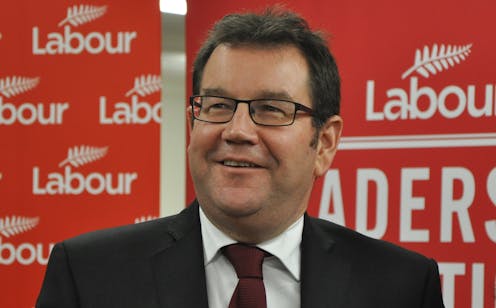
Global media have shown a great deal of interest in New Zealand’s third woman prime minister, Jacinda Ardern[1], and they eagerly anticipate the imminent arrival of her baby. Less attention has been paid to New Zealand’s first openly gay minister of finance, Grant Robertson, who delivers his first budget[2] tomorrow.
The average Kiwi is still getting used to the idea of a Labour/New Zealand First coalition government supported on confidence and supply by the Green Party. For the first time under the proportional representation system, the party that won the most seats at the election – the National Party – failed to form a government.
Labour campaigned hard on promises to boost health[3] and education[4] in particular, saying both sectors had been underfunded by the previous National government.
Read more: New Zealand’s health service performs well, but inequities remain high[5]
Fiscal responsibility
Labour-led governments always have to work harder than National-led ones to build credibility as sound fiscal managers. There is a more-or-less mythical belief out there that National earns it, and then Labour spends it. The pre-electoral agreement[6] between Labour and the Greens about fiscal responsibility was aimed at managing such impressions.
Labour MP and finance minister Grant Robertson’s first budget is a real-world test[7] of the actual strengths and weaknesses of these commitments. It is the first of three shots at persuading the public to keep him and his colleagues on the treasury benches after the next election in 2020.
The skirmishing began well in advance of the budget. Take health, for example. Hospitals need capital investment[8], midwives demand better pay[9], people were promised free visits to the doctor[10], and more.
Already, health minister David Clark has signalled delayed spending, including phased spending to reduce the fees for doctor’s visits[11].
Other pre-budget announcements have focused on education, with a NZ$21.5 million funding boost over four years for early intervention services to ensure support for children with special learning needs[12]. Conservation will also receive an extra NZ$81.3 million in operating funds for predator control[13] over four years.
Budget day
The moment the budget speech begins, the opposition and an army of sceptical reporters go to work, looking for chinks in the government’s armour. National’s new leader, Simon Bridges[14], and others will be out to convince us that the country needs a change of government and the budget is the evidence. Left-wing critics will find that not enough is being spent on most things, and will accuse Labour of bowing down to neoliberal orthodoxy.
The Child Poverty Reduction Bill[15], presently at the select committee stage, will require governments to set targets to reduce rates of child poverty and to report on progress. It will amend the Public Finance Act to make governments explain how its annual budget will contribute to meeting these targets. This brings a critical objective of social policy into the engine room of fiscal policy and accountability.
The government’s financial planning and the performance of the economy – and the interactions between those two domains – form the basis of budget analysis and debate. But, beginning next year, the new government will introduce a living-standards framework[16] for “sustainable inter-generational wellbeing”. Financial, social, environmental and human capital will be accounted for.
Accounting for natural capital
It should be possible, for instance, to estimate the capital value of clean rivers, based on the value of the ecosystem services they supply. Then we could ask how effectively public spending and investment sustain or enhance such natural capital. This will have major consequences in future, as public finance and accountability will be calculated on a more holistic basis, beyond the traditional measures of economic productivity.
Mr Robertson is nonetheless bound by conservative fiscal responsibility commitments, including budget surpluses and reduction of net public debt. He was pleased to announce that the surplus would be almost a billion dollars higher[17] than the treasury had forecast in December.
Sounds fine, but we do not live in a risk-free world. Some economists[18] have pointed to warning signs of another global meltdown. If that happens, the government would need to rethink its fiscal parameters.
The 2018/19 budget is only round one in a longer political boxing match. Next year’s budget may be the crucial one, as the new government is planning substantial innovations to fiscal analysis. By the time we get to the 2020 election, the people’s verdict on Jacinda Ardern’s government will depend a great deal on how well Grant Robertson performs on the next three budget days.
References
- ^ Jacinda Ardern (www.nzherald.co.nz)
- ^ budget (beehive.govt.nz)
- ^ health (www.radionz.co.nz)
- ^ education (www.radionz.co.nz)
- ^ New Zealand’s health service performs well, but inequities remain high (theconversation.com)
- ^ agreement (www.labour.org.nz)
- ^ real-world test (www.radionz.co.nz)
- ^ Hospitals need capital investment (www.stuff.co.nz)
- ^ midwives demand better pay (www.stuff.co.nz)
- ^ promised free visits to the doctor (www.radionz.co.nz)
- ^ phased spending to reduce the fees for doctor’s visits (www.radionz.co.nz)
- ^ children with special learning needs (www.beehive.govt.nz)
- ^ funds for predator control (www.beehive.govt.nz)
- ^ Simon Bridges (www.radionz.co.nz)
- ^ Child Poverty Reduction Bill (www.parliament.nz)
- ^ living-standards framework (treasury.govt.nz)
- ^ surplus would be almost a billion dollars higher (www.beehive.govt.nz)
- ^ Some economists (www.nzherald.co.nz)
Authors: Grant Duncan, Associate Professor for the School of People, Environment and Planning, Massey University
Read more http://theconversation.com/nz-budget-2018-election-promises-and-real-life-tests-96527