

Treasury warns the government it may not balance the budget or meet its housing targets
- Written by: John Hawkins, Head, Canberra School of Government, University of Canberra
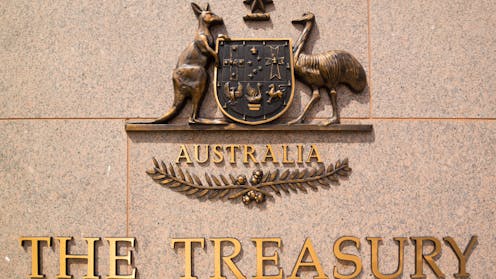
In the runup to each election, federal treasury produces a “blue book” and a “red book”, with advice tailored to the priorities of the two alternative governments.
One of these is given to the incoming government and the other is never released. Freedom of Information requests have generally resulted in only heavily redacted versions[1] of the incoming government brief being made public.
But this week, the table of contents was accidentally released[2], revealing treasury’s view of how the government should be handling the economy.
Taxes “need to be raised”
Treasury suggests more tax should be raised. This is unsurprising – there is bipartisan support for more defence spending[3], and an ageing population means more spending on health and aged care, only partially offset by less spending on education.
Read more: The 2025 budget has few savings and surprises but it also ignores climate change[4]
The government is hoping to slow spending on the National Disability Insurance Scheme[5] but it is still projected to grow much faster than government revenue.
No one wants to default on government debt. So higher bond yields and the deficits incurred during the COVID pandemic, and projected for the next decade, mean governments will be paying more interest.
There are few areas of government spending expected to contract. So the cruel arithmetic is unless we are happy to keep government debt[6] – already close to a trillion dollars – growing indefinitely, taxes need to rise.
The challenge is to find the most efficient way to do so. We don’t know whether Treasury made specific suggestions.
As we will probably hear at next month’s Economic Reform Roundtable[7], most economists think we should be putting more tax on things we want to discourage (greenhouse gas emissions, consumption of unhealthy products) and less on things we want to encourage (working, saving).
We want more taxes that do not alter economic activity (such as on land and excess profits from minerals) and less that discourage useful economic activities (such as stamp duties, which discourage mobility). We also want less tax where activity is being driven into black markets (arguably the case with cigarettes).
There may be some areas where tax concessions are excessive. Superannuation tax concessions[8] are subsidising some rich people to build much larger savings than are needed for a comfortable retirement. (A proposal[9] from the government to trim these will be before the Senate when parliament resumes next week.)
Capital gains tax concessions[10], which mainly help the rich, are also hard to justify.
We also want to consider equity. Most people accept that a tax system should be progressive. This means the rich pay a higher proportion of income in taxes than do the poor. In our current tax system, income and land taxes are progressive but GST and some other excises are regressive. The overall system is roughly proportional.
Housing target “will not be met”
Treasury also warned the government that its pledge to build 1.2 million homes over five years will be very difficult to achieve. In the year to June 2024, just 176,000 homes were built.
Even the relevant ministers have described the target as “ambitious[11]”. Treasurer Jim Chalmers said on Monday[12] “we will need more effort”.
Many commentators[14] have described how difficult it will be to achieve this target.
A shortage of construction workers, the impact of planning restrictions, and weak productivity are also concerns. A recent study by the Productivity Commission[15] concluded:
over the past 30 years, the number of dwellings completed per hour worked by housing construction workers has declined by 53%.
Concerns about the US
Another unsurprising revelation in the briefing is Treasury is concerned about the economic consequences of Donald Trump as US president.
One threat comes from the ever-changing array of tariffs Trump is introducing. If other countries retaliate by raising their own tariffs, the adverse impact on the global economy will be even greater.
Read more: What would a second Trump presidency mean for the global economy?[16]
We can get some idea of the possible impact on Australia from modelling published by the Reserve Bank. In its Statement on Monetary Policy[17], the bank presented two alternative scenarios.
Under what it called the “trade war” scenario, global gross domestic product declines by more than it did during the 2007 global financial crisis. Australian unemployment increases to nearly 6%. Under the “trade peace” scenario, unemployment remains around its current 4% level.
Another concern held by Treasury was the possible loss of independence of the US Federal Reserve Board (or “Fed”), the counterpart to Australia’s Reserve Bank. Trump has vowed[18] to replace Fed chair Jerome Powell with someone more compliant when Powell’s term ends next year.
Trump wants the Fed to slash short-term interest rates regardless of the economic circumstances. This would raise the risk of a surge in inflation. It could also lead to higher bond yields, which would flow into higher interest rates charged by banks on loans. This could plunge the US economy into recession, with impacts felt around the world.
References
- ^ heavily redacted versions (www.abc.net.au)
- ^ accidentally released (www.abc.net.au)
- ^ defence spending (www.news.com.au)
- ^ The 2025 budget has few savings and surprises but it also ignores climate change (theconversation.com)
- ^ National Disability Insurance Scheme (www.ndis.gov.au)
- ^ government debt (www.pbo.gov.au)
- ^ Economic Reform Roundtable (treasury.gov.au)
- ^ Superannuation tax concessions (www.ato.gov.au)
- ^ proposal (australiainstitute.org.au)
- ^ Capital gains tax concessions (www.ato.gov.au)
- ^ ambitious (www.abc.net.au)
- ^ said on Monday (www.theguardian.com)
- ^ Inga Blessas/Shutterstock (www.shutterstock.com)
- ^ Many commentators (www.theguardian.com)
- ^ recent study by the Productivity Commission (www.pc.gov.au)
- ^ What would a second Trump presidency mean for the global economy? (theconversation.com)
- ^ Statement on Monetary Policy (www.rba.gov.au)
- ^ vowed (www.ft.com)
Authors: John Hawkins, Head, Canberra School of Government, University of Canberra






