

Australia’s construction industry needs more hands on deck – so why is it ignoring skilled migrant women?
- Written by: Martin Loosemore, Professor of Construction Management, University of Technology Sydney
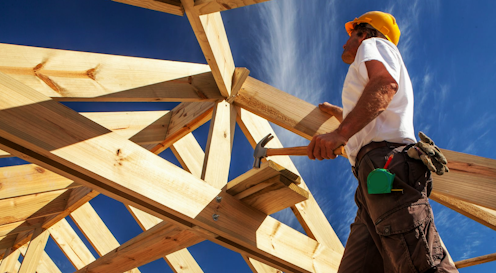
Australia’s construction industry is facing a perfect storm: enormous targets for building – 1.2 million[1] new homes and A$230 billion[2] worth of infrastructure over the next five years – at the same time as net migration is forecast to halve[3].
Without as many migrants, Australia might not have the workforce it needs to meet these targets.
Unless it does something different. Our team at the University of Technology Sydney has been examining the barriers to employing existing migrants in the construction industry, and we find they are substantial.
Migrants who arrived in Australia in the past five years account for only 2.8%[4] of Australia’s construction workforce, but 4.4% of the entire Australian workforce.
Migrant engineers are significantly more likely than Australian-born engineers to be unemployed or underemployed – working at a more junior level than their skills and experience warrant.
Women face extra barriers
Women skilled in the trades needed face special barriers. This might be expected from an industry in which (in New South Wales at least) around half the employers have a workforce that is nearly all male[5] and one-third employ no women at all.
Our survey of 70 Australian subcontractors found they saw significant safety, productivity and cost risks[6] in employing migrants and refugees and groups including disengaged youth, people with a disability, ex-offenders, women and Indigenous workers.
In many cases, these perceived risks did not align with actual risks.
Our online survey of 79 refugees and migrants who had sought work in construction found that the less[7] experience a refugee or migrant had working in construction overseas, the more likely it was they would secure a full-time job.
Education can hurt foreign jobseekers
Education counted against them as well. High school, undergraduate and masters educated migrants and refugees were more successful in securing full-time permanent work then those with doctorates and technical education.
Employers were often unwilling to recognise their qualifications and experience.
Our in-depth interviews with 16 skilled female migrants who had sought work in the NSW construction industry found their initial hopes of finding work easily and quickly turned to frustration and an acknowledgement that their qualifications and experience were not as transferable as they had thought[8].

Most described struggling to get shortlisted for an interview, even when they felt their skills and experience closely matched those needed.
Many complained that the formal, online, and impersonal nature of the initial shortlisting process automatically excluded them from securing interviews.
In the rare events they did secure face-to-face interviews, many complained many employers used the so-called STAR[10] method (“situation, task, action, and result”) that required them to tell stories about situations they hadn’t been in.
All found their interviews very stressful, impersonal and intimidating.
You shouldn’t need a relative to get a job
Among the challenges facing female migrants with the skills needed by the construction industry were sexism, racism and traditional cultural expectations about their role in society.
Many felt frustrated, abandoned and under-valued after arriving in Australia. This was despite being willing to accept jobs well below their expectations, previous roles, experience and qualifications.
Those fortunate to have family and friends in the construction industry relied heavily on them to find their first jobs. However, these jobs tended to be low level, with limited career opportunities and exposure to exploitation by unscrupulous employers, labour hire companies and job agencies.
Treating foreign-born construction industry workers as well as we treat Australian-born workers, and tackling the special barriers that apply to foreign-born women, ought to be an easy way to boost our construction workforce.
We have identified some of the things holding the industry back. The next step is to examine why.
This research was conducted with refugee and migrant support agencies including Metro Assist[11] and Scarf Illawarra[12].
References
- ^ 1.2 million (treasury.gov.au)
- ^ A$230 billion (www.infrastructureaustralia.gov.au)
- ^ halve (cdn.theconversation.com)
- ^ 2.8% (theconversation.com)
- ^ nearly all male (www.nsw.gov.au)
- ^ productivity and cost risks (www.buysocialcanada.com)
- ^ less (www.buysocialcanada.com)
- ^ not as transferable as they had thought (cdn.theconversation.com)
- ^ Indypendenz/Shutterstock (www.shutterstock.com)
- ^ STAR (resources.biginterview.com)
- ^ Metro Assist (www.metroassist.org.au)
- ^ Scarf Illawarra (rotarydownunder.com.au)
Authors: Martin Loosemore, Professor of Construction Management, University of Technology Sydney






