

Inflation is slowly falling, while student debt is climbing: 6 graphs that explain today’s CPI
- Written by: John Hawkins, Senior Lecturer, Canberra School of Politics, Economics and Society, University of Canberra
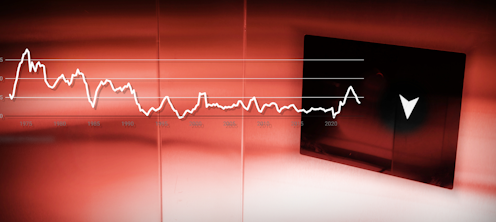
Australia’s inflation rate has fallen[1] for the fifth successive quarter, and it’s now less than half of what it was back in late 2022.
The annual rate peaked at 7.8% in the December quarter of 2022 and is now just 3.6%, in the March quarter figures released on Wednesday, leaving it within spitting distance of the Reserve Bank’s 2–3% target.
But it’s too early for mortgage holders to celebrate.
On Wednesday Westpac noted the pace of improvement was slowing and pushed out its forecast of when the Reserve Bank would begin cutting rates from September this year to November[2].
The monthly measure of annual inflation also released on Wednesday rose marginally from 3.4% in February to 3.5% in March.
While some may see this as suggesting that the “last mile” of bringing inflation to heel might be difficult, not too much should be read into it.
The monthly series is experimental and volatile[3]. As the chart shows, it has twice given a false impression that inflation was rising again over the past year.
Australia is in good company. While inflation has fallen throughout the developed world since late 2022, in recent months the improvements have slowed.
In the US, inflation is edging up.
US Federal Reserve chair Jerome Powell says it might take “longer than expected[4]” for them to be sure inflation has fallen low enough to begin cutting rates.
Other banks might cut rates first. The head of the European Central Bank Christine Lagarde said she was “data-dependent, not Fed-dependent[5]”.
In Australia, as in much of the rest of the world, inflation in the price of goods has come down faster than inflation in the price of services.
But the figures released on Wednesday show inflation in the price of services continuing to fall, although more slowly over the March quarter.
Rents climbed a further 2.1% in the quarter, to be up 7.8% over the year.
The measure reported is out-of-pocket rents, net of rental assistance. The Bureau of Statistics said had it not been for the increases in rent assistance [6]announced in last year’s May budget, it would have recorded an increase in rents of 9.5%
In a report released with the consumer price index, the Bureau noted that renters’ experiences were not uniform and that many received rent reductions during COVID.
One in five[7] city renters continued to pay less rent than before the pandemic.
Price falls for electricity (due to government rebates) and clothing in the March quarter helped lower annual inflation.
But sharp rises in the prices of insurance (a response to natural disasters) as well as education and pharmaceuticals made the task harder.
There might have also been a Taylor Swift effect. Prices for restaurant meals, urban transport, domestic accommodation and “other recreational and cultural services” rose more strongly in Sydney and Melbourne, where she played concerts in February, than in Brisbane and Perth where she did not.
While interest is not charged on the debt accumulated by students as part of their student loans, the amount owed increases every June in line with the March quarter consumer price index.
The formula is complicated, although easy to calculate[8].
Today’s figures produce an increase of 4.7499517% – a figure slightly closer to 4.7% than 4.8%, meaning it rounds down to 4.7%.
However, one interpretation of rules[9] suggests it might be rounded up, to 4.8%.
Regardless, the increase due in June will be substantial, on top of an already outsized increase of 7.1% in June last year.
There’s a chance the increase won’t be either of these figures. The government promised an announcement about the scheme before the May budget.
The Reserve Bank will update its inflation and other economic forecasts one week before the May budget on May 7. Treasurer Jim Chalmers will hand down the budget on May 14.
References
- ^ fallen (www.abs.gov.au)
- ^ November (www.westpaciq.com.au)
- ^ experimental and volatile (theconversation.com)
- ^ longer than expected (finance.yahoo.com)
- ^ data-dependent, not Fed-dependent (www.barrons.com)
- ^ rent assistance (theconversation.com)
- ^ One in five (www.abs.gov.au)
- ^ easy to calculate (www.aph.gov.au)
- ^ rules (www.ato.gov.au)
Authors: John Hawkins, Senior Lecturer, Canberra School of Politics, Economics and Society, University of Canberra






