How to Select the Right HDPE Pipe SDR/PN for Your Application
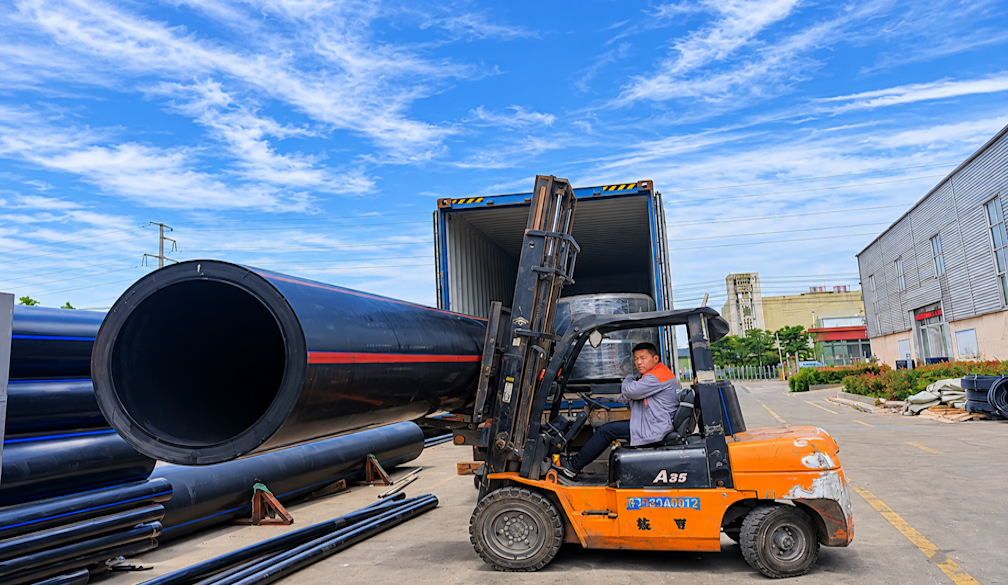
A practical guide to HDPE pipe pressure class selection — PE100 working pressure, SDR/PN conversion, surge analysis, temperature derating and typical SDR/PN choices for water mains, mining slurry pipelines and irrigation systems.
When buyers specify HDPE pipe, the diameter (DN) is usually obvious. The pressure class is not. PN10 or PN16? SDR17 or SDR11? Get it wrong and you either over-pay for wall thickness you do not need, or under-specify for a surge that ruptures the line three years into service.
This guide walks through the SDR/PN system, the working-pressure formula, surge allowances, temperature derating and the practical rules of thumb used by application engineers on B2B pipeline projects.
What is SDR?
SDR stands for Standard Dimension Ratio. It is the ratio of pipe outside diameter (OD) to wall thickness (e):
SDR = OD / e
For a DN200 pipe with an 18.2 mm wall, SDR = 200 / 18.2 ≈ 11.
The lower the SDR, the thicker the wall — and the higher the pressure rating. SDR is the parameter manufacturers extrude to, because the outside diameter is fixed by the fitting and jointing standard, while wall thickness is what changes with pressure class.
Common HDPE SDR values include 41, 33, 26, 21, 17, 13.6, 11, 9 and 7.4, corresponding to progressively thicker walls and higher PN ratings.
Because SDR is dimensionless, it applies equally to a DN20 service line and a DN1200 mining slurry main. That universality is why ISO 4427, EN 12201 and ASTM F714 all standardise around SDR rather than absolute wall thickness.
What is PN?
PN is Nominal Pressure — the maximum continuous internal water pressure the pipe is rated for, at 20 °C, over a 50-year design life, with a safety factor built into the rating.
PN is expressed in bar. Approximate conversions:
-
1 bar ≈ 14.5 psi
-
1 bar ≈ 0.1 MPa
-
PN10 = 10 bar continuous service at 20 °C
The relationship between SDR and PN follows the hoop-stress formula:
PN = 2 × MRS / [C × (SDR − 1)]
Where:
-
MRS = Minimum Required Strength of the resin — 10 MPa for PE100, 8 MPa for PE80
-
C = design coefficient — typically 1.25 for water
-
SDR = outside diameter divided by wall thickness
This is why PE100 gives a higher PN than PE80 at the same SDR. The wall thickness is the same, but the resin has greater strength.
PE100 is now the default for most modern utility specifications. PE4710, a PPI-listed grade equivalent to PE100, is the North American counterpart used in ASTM F714 and AWWA C906 specifications.
Table 1 — SDR to PN conversion for PE100 and PE80 water pipe
|
SDR |
Wall relationship |
PN — PE100 |
PN — PE80 |
|---|---|---|---|
|
SDR 7.4 |
Wall = OD / 7.4 |
PN 25 bar |
PN 20 bar |
|
SDR 9 |
Wall = OD / 9 |
PN 20 bar |
PN 16 bar |
|
SDR 11 |
Wall = OD / 11 |
PN 16 bar |
PN 12.5 bar |
|
SDR 13.6 |
Wall = OD / 13.6 |
PN 12.5 bar |
PN 10 bar |
|
SDR 17 |
Wall = OD / 17 |
PN 10 bar |
PN 8 bar |
|
SDR 21 |
Wall = OD / 21 |
PN 8 bar |
PN 6 bar |
|
SDR 26 |
Wall = OD / 26 |
PN 6 bar |
PN 5 bar |
|
SDR 33 |
Wall = OD / 33 |
PN 5 bar |
PN 4 bar |
|
SDR 41 |
Wall = OD / 41 |
PN 4 bar |
PN 3.2 bar |
Key point: PE100 gives roughly 25% higher PN than PE80 at the same SDR. That is why most modern water and mining specifications mandate PE100 — same wall thickness, more pressure capacity, better material efficiency.
Always confirm the actual pressure rating against HDPE pipe manufacturer’s certified product data and the relevant standard, especially where temperature, chemical exposure or cyclic loading differs from the standard water-at-20 °C basis.
The 5-step SDR/PN selection process
Here is the workflow application engineers use on B2B pipeline projects. Skipping any step — especially Step 4 — is one of the most common causes of premature pipe failure.
Step 1 — Determine the maximum operating pressure (MOP)
For a gravity-fed water main, MOP is the static head from the highest reservoir level to the lowest delivery point.
For a pumped system, MOP is the pump shut-off head, not just the normal operating head.
Express the result in bar.
Step 2 — Add a surge / water-hammer allowance
Sudden valve closure, pump start/stop, check-valve slam and power failure can spike pressure well above MOP.
Depending on system size and valve closure time, surge can add 2–10 bar or more. Large systems with fast-acting valves should be checked with a transient analysis.
Step 3 — Apply the design margin
The PN definition already includes a design coefficient on the resin side. But a separate operational margin is still prudent to protect against future de-rating, temperature effects and uncertain surge behaviour.
A common rule is to add at least 25% margin between calculated demand and selected PN.
Step 4 — Round up to the next standard PN class
If your calculated demand is 11.8 bar, do not select PN10. Round up to PN12.5 or PN16.
Plastic pipe does not tolerate sustained over-pressure the way steel does. The weakest link — pipe, fitting, valve or joint — defines the system rating.
Step 5 — Adjust for temperature
PN ratings are based on 20 °C water service.
For indicative guidance:
-
At 30 °C, derate by approximately 10%
-
At 40 °C, derate by approximately 25%
-
Above 40 °C, HDPE is generally not recommended for pressure service without specialist review
Always confirm derating factors with the pipe manufacturer and the applicable standard.
Recommended SDR / PN by application
Table 2 — Typical SDR / PN by application, PE100
|
Application |
Typical SDR |
Typical PN |
Why |
|---|---|---|---|
|
Municipal water main — city pressure |
SDR 17 |
PN 10 |
Standard 10 bar service with margin for normal surge |
|
High-rise or pumped water main |
SDR 11 |
PN 16 |
Pump head plus surge can reach 13–14 bar |
|
Mining slurry / tailings |
SDR 11 or SDR 9 |
PN 16–20 |
Solids loading, cyclic transients and abrasion need extra wall |
|
Gas distribution |
SDR 11 or SDR 17.6 |
PN 10 equivalent |
ISO 4437 mandates SDR 11 for high-pressure gas |
|
Irrigation main |
SDR 17 or SDR 21 |
PN 6–10 |
Lower head, controlled valving, cost-sensitive |
|
Drainage / gravity sewer |
SDR 26–41 |
PN 4–6 |
No internal pressure; SDR selected for stiffness |
|
Fire protection main — AWWA C906 |
SDR 11 |
PN 16 / DR 11 |
Fire codes require pressure-class margin |
These are starting points, not substitutes for project-specific calculation.
The surge problem nobody talks about
Steady-state pressure is easy to model. Transient pressure — the spike when a downstream valve closes in 0.5 seconds, or a pump trips on a power outage — is the silent killer of plastic pipelines.
The Joukowsky equation gives the maximum pressure rise:
ΔP = ρ × a × ΔV
Where:
-
ρ = fluid density
-
a = wave celerity — about 350 m/s in HDPE because the pipe is more compliant than steel
-
ΔV = change in flow velocity
A 2 m/s flow stopped abruptly can produce roughly 7 bar of surge. That is enough to push a PN10 pipe outside its rating.
If your line includes any of the following, get a transient analysis:
-
Pumps larger than 50 kW
-
Automatic or fast-acting valves
-
Check valves
-
Long pipeline sections over 500 m
-
Significant elevation change
-
Multiple pump starts/stops per day
A transient study typically costs a few thousand dollars and can save far more by preventing wrong PN selection, premature rupture or unnecessary over-specification.
Procurement checklist before you order HDPE pipe
Use this checklist before releasing a purchase order:
Confirm the design standard: ISO 4427, EN 12201, ASTM F714, AWWA C906 or project-specific.
Confirm resin grade: PE100 / PE4710, with certified MRS.
Confirm SDR and PN against calculated MOP plus surge plus temperature derating.
Check the HDPE fittings, valves and joints have the same or higher pressure rating as the pipe.
Request manufacturer pressure test data and certification.
Confirm surge allowance with a transient analysis where required.
Confirm temperature derating for the actual burial depth and climate.
Check handling, bedding and backfill requirements — wall thickness affects stiffness but installation still matters.
Confirm the selected SDR is available in the required DN and fitting range.
Document the weakest-link pressure rating for the complete system.
SDR/PN selection is not a vibe — it is a calculation.
Get the maximum operating pressure right, add the surge component, apply the temperature derate, apply an operational margin, and round up to the next standard PN class.
When in doubt, go one class higher. The cost premium between PN10 and PN16 in DN200 PE100 is often around 30%, while the cost of replacing a ruptured main — plus downtime, environmental impact and reputational damage — can be orders of magnitude higher.
For B2B projects, the safest approach is to send your route survey, pump curve and valve schedule to an application engineer and ask for a sized specification. A two-day engineering review is cheap insurance against a multi-year pipeline failure.


 Business Daily Media