Ceiling Fan Wobbling Only on High Speed: Is It the Blades, the Bracket or the Ceiling?
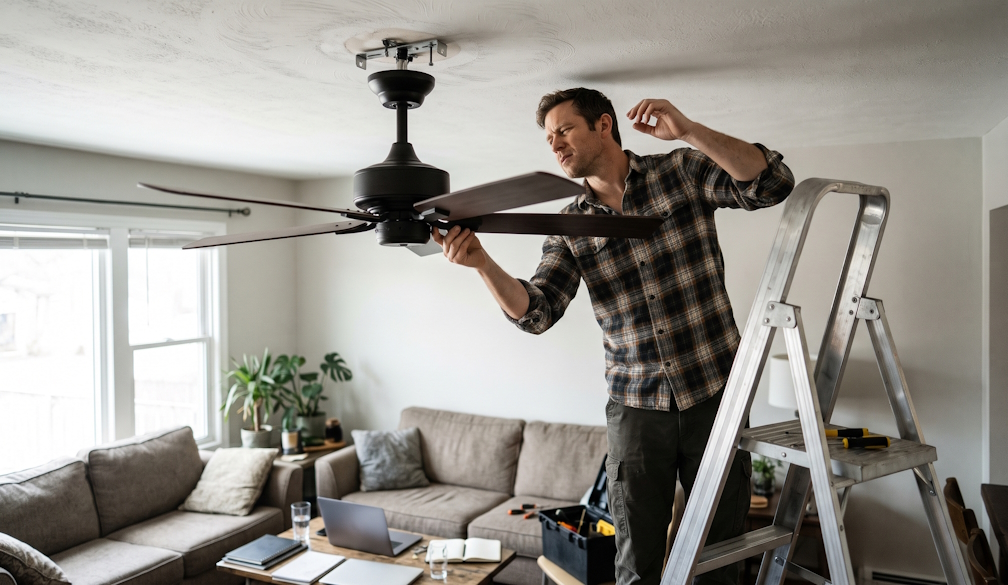
A ceiling fan that runs smoothly on low and medium but starts to sway on high is one of the most common complaints about fans. On a hot night, high is exactly the setting you want, and watching the whole fan rock back and forth above the bed is not relaxing.
A little movement is normal. Fans hang from a single point and spin heavy blades at speed, so some gentle motion is expected. Visible wobble, rattling or a fan that seems to get worse each summer is different. That is the fan telling you something is out of balance or no longer held as firmly as it should be.
The cause usually sits in one of three places: the blades, the bracket or the ceiling itself.
Why high speed exposes the problem
At low speed, small imbalances barely register. As the speed increases, the forces created by an uneven blade or a loose fixing grow quickly. A tiny difference in blade weight that is invisible on low becomes an obvious sway on high.
That is why the speed at which the wobble starts is a useful clue. A fan that only moves on high usually has a small imbalance or a slightly loose fixing. A fan that wobbles on every speed often has a bigger problem with its mounting.
Start with the blades
Blades are the easiest place to begin and the most common cause. Each blade attaches to the motor with a blade holder, sometimes called a blade iron, held by small screws. Over time those screws can loosen with vibration, especially in the first few months after installation.
Blades can also warp. Timber and some composite blades can absorb moisture, and a fan on a coastal verandah in Merewether or Nelson Bay, or in a steamy room, can end up with one blade slightly heavier or bent compared with the others. A blade holder that has been knocked, perhaps during cleaning or by a ladder, can sit at a slightly different angle and throw the whole fan out of balance.
With the fan switched off and fully stopped, it is reasonable to check that the blade screws are snug and to measure whether each blade tip sits the same distance from the ceiling. Many fans come with a balancing kit containing small clip-on weights, and the manufacturer's instructions explain how to use it.
Check the downrod and canopy
If the blades are sound, the next suspect is the downrod, the metal tube between the ceiling bracket and the motor on many fans. If the downrod has not seated properly in its ball joint, or a locking pin has worked loose, the fan can swing more freely than it should.
The canopy, the cover sitting against the ceiling, can also rattle if its screws have loosened. That is often more of a noise problem than a wobble problem, but the two frequently arrive together.
Checking these parts properly means removing covers that sit over the electrical connections. That is the point where a homeowner should stop and let a licensed electrician take over.
The bracket and the ceiling are the serious part
The most important question is how the fan is attached to the house. A ceiling fan must be fixed to the structure of the roof or ceiling, such as a joist or a timber noggin fitted between joists, using a bracket designed for the weight and movement of a fan.
Problems start when a fan is fixed only to plasterboard, attached with a bracket meant for a light fitting, or secured with screws that have gradually loosened from the timber. A fan mounted this way may feel fine at first, then start to wobble more over each summer as the fixing works loose.
Sloping ceilings add another complication. They need an angled mounting kit so the fan hangs straight. Without one, the fan can sit slightly off vertical and wobble on higher speeds no matter how well the blades are balanced.
If you notice cracks in the plaster around the fan, a canopy that has dropped away from the ceiling, or a fan that moves when you gently press on the canopy with the power off, treat it as a mounting problem rather than a balance problem.
When the motor is the cause
Less commonly, the wobble comes from the motor itself. Worn bearings can let the motor run slightly off centre, and a motor that has been dropped or damaged may never run truly straight again. This is often accompanied by noise, a grinding sound or a hum that changes with speed.
For an older fan, this is usually the point where replacing it makes more sense than repairing it.
What you can safely check yourself
There are a few sensible checks before calling anyone. Switch the fan off and let it stop completely. Tighten the blade screws if they are loose. Measure the blade tips from the ceiling. Use the balancing kit if one came with the fan. Clean the blades, because dust build-up on one side can sometimes be enough to make a difference.
Then run the fan through each speed and watch closely. If the wobble improves, the problem was likely the blades. If nothing changes, the issue is probably further up.
When to call an electrician
A wobble that does not respond to balancing, a fan that moves when the canopy is pressed, cracking plaster, rattling from inside the canopy or any sign the fan has dropped slightly from the ceiling all deserve a professional look. A local electrician who repairs and replaces ceiling fans can check the bracket, the fixing into the ceiling framing and the downrod, then tighten, brace or refit the fan so it runs steady on every speed.
A wobbling fan is usually more annoying than dangerous at first. Left alone, though, a loose mounting does not get better with time, and the fan above the bed is one fitting you want to be completely sure of.


 Business Daily Media