Why the Operator and the Tool Decide What a Rock Breaker Produces
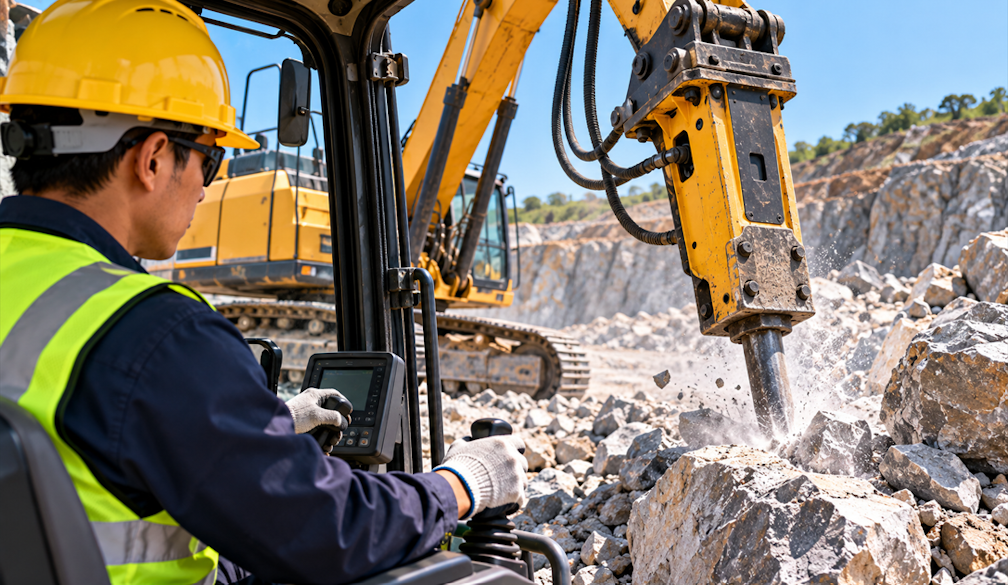
Demolition and trenching work across Canada crowds into the stretch before the ground freezes hard, and that is when a hammer on the back of a mid-size machine earns its keep. The usual complaint afterwards is that the hammer felt slow.
Most of the time the hammer was fine. An excavator hydraulic breaker delivers a fixed amount of energy per blow, and what happens to that energy after it leaves the piston is decided by the tool fitted and the hand on the joystick, not by the hammer itself.
Where the Energy Actually Goes
Energy only breaks material when the tool stays loaded against it. Lift the boom slightly and the same blow goes into the hammer housing instead of the rock, which is why a machine that bounces produces noise and very little broken material. A quick check is to watch the boom tip, because if it rises with each blow the preload has gone.
Pushing down hard enough to keep the tool pressed into the surface, without lifting the tracks, is what couples the hammer to the work. That single habit separates a productive rock breaker from one that seems underpowered on the same material.
Each blow sends a stress wave down the tool and into the material, and the wave only does useful work when it meets resistance. In soft or already fractured ground it has nothing to push against and returns to the hammer, which is why chewing at a broken edge wastes effort.
Choosing the Point for the Material
On a rock breaker the moil point concentrates force to start a fracture in hard stone. A chisel follows seams and suits layered material and concrete. A blunt tool spreads the blow and is the one for secondary breaking of oversize boulders.
A chisel in homogeneous granite deflects along no seam at all and simply polishes itself away. Material dictates the tool, and running a concrete breaker point through rock is the most common reason tool steel disappears in a week.
Point diameter matters as much as shape. A slimmer tool concentrates the same energy onto less area and penetrates faster, while a thicker one survives abuse better and wears more slowly. Most contractors keep a spare of each profile on the truck and change as the material changes.
Matching the Hammer to the Carrier
A hammer has to suit the machine carrying it. Too heavy and it overloads the stick and boom pins, which crack long before the hammer shows any wear. Too light and it runs happily while producing a fraction of the output the carrier could support, and the shortfall looks like a slow operator.
The auxiliary circuit has to deliver the oil flow and pressure the hammer is built around. Short on flow and the blow rate drops, and over the relief setting the circuit simply dumps oil as heat. Either way the symptom is the same weak, slow hammer that gets blamed on the tool.
A six to nine ton excavator or backhoe sits where this matters most, because it is small enough to be overloaded by a hammer from the next class up. A quick-connect mount lets the carrier swap between bucket and hammer in minutes, which is how a hammer gets used on small jobs at all.
Technique That Protects the Tool
A few habits account for most tool life.
- Reposition rather than pry with the boom
- Keep the tool perpendicular to the surface
- Move the point after roughly thirty seconds
- Stop the moment material gives way
Prying is what snaps the tool steel on a rock breaker, because the shank was designed for axial load and nothing else. An operator who levers a stubborn slab instead of moving to a fresh spot will break the tool long before the hammer wears out.
Work from a free edge toward the middle of a slab rather than starting in the center. Material breaks into the void beside it, so an edge cut needs less energy than a hole punched into solid mass, and the pieces come away small enough to load without a second pass.
Where a Hammer Earns Its Place and Where It Does Not
A hammer is quick on rock, thick concrete and frozen ground that a bucket cannot touch, and it lets a small machine do work that once needed a larger one. It needs no drilling, no explosives and no extra crew, which is why it dominates trenching and demolition on tight sites.
The cost is noise, vibration and dust, all of which travel well beyond the work area. Municipal bylaws often restrict hammer hours, and the operator takes the vibration through the seat and controls all day. A saw or crusher is quieter on a clean, repetitive cut.
Working Safely Around Flying Debris
Broken material leaves the work face fast, and the first few feet around a hammer are the dangerous ones. Keep everyone outside a clearly marked radius, and check that the cab guard and windows are rated for impact before the first blow rather than after the first crack.
Breaking concrete and stone also releases fine silica dust, which is a serious long-term hazard. Water spray at the work face holds most of it down, and where that is impossible the operator and anyone nearby need a properly fitted respirator rather than a paper mask.
Keeping One Alive Through a Season
The bushing between tool and housing carries side load and depends entirely on grease reaching it. On a hydraulic hammer worked through a full shift that means greasing every two hours, not once in the morning. Grit packed into a dry bushing wears the tool shank faster than any rock does.
The accumulator charge fades slowly and nobody notices, because the hammer keeps running while producing weaker blows. Checking that charge on schedule is the difference between a demolition hammer that holds output and one that quietly declines all season.
Cold oil is the winter problem on a Canadian site. Thick hydraulic fluid starves the hammer for the first minutes, so a short warm-up at low load before heavy work protects the seals and the piston from the stresses of a cold start.
Where Breaker Design Is Heading
Automatic greasing systems have moved from large hammers down into this weight class, which removes the interval that operators forget most often. Variable blow-rate valving that adapts to the material is also appearing on mid-size units rather than only on dedicated demolition fleets.
The practical takeaway is that production comes from preload and the right point, and no specification sheet captures either. TMG Industrial states carrier weight range, tool diameter and required flow together, which is what lets a hammer be matched before any of that technique matters.


 Business Daily Media